Ty Nash’s move to ASU highlights CHL-to-NCAA rule change
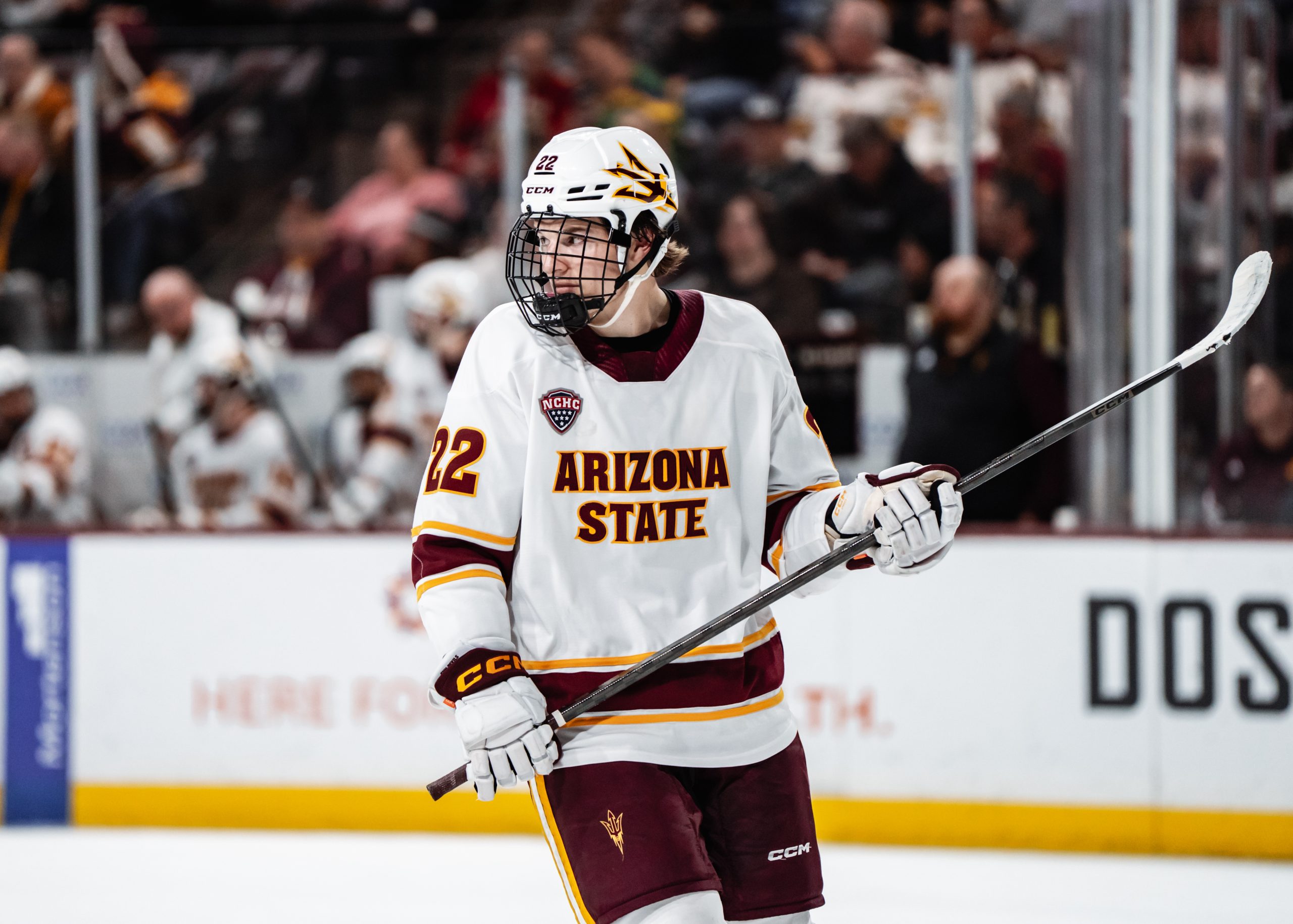
PHOENIX – When Arizona State hockey coach Greg Powers called, Ty Nash knew it was going to be a quick decision.
“My career was kind of winding down a little bit, then Powers reached out, and it was probably the easiest decision I’ve ever made,” said Nash, who was born in Scottsdale. “As soon as he offered, I called my parents right away. I was like, ‘This is what I want to do,’ and they were like, ‘Of course — we want you to come home and get to play in front of us.’”
After playing five seasons in the Western Hockey League and an additional season with the University of Alberta, Nash was running out of options. Until a recent rule change, the jump he made from the Canadian Hockey League to ASU was impossible.
It was only in late 2024 that the NCAA eliminated eligibility restrictions, unlocking a much larger talent pool and transforming the recruiting and roster landscapes across college hockey.
Nash’s father, former NHL forward Tyson Nash who spent two seasons with the Phoenix Coyotes (as they were called then), has been around the game long enough to see the need for change.
“I think we’re about 30 years overdue for the rule change,” Tyson said. “They don’t make enough money to fill their gas tanks. I mean, they’re making the same money that I was making 33 years ago.”
CHL players are limited to small stipends rather than full salaries, which has fueled criticism about financial sustainability for young athletes.
In some cases, the elimination of restrictions has already pushed the next wave of elite talent through college hockey, including the projected 2026 NHL Draft No. 1 overall pick, Penn State forward Gavin McKenna, along with top-draft prospects Porter Martone and Cayden Lindstrom of Michigan State and North Dakota’s Cole Reschny.
For Nash, a 22-year-old forward, the impact extends beyond where he’s playing, upping the level of competition. The rule change placed him in a faster, more physical environment against older, more skilled opponents, where every game carries weight and there is little margin for error.
“Stepping into a new league like that is definitely a little scary,” Nash said. “But after the first few games, I got my feet under me and felt a lot better.”
ASU finished ninth in the National Collegiate Hockey Conference this season, posting a record of 14-21-1 in a season marred by key injuries. The top eight teams made the NCHC playoffs, which ASU did not, highlighting the team’s adjustment to the influx of new players in college hockey.
That adjustment, like the team’s, is one that many players are still navigating. In the CHL, the grind of a 60-plus game schedule leaves little time for skill development between games. At the NCAA level, that flips, with fewer games but more practice time.
“You’re playing 68 games a year and not practicing as much,” Nash said. “You’re not working on your skills, and I was lucky enough to play at the University of Alberta last year, with similar college schedules we have here.
“It really showed how important games were. In the Western League or the CHL, you want to win, but it’s not the end-all, be-all. But you lose a game in college, and just so much more detrimental to your record and your ranking.”
That difference in playing abilities hasn’t gone unnoticed by Tyson, who has watched his son navigate the adjustment firsthand.
“They’re bigger, they’re stronger,” Tyson said. “I mean, some of these kids are 25 years old in the NCAA, so it’s big-boy hockey, and now you’re really seeing what you’re all about as a hockey player.”
For Nash, it wasn’t just about extending his career or finding another place to play; it was about putting himself in an environment, like college hockey, where he could continue to grow and ultimately reach a higher level.
“They didn’t hype it up enough,” Nash said. “Some of the players that you get to play with and play against, Cruz Lucius, (Bennett) Schimek, and some of the guys you play against. It’s definitely better for my development and everyone’s development.”
Chris Peters, an NHL Draft and prospect analyst for FloHockey, said the rule change is the biggest development in college hockey in decades.
“I think the way that it changes the development path is that it is now giving players a little more runway that they didn’t have before,” Peters said. “It’s not just about the top prospects … It’s just as much about the guys that were undrafted in the CHL who continue to play. Now they have the option to go the NCAA route.”
That additional runway is exactly what Nash and his father hoped the move would provide, which is a chance to grow, compete at a higher level, and keep pushing toward his professional goals.
“He (Tyson) always likes to call me a late bloomer, which is, whatever,” Nash said. “I think the more you can play, and the longer you can play before you step into pros or anything, is the best for everyone. You get to develop and really figure out what kind of player you want to be.”
Powers said the addition of CHL players like Nash is reshaping the way college programs approach recruiting and player development.
“Evolving is an accurate description; it’s ever-changing,” Powers said. “There’s so many factors that come into it now that are brand new for everybody.”
Powers also highlighted the balance needed between recruiting top talent and maintaining the team’s culture in bringing in players like Nash.
“You never want to sacrifice the culture that you built and you believe in,” Powers said. “When you roster 26 scholarship kids, juggling that culture piece and keeping kids engaged who have never sat a game in their life, then they come here to sit a game for the first time and see the world can end. It was a really weird dynamic that we had to adjust to.”
For the Nashes, this isn’t just about hockey; it’s about coming full circle. Nash returns home with his family cheering from the stands, in a city where his father played for two seasons as a member of the Coyotes and was later a TV analyst for the team.
“We literally pinch ourselves some days that this is all happening and the way it’s happened,” Tyson said. “It’s a dream. He’s been gone since he was 15 or 16 years old, and now he’s back home.”
The opportunity to return to the Valley has brought Nash both familiarity and the confidence that he made the right decision.
“(It’s) just so good for my development to play against some of the best players in the world,” Nash said. “At my age, I’ll never regret this decision. I love being home. I love playing in front of my family.”
Related

Source link