The UN Security Council is hearing warnings about the escalating standoff between the US and Venezuela
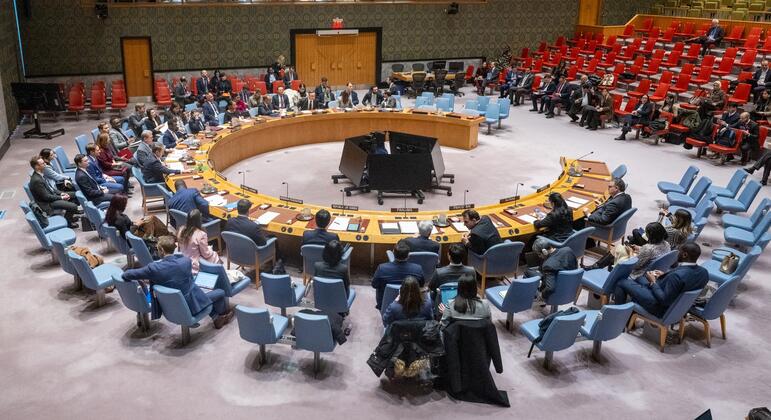
Briefing ambassadors on Tuesday, UN Assistant Secretary-General Khaled Khiari said that the US military presence and operations off the coast of Venezuela have expanded since the Council last discussed the issue in October, further increasing tensions.
The United States has described its expanded military deployment as part of what it calls a “non-international armed conflict” against drug cartels and trafficking, Mr. Khiari said.
“President Donald Trump has declared that he will ‘use the full power of the United States to target and root out these drug cartels wherever they operate.’”
The Venezuelan government, including its Permanent Representative to the UN, has described the United States’ actions as “a serious threat to international peace and security,” Mr Khiari continued.
In a December 16 letter to the Council president, Caracas accused Washington of “violating the principle prohibiting the threat or use of force in international relations.”
Strikes on alleged drug barrels
US attacks on ships allegedly carrying drugs in the southern Caribbean Sea and eastern Pacific Ocean have continued, Mr Khiari said, citing US authorities reporting that 105 people have been killed in these attacks since September 2.
The exact locations were not disclosed, with US officials stating they took place in “international waters” or under the responsibility of the US Southern Command.
The UN High Commissioner for Human Rights has warned that the airstrikes violate international human rights law, Mr Khiari added, stressing that countering drug trafficking is a law enforcement issue governed by strict limits on the use of lethal force.
Tensions continue to rise
Mr Khiari further informed the Council that the US designated the Cartel de los Soles as a “foreign terrorist organization” and declared Venezuelan airspace “completely closed” – causing many international airlines to suspend flights.
Washington also announced that it has since seized oil tankers, imposed new sanctions and ordered what President Trump described as “a total and complete blockade” of sanctioned oil shipments.
Venezuela in turn denounced these actions as a “unilateral naval blockade” and a violation of international law, and in recent days its navy has reportedly begun escorting petroleum tankers.
Khaled Khiari, Assistant Secretary General for Political Affairs, briefs the members of the Security Council.
Dialogue is the only viable path
Mr Khiari reiterated the position of the United Nations on the need for all Member States to respect international law, in particular UN Charterand to exercise restraint and de-escalate tensions to maintain regional stability.
The Secretary-General stands ready to support all efforts in diplomatic engagement, he added, including through his good offices, if both sides so request.
“Dialogue is the only viable path to lasting peace and preventing further instability and human suffering,” Mr Khiari said.
Council members urge restraint
In the ensuing debate Security Council members and participating countries expressed concern about the situation, with many warning of escalation that could destabilize the region.
Michael Imran Kanu, Sierra Leone’s ambassador, stated that the UN Charter’s rules on the use of force are “central to international stability” and are intended to prevent escalation, miscalculations and illegal wars of choice.
French Ambassador and Deputy Permanent Representative Jay Dharmadhikari noted that efforts to combat drug trafficking must be carried out in accordance with international law. Eloy Alfaro de Alba, Panama’s ambassador, urged all states to cooperate using “relevant international instruments” and called for respect for the UN Charter.
Regional participants expressed opposing views, with some expressing solidarity with Venezuela against outside pressure – “their struggle is our struggle,” said Jaime Hermida Castillo, Nicaragua’s ambassador. However, others warned that the Venezuelan people are suffering as a “direct consequence” of the government, “and not as external or third factors,” said Paraguay representative Miguel Ricardo Candia Ibarra.
The United States vows to root out cartels
US Ambassador Michael Waltz emphasized that his country will root out drug cartels, “which have operated with impunity in our hemisphere for far too long.”
Sanctions will be enforced to the maximum extent possible to “robber [Venezuelan President Nicolás] Maduro on the resources he uses to finance the cartel [de los Soles]”.
This, he added, includes profits from the sale of oil, as these enable “his fraudulent claim to power and his narco-terrorist activities.”
Mr. Waltz underscored that the “illegitimate Maduro regime” poses an “extraordinary threat to the peace and stability of our hemisphere” and stated that the United States “will do everything in our considerable power to protect our hemisphere, our borders, and the American people.”
Venezuela claims the US is pursuing oil
“It seems that the United States is destined by Providence to plague Latin America with misery in the name of freedom,” said Samuel Moncada, ambassador to Venezuela, quoting Simón Bolívar, the 19th century Latin American independence leader and statesman.
Underscoring that it is not his country – but the current US administration – that poses a threat, he added: “It’s not drugs, it’s not security, it’s not freedom – it’s oil, it’s the mines, it’s the country.”
Mr Moncada demanded that the Security Council condemn the continued aggression and ensure that the United States withdraw its military.
“The world knows that if the scale of armed attacks continues, we will exercise with all determination our inalienable right to self-defense,” he said.
Click here for additional coverage of the meeting from coverage of UN meetings.