tension with justices, tough talk on deportations and Iran
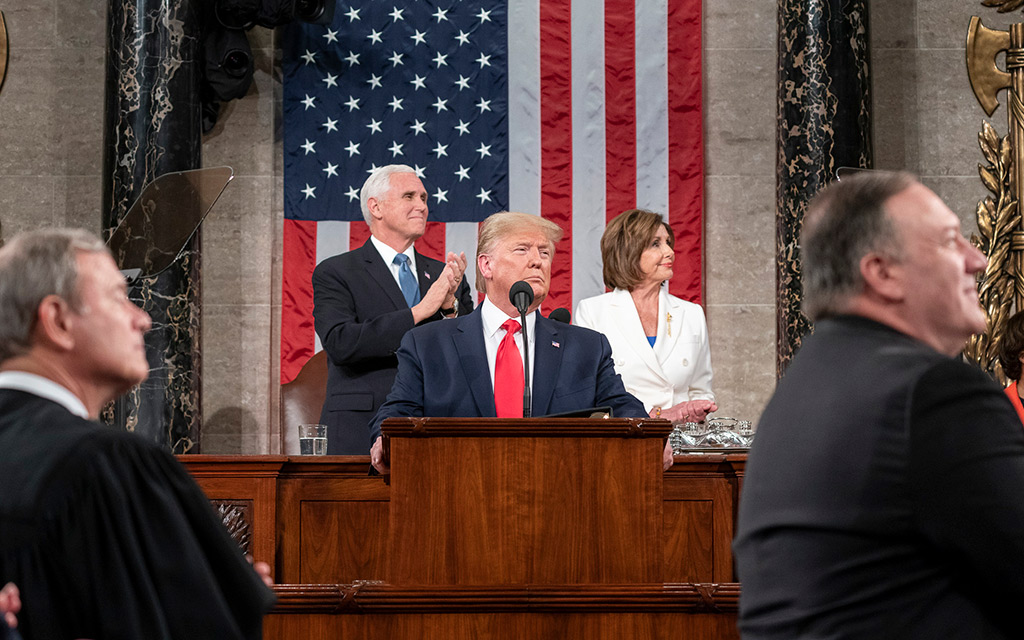
WASHINGTON – Few presidential events command as much attention as a State of the Union address. It’s a rare chance to boast about wins and sell priorities for the coming year.
President Donald Trump is likely to talk about immigration enforcement and economic growth on Tuesday night. Tariffs are very much on his mind after a big setback last week at the Supreme Court.
Three Arizona Democrats plan to boycott the speech: Sen. Ruben Gallego and Reps. Adelita Grijalva of Tucson and Yassamin Ansari of Phoenix.
“I have more productive ways to spend two hours than listening to more lies,” Gallego said in a statement announcing he would skip the event.
Sen. Mark Kelly, though, does plan to attend, less than two weeks after a federal grand jury rejected the Trump administration’s effort to prosecute him for reminding active duty military personnel that they can disobey illegal orders.
“I feel I need to be in the room,” he told reporters Monday at the Senate. “I’m going to continue to do my job, and I’m going to be sitting there right in front of him. And maybe he’ll notice, maybe not.”
Here are some things to watch for when the speech begins shortly after 9 p.m. Eastern Time.
Deportations, ICE controversies
Trump campaigned in 2024 promising the largest mass deportation in history.

One year into his second term, the Department of Homeland Security took credit for 675,000 deportations, plus 2.2 million “self-deportations” by people who decided to leave the country rather than face immigration authorities.
That’s a success story for his base and Trump is likely to mention it.
But the roundups have been controversial, with deployments of thousands of National Guard and immigration and border officers into a number of cities. The killings of two Minneapolis residents – Renee Nicole Good and Alex Pretti – drew widespread condemnation.
White House border czar Tom Homan announced the end to that surge operation Feb. 12.
Top aides initially portrayed Good and Pretti as domestic terrorists. Trump himself has not apologized for the deaths.
He doesn’t want to feed allegations that DHS is “inept,” said Lisa Magaña, professor at the School of Transborder Studies at Arizona State University.
With public support for his immigration crackdown dropping, he’s likely to reiterate the case.
“He’ll say that (he) was overwhelmingly elected to take care of immigration. That this is what people voted for. ‘We closed the border, we’ve got these terrorists out, we’ve got these really bad criminals,’” she said.
Tariffs and Supreme Court

On Friday, four days before the big speech to Congress, Trump suffered a major defeat when the Supreme Court voted 6-3 to strike down tariffs he has imposed against allies and adversaries alike.
States and businesses are seeking billions in refunds.
Trump has used the tariffs against more than 100 countries, though the taxes are paid almost entirely by U.S. businesses and consumers.
In the wake of the ruling, Trump said he will use other legal avenues to impose global tariffs of 10% and quickly ramped that up to 15%.
He’ll say “he’s got a great plan for new types of tariffs,” said Robert Saunders, a geopolitics and international relations professor at the State University of New York-Farmingdale State College. “He’s going to talk about this global approach to tariffs, and why that’s going to be great for Americans.”
Rep. Greg Stanton, D-Phoenix, plans to bring Greg Fraley, chief operating officer of FALCO, a specialized aluminum manufacturer in Chandler, as his guest to make the point that tariffs are squeezing U.S. businesses.
FALCO is “getting clobbered” by Trump’s tariffs, Stanton’s office said.
Affordability and economy
Trump focused on “affordability” during his 2024 campaign, promising to bring down inflation and “fix the economy.” He hammered President Joe Biden over the price of eggs and gasoline.
Six weeks into his second term, Trump told last year’s joint session of Congress the economy he inherited from Biden was a “catastrophe.”
A year later, unemployment stands at 4.3%; inflation has cooled from 2.7% to 2.4%; and 181,000 jobs have been created.
Trump isn’t shy about taking credit for things and he has ammunition to tout economic gains.
Economists say the tariffs haven’t reduced the U.S. trade deficit, which was one of Trump’s stated goals.
And they’ve cost the average household hundreds of dollars already.
“I don’t know that the average American watching (has) started to really connect the dots and see tariffs as a form of taxation,” Saunders said, and Trump will try “to avoid any discussion of how tariffs have been impacting people’s pocketbooks.”
Tension with justices
By tradition, members of the Supreme Court get prime seats on the House floor, steps from the rostrum. They wear their black robes and poker faces and don’t join in standing ovations.
Several should brace for harsh treatment.
Hours after the tariff ruling came down, Trump called the court majority a “disgrace to our nation” and “very unpatriotic and disloyal to the Constitution.”
“I’m ashamed of certain members of the court, absolutely ashamed,” he said.
Trump is especially angry at two justices he named to the court, Neil Gorsuch and Amy Coney Barrett, who sided against him on tariffs.
After the ruling, he said they were still invited to the speech, but only “barely.”
Last year, Chief Justice John Roberts and three other current justices attended. He and the president shook hands. Roberts wrote last week’s tariff ruling, though, and cameras will be trained on them Tuesday night to catch their interactions.
Arizona boycotts
At least two of the six Arizona Republicans in the House plan to attend.
Rep. Juan Ciscomani, R-Tucson, posted on X that he is bringing a fifth-generation rancher from Graham County as his guest.
After Sen. Adam Schiff, D-Calif., announced he will skip the speech, Rep. Paul Gosar, R-Bullhead City, posted on X that he would happily take any unused tickets. “I have a long list of patriots wanting to attend,” he wrote.
On the Democratic side, Ansari and Grijalva plan to attend the “People’s State of the Union,” a progressive event on the National Mall scheduled to overlap with Trump’s speech.
Grijalva’s office said she has given her guest ticket to Rep. Ilhan Omar, D-Minn., so she can bring Mubashir Khalif Hussen to Trump’s address. Hussen is an American of Somali descent who was detained by federal immigration agents.
“I will not sit silently while Trump gaslights the American people with lies about how great everything is,” Grijalva said in a statement. “Here’s the real state of the union: our communities are living in fear, working families cannot make ends meet (and) healthcare is unaffordable… . These are policies that should be protested, not applauded.”
Foreign affairs
Tensions with Iran are high as Trump heads to the Capitol.
He has ordered a large military buildup in the Persian Gulf and told advisors he may order a strike soon if talks over Iran’s nuclear program remain stalled.
Saunders expects “a lot of tough talk directed at Iran” and “a victory lap on Venezuela,” where U.S. forces toppled Nicolas Maduro Jan. 3. The former president is in a New York prison awaiting trial on drug trafficking charges.
“The administration as a whole couldn’t be happier about how that played out,” Saunders said. “It was a pretty immaculate military operation on many levels. They were able to, basically, make sure nothing really stopped them from doing what they wanted to do.”
The 57,000 or so residents of Greenland will certainly be listening closely for any mention of their home. Trump spent much of his first year demanding Denmark sell the autonomous territory.
Midterms and election integrity
The midterm elections weigh heavily on the president. He has warned supporters that if Republicans lose the House, he expects to be impeached a third time. Democrats need to swing only a handful of seats in either chamber.
Legislatures in numerous states have been frantically redrawing U.S. House districts as partisans on each side try to gain an edge.
In early February, Trump declared that he wants Republicans in Congress to “nationalize” elections by having the federal government “take over” administration of voting in at least 15 states controlled by Democrats.
The extraordinary proposal sent shock waves through Congress and prompted blowback even from many fellow Republicans. Senate Majority Leader John Thune, R-S.D., pointed to Constitutional requirements that states conduct their own elections.
On Feb. 11, the House narrowly approved the SAVE America Act, requiring proof of citizenship to vote. Senate Democrats oppose the bill.
Trump may use the speech to pressure Senate Democrats, whose leader, New York Sen. Chuck Schumer, called the bill “dead on arrival.”
Related

Source link