Supreme Court hears oral arguments for President Trump’s order limiting birthright citizenship
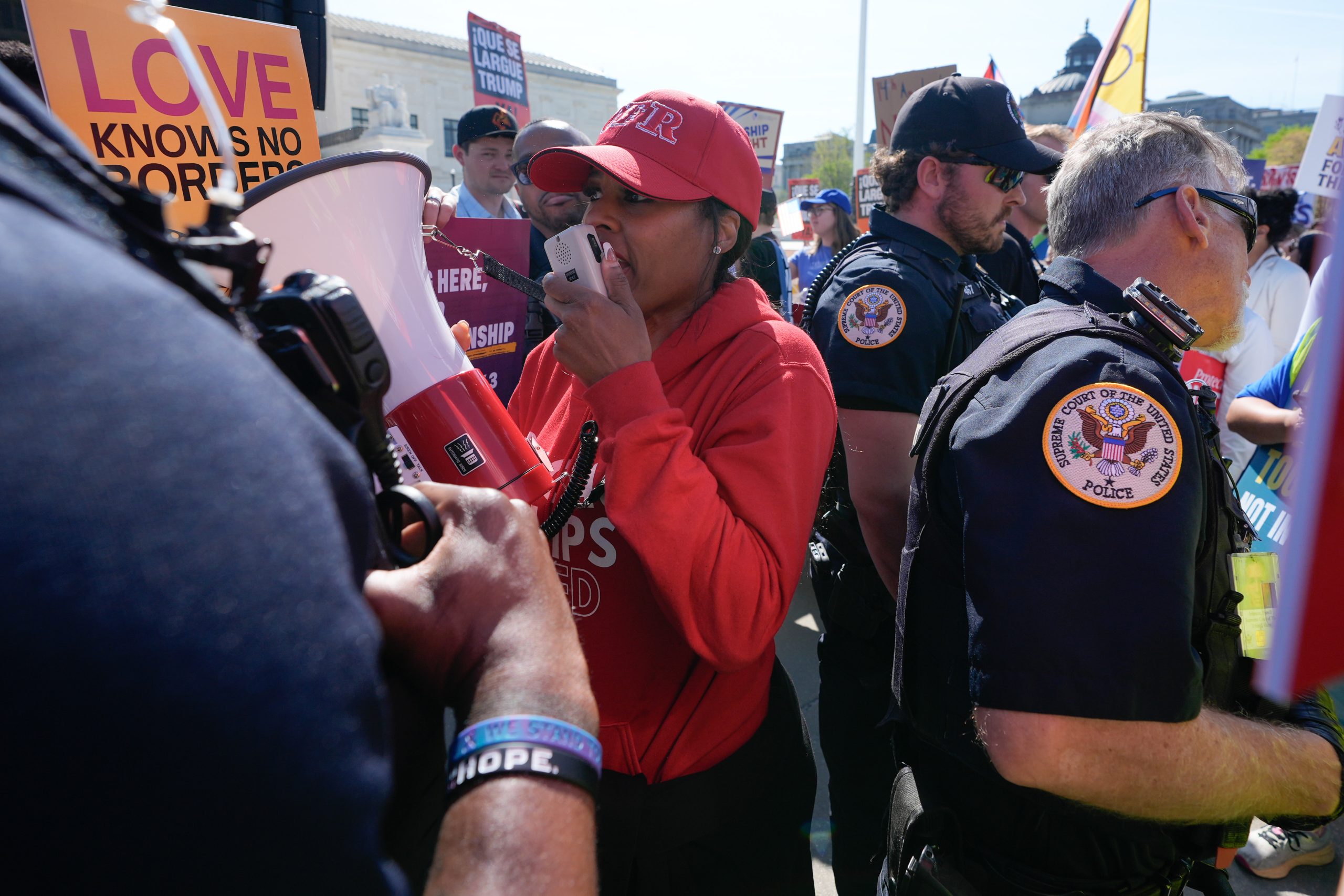
WASHINGTON – Demonstrators and observers lined the steps of the Supreme Court as justices heard oral arguments – with President Donald Trump in attendance – for a case that could restrict birthright citizenship in the United States.
Parents, grandparents and children stood for hours with supporters like Court Appointed Special Advocates, or CASA, and denounced the administration’s threat to birthright citizenship and how they and their communities might be impacted.
“My mom is a TPS holder, so if this goes in Trump’s favor, immigrant families like mine would be affected,” said Marilyn Miranda,16, who attended with her parents. TPS, or temporary protection status, is an immigration status granted to eligible nationals of designated countries experiencing conflict, environmental disasters or extraordinary problems that make it unsafe to reside.
On his first day of his second term, Trump signed an executive order called “Protecting the Meaning and Value of American Citizenship,” which sought to redefine how children qualify for citizenship at birth. Soon after, the American Civil Liberties Union sued the administration, leading to a nationwide injunction that kept the government from enforcing the order.
Yet, many remain concerned for those who would be affected if the Supreme Court votes in favor of the Trump administration.
Makoto Sumida, a fourth generation Japanese American teacher working for CASA in Silver Spring, Maryland, said she came in support of her students.
“I teach immigrants for CASA,” she said. “I want to support my students. … They’re the new generation, and they’re children.”
Others in the crowd said that while their own connection to the case was not personal, they felt like the case threatened democracy itself.
“I feel like our democracy is being attacked in the most basic and horrifying ways,” said Kathleen Otal, a 55-year-old school counselor from Virginia. “Every person deserves equal rights, and this country is going backwards, not forwards, in the progression of human rights.”
Holly Hobbs, the daughter of Charles A. Hobbs, a clerk for Supreme Court Justice Warren Burger, said she was “disappointed in Justice [John] Roberts” for not sticking with precedent and the rule of law. She also voiced her overall support for immigrants and their families in the United States.
“I’m the great-great-granddaughter of an immigrant. America was built on immigrants, it always has been,” Hobbs said.
There were only a handful of people demonstrating in favor of the president’s executive order.
A Pew research study published in February 2025 found that 56% of adults in the United States disapproved of Trump’s executive order, although it remains a highly partisan issue.
The same study also noted that 84% of Democrats or Democratic-leaning voters disapproved of the Trump administration’s actions, while 72% of Republicans approved.
In the courtroom, U.S. Solicitor General D. John Sauer argued on behalf of the Trump administration that other “modern nations” do not grant unconditional birthright citizenship, and the country’s current practice “spawned a strong industry of birth tourism.”
Sauer also argued that the language of the law itself has been misinterpreted, and should be followed based on language from the early 19th century.
To support his argument, Sauer cited the enactment of the Civil Rights Act of 1866, which used the phrase “not subject to any foreign power” rather than “subject to the jurisdiction of” to define who qualifies for birthright citizenship.
Both liberal and conservative justices pushed back.
Justice Neil Gorsuch questioned Sauer’s argument that a child’s citizenship should be dependent on their parents’ domicile. Justice Elena Kagan also agreed with Gorsuch’s point.
“It is striking that in none of the debates do we have the parents discussed. We have the child’s citizenship, and the focus of the cause is on the child, not the parents, and you don’t see domicile mentioned,” Gorsuch said. “The absence is striking.”
Cecillia Wang, the ACLU’s national legal director, argued that the interpretation of the 14th Amendment’s citizenship clause has been upheld since the 1898 case United States v. Wong Kim Ark, and reaffirmed 30 years later.
“This court held that the 14th Amendment embodies the English common law rule – virtually everyone born on U.S. soil is subject to its jurisdiction and is a citizen,” she said. “Domicile is irrelevant under common law.”
Norman Wong, the great-grandson of Ark Kim Wong, spoke outside the courthouse about the cultural significance of the United States’ promise of birthright citizenship.
“It’s a statement about who we are as a nation. It affirms that America is not defined by bloodlines or exclusion, but shared values and equal rights,” he said.
After the hearing concluded, ACLU Executive Director Anthony D. Romero said, “I will predict today that we will win this case – definitively. Possibly with a 7-2 vote.”
The Supreme Court is expected to hand down their ruling by late June.
Related

Source link