Smart Catering: reducing food waste in the cabin with AI | News
The global aviation industry currently generates an estimated 3.6 million tonnes of cabin and catering waste annually, based on 2024-2025 data from the International Air Transport Association (IATA) and the Aviation Sustainability Forum (ASF). This volume should reach four million tonnes by the end of 2025 and could potentially double by 2040 if current practices are not changed, mainly due to increased passenger numbers.
A significant portion of this waste – between 18% and 20% – consists of untouched food and drinks. Most of it is burned or sent to landfills, often due to strict international regulations. Airbus has identified this food waste as a challenge that must be addressed in support of the UN 2030 Agenda for Sustainable Development.
From concept to reality: AI-powered catering testing with Virgin Atlantic
In 2025, Airbus tested an innovative concept: ‘Smart Catering’ in live conditions on several flights with Virgin Atlantic. It confirmed that the AI and data-driven solution paints a clear picture by automatically capturing passengers’ meal consumption data and tracking the amount of unconsumed food and drinks.
The ‘Smart Catering’ solution, designed for operational efficiency and hassle-free consumption tracking without the need for additional crew activities, was first successfully tested at a Virgin Atlantic ground cabin mock-up center in the UK. After the successful ground test, the aircraft was used on board for reality checks of the catering service during the flight on an A330 (London to New York and back) and an A350 (London to Orlando and back).
Darryl Bailey, Head of Inflight Services at Virgin Atlantic said: “At Virgin Atlantic we are always looking for innovative ways to improve our premium inflight experience while reducing our impact on the environment. Working with Airbus on the Smart Catering trials has given us valuable insight into how data and AI can help us better match customer preferences, minimize waste and operate more efficiently. This is an exciting step forward in our commitment to sustainability, without compromising the high-quality service our customers know and appreciate.”
How digital tools improved on-board service during testing?
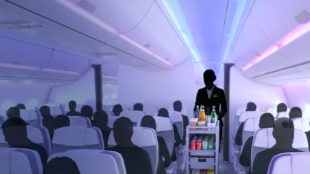
The solution on board the connected plane provides extra value for the crew and passengers.
Smart catering
Elise Weber, Airbus’ Head of Service Ecosystem Connected Aircraft explains: “During the test flights, the tool provided features such as interactive galley search, live inventory and intuitive nutritional information, eliminating the need for manual forms and reporting for the crew, allowing them to focus on the passenger. The system provided real-time availability and location status of all food and beverages, and could indicate which trolley and galley they can be found in during the flight.”
How the AI food scanner tracks meal consumption…
The solution includes AI software that can be installed on existing crew tablets and mobile devices that can be installed on any standard trolley during meal and beverage service.
Camera-based AI recognition: The AI would rely on the existing camera of the cabin crew’s mobile phone or tablet to check the tray as they pull it out of the trolley. The inventory on board is being updated. As with beverages, the solution would track consumption and update inventory.
Intelligent Crew Assistance: While meal and beverage tracking is done transparently in the normal way cabin crew members work, the Smart Catering solution goes beyond tracking consumption levels: cabin crew members also have real-time inventory management and location information, allergy and nutritional information, and more on their crew device.
Catering intelligence for the entire fleet: Smart Catering comes with a ‘ground cloud’ that allows all data on board the crew’s devices to be analyzed. This allows airlines to use route-level insights to quantify the precise fulfillment of passenger demand.
This approach has the potential to achieve double digits in the avoidable waste associated with carrying food and beverages on board.