Roping coach embraces technology
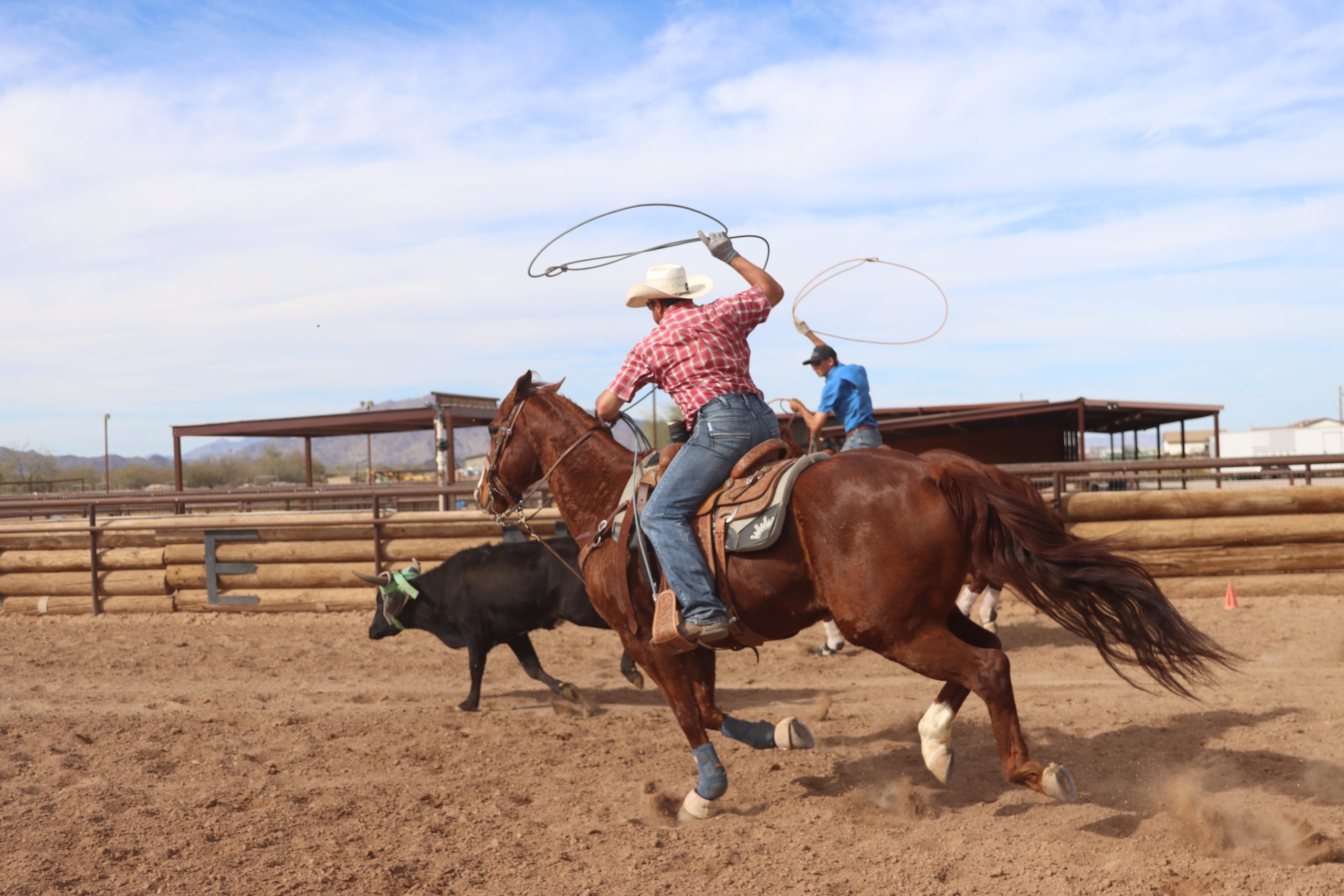
MARICOPA – The dust hadn’t fully settled when team roping coach Aldo Garibay instructed his students to take a quick break before returning for training reviews at a cattle ranch here on a recent March afternoon.
Garibay grabbed a remote off of the table beside him and raised his hand toward the sky. He kept it there until the drone he was piloting landed softly in his palm.
The drone is a part of the 11-time Mexican rodeo champion’s team roping performance clinic, My Roping Coach, where he utilizes video analysis, data analytics and over 30 years of experience to help his students identify their weaknesses and improve their skills.
“In team roping, you can spend 40 or 50 years at level four if you don’t know the things to change,” Garibay said. “Here, this gives you the clarity to say, ‘Okay, not everything is bad.’ With different information, you can find the specific things you need to fix and that’s how you’ll get better. Then you get out into competitions and you’re not the same. You have an advantage.”
The practice of team roping was originally developed on cattle ranches when a cow was too large to be captured and restrained by a single person. It involves headers – the riders responsible for roping the front of the steer – and heelers, who rope the steer by its hind legs.
Once it became a competitive sport in the late 19th century, a number system was eventually implemented to account for various levels of skill. Headers and heelers can each be classified anywhere from handicap levels 1-10, which determine whom a contestant is allowed to compete alongside and against.

Garibay grew up a few hours south of Arizona’s border in the Mexican state of Sonora on his family’s ranch. From age 13 until he was 23, he struggled to surpass United States Team Roping Championships (USTRC) handicap 3. For a long time, Garibay wanted to share his ideas for improving training techniques within the sport, but first he had to gain credibility.
Eventually, he and his older brother Sergio went on to make a name for themselves in the Mexican rodeo world, each winning a record-breaking number of championship titles – Sergio with 12 and Aldo with 11.
Years later, Garibay has applied his training philosophies by helping more than 5,000 students in eight different countries.
“We try to find and break everything down so everyone can understand every part of their run and where they have leaking parts,” said Fernando Higuera, who works as Garibay’s assistant. “We are having really good results with all of our students that have come in Mexico, Costa Rica, Ecuador, Colombia and even here in the States.”
Garibay’s clinics typically last two days, running from 9 a.m. to around 5 p.m. Multiple camera angles, including the drone, are used to show students different perspectives of their own performances.
“The videos that we show them are basically for them to see what I’m seeing,” Garibay said. “It’s evidence so they can really make the changes”

One of Garibay’s students, Mitch Campbell, has been to several roping clinics in the past – none of which incorporated technology in the same way.
“It’s been huge,” Campbell said. “Different clinics I’ve been to, you can talk about it and they say what you need to fix, but sometimes you can’t see the problem that you had. Especially the drone video, it’s really neat.
“We can see our horses’ angle to cattle, and the cattle’s natural tendencies in certain areas. And the statistics of what you do wrong that (Garibay) keeps track of, I think are also very valuable.”
Garibay conquered the challenges he faced earlier in his life, and now he helps others do the same. He’s become the mentor he wished he had when he was younger.
“Usually, a bad streak is not because of a lack of effort, it’s because of a lack of clarity,” he said. “I try to show them exactly what it is that they have to change, and then they get better.”
Garibay still loves to compete himself, but he finds all the joy he needs in coaching.
“We have our minds set on having the best program in the world,” Garibay said. “So that keeps us going.”
Related

Source link