Review ‘How to Get to Heaven from Belfast’: a sequel to ‘Derry Girls’
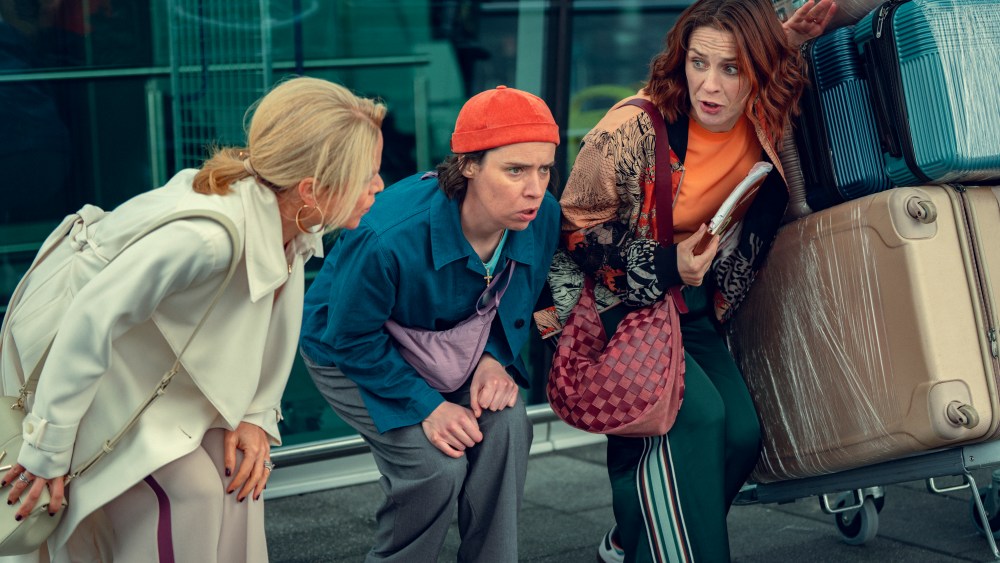
Even before Saoirse-Monica Jackson shows up halfway through, it’s clear that “How to Get to Heaven from Belfast” draws from the same sensibility as “Derry Girls,” in which Jackson played angsty teenager Erin Quinn. Not only is the black comedy airing on Netflix, where “Derry Girls” became a global sensation after initially airing on Britain’s Channel 4; ‘How to Get to Heaven from Belfast’ – formerly known as ‘Belfast’, to reduce my risk of carpal tunnel – Also revolves around a close-knit group of Northern Irish girlfriends prone to nervous chatter and hasty decisions. But for creator Lisa McGee, spending some of the capital rightfully acquired from three delightful seasons of “Derry Girls,” “Belfast” is a level up in scale and ambition. (“Belfast” was also initially set up on Channel 4, but moved to Netflix in part due to rising production costs.) Adding dual timelines, deadly intrigue and a doubled running time to the “Derry Girls” blueprint, “Belfast” sometimes suffers under the weight of all these extra elements, but never loses the infectious appeal of the platonic chemistry at its core.
Like McGee herself and the titular “Derry Girls” inspired by her upbringing, Saoirse (Roisin Gallagher), Robyn (Sinéad Keenan) and Dara (Caoilfhionn Dunne) are alumni of an all-girls Catholic school that cemented their friendship. (Though the trio is a little older than Erin and her peers, having attended high school in the years after the Good Friday Agreement. The issues that formed the backdrop to “Derry Girls” are a recent memory here, but a memory nonetheless.) But they graduated twenty years ago and are now in their late thirties, in a state of varying dissatisfaction. Saoirse is the London-based creator of a hit TV show – an apparent McGee surrogate, except for the fact that Saoirse hates her schlocky crime drama “Murder Code” and the self-centered actress who leads it. Dara, a closeted lesbian, uses caring for her elderly mother as an excuse to never build a life of her own; Robyn is a wealthy housewife, exhausted by her three rambunctious children.
The missing fourth member of this quartet is Greta (Natasha O’Keeffe), with whom the other three lost contact after a fateful night twenty years ago. In the present, when Greta dies abruptly after what her family believes was a freak fall down the stairs, the news threatens to reveal secrets the group has long hidden. The girls (this is Ireland, where even grown women approaching forty are still “girls”) are already on edge as they cross the border into rural County Donegal for Greta’s wake, as events unfold. They were invited via an email from Greta’s sister-in-law, but her widower Owen (Emmett J. Scanlan) doesn’t even know to have a sister. A friendly Englishman at the local watering hole is a dead ringer for Greta’s ex Jason (Josh Finan), whose inexplicable disappearance twenty years ago lies at the heart of what the group is hiding. Finally, Saoirse gets a look inside the coffin and comes away convinced that the body is not Greta’s. The final revelation of the premiere confirms that the writer is not just making up another story.
A group of Irish women under a high-stakes code of silence recall Sharon Horgan’s excellent — in Season 1, at least — “Bad Sisters,” right down to specific plot beats like an ill-advised flirtation between fiancée Saoirse and Liam (Darragh Hand), a local cop. (The leads are certainly close and argumentative enough to pass for siblings.) But McGee’s voice, even when spread across a writers’ room on a different shift from “Derry Girls,” is distinctive enough that “Belfast” exists outside the shadow of the previous show. The tensions between Robyn, Dara and Saoirse are especially well drawn; the women call each other out for Robyn’s self-righteousness, Dara’s cowardice, and Saoirse’s inappropriate thirst for excitement, as only old friends can. The performances are also each a revelation in themselves. Gallagher’s nervous charm, Keenan’s shameless hauteur and Dunne’s elastic face keep the laughs coming, even though their characters are more jaded and repressed than the teenagers they once were.
Greta remains more obscure by design. Some of this vagueness is emphasized: Ireland is the kind of place where someone is still known as “the transfer student” two years after they show up at school, with Greta (played in flashbacks by an ethereal Emma Canning) marked as an outsider even before she gets into trouble. But because “Belfast” spends so much less time with her, the late revelations about her past and its consequences don’t land with the same force as the more steadily constructed portraits of her peers. We understand so little about who Greta has become today that she never comes into focus as anything more than the target of the factual projection of the main characters. The finale features a short clip of Greta developing photos in a dark room before her disappearance. She’s a photographer, a nice detail that goes unnoticed until it’s too late to investigate what it says about her adult life.
Saoirse and company soon cross paths with a menacing fixer known as Booker (Bronagh Gallagher), who already seems suspicious before we see Greta tied up in her trunk. Towards the end of the season, we are informed of a nesting doll full of intrigue: who Booker works for, who the body is if it’s not Greta’s, what happened to Greta in the 2020s, what happened between Greta and Jason in the 2000s, what happened to Greta as a small child in the 1990s that led her to Our Lady of Sorrows House, and what it all has to do with a creepy symbol. Four were tattooed on their bodies at Greta’s insistence. It’s a lot to keep track of, and to be honest, I wasn’t half as addicted to it as I was just watching the actors bounce off each other. When the final shot telegraphed the hope of a season 2, I was looking forward to seeing more of it, rather than a resolution to a cliffhanger – the takeaway was that I am I look forward to more.
‘Belfast’ builds on a resolution that relies a little too heavily on the now worn-out conventions of the trauma plot. As trope-laden as the payoff may be, it is offset by the specificity and sense of place that McGee builds on both sides of the line that divides Ireland in two. Critical scenes hinge on the use and meaning of the Irish language, Catholicism permeates everything, and the long hangovers of the Troubles and the abortion ban are still in effect even if the original causes are not. ‘Derry Girls’ have struck comedic gold from the ordinary lives led amid geopolitical turmoil; ‘Belfast’ continues that tradition in its aftermath, tinged with the retrospection and regrets of adulthood.
All eight episodes of ‘How to Get to Heaven from Belfast’ are now available to stream on Netflix.