Prediction markets are opening many new opportunities for unregulated insider trading and unethical bets – in the name of making a game out of politics
Arrests for betting on the U.S. military operation that removed Venezuelan leader Nicolás Maduro. Death threats from gamblers to a journalist reporting on an Iranian missile attack on Israel. Fears of government officials manipulating world events – including the Iran war – to make a quick buck.
These are some of many concerns that experts have raised about how prediction markets – online marketplaces that allow people to bet on world events – might be affecting national security in the U.S. and abroad.
But prediction markets may not be only influencing international affairs. They could also affect the 2026 midterm elections.
We are social scientists who study gambling, public policy and national security. Here are four things you need to know about how prediction markets may be changing American politics:

Nikolas Kokovlis/NurPhoto via Getty Images
Prediction markets turn politics into a game
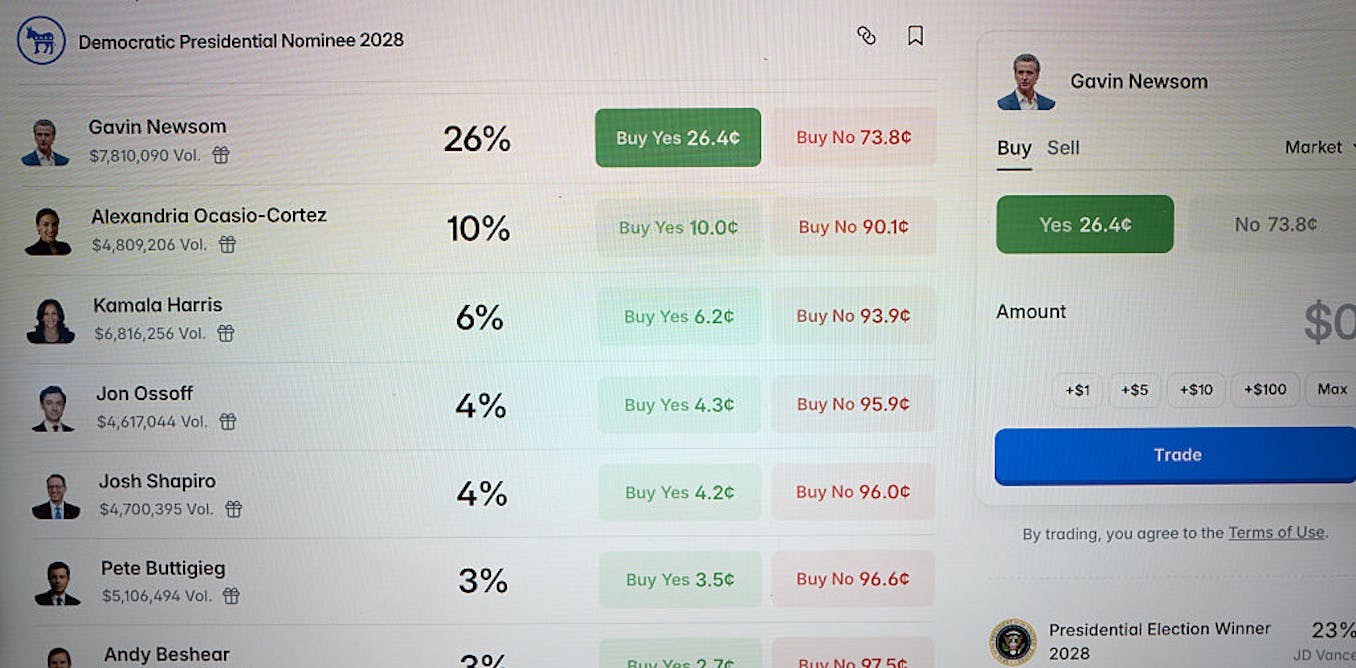
Prediction markets offer people the opportunity to bet on political events by purchasing “shares” – like stock in a company – of different potential outcomes. If an outcome takes place, the market pays out for each share purchased by those who guessed correctly. More betting activity in favor of an outcome raises its price and lowers its payout, and vice versa.
Prediction markets are different from casinos and online sportsbooks because there is no “house” – like a casino – that determines the size of the payout for correctly guessing who will win or lose a sporting event. In a prediction market, players “bet” against one another, not the house. The markets make money by charging transaction fees on each trade.
Betting on prediction markets allows users to turn many aspects of U.S. politics into a game. For example, betting on election outcomes is very popular on prediction markets. Kalshi – a popular prediction market platform – has a portion of its site specifically designated for election-related markets. That includes the chance to bet on the eventual winner of the 2028 presidential election, the margin of victory in the 2026 South Dakota primary elections and which of two Dan Sullivans could become Alaska’s next senator.
Kalshi also offers opportunities to bet on nonelection outcomes, like whether or not the Supreme Court will ban transgender girls and women from competing on “female sports teams,” or whether the government will confirm before September 2026 that aliens exist.
The gamification of politics through prediction market betting is not new. Predictit, a self-described “political prediction market,” has been operating in the U.S. for over a decade.
What has changed in recent years, however, is that prediction markets are no longer an obscure pastime enjoyed by political junkies. Prediction markets have become quite popular, and media organizations are even integrating betting market data in their political analysis. For example, Kalshi is CNN’s “official prediction markets partner.” In a segment called “The Odds,” CNN commentators often use Kalshi data to make predictions about candidates’ electoral performance.
Insider trading could affect US elections
Insider trading on prediction markets occurs when people with nonpublic information – like internal polling, military intelligence, etc. – place wagers on events. While some prediction markets are trying to crack down on the practice, insider trading could already be affecting the upcoming U.S. midterm elections.
In spring 2026, for example, NPR documented several cases where campaign staffers working on statewide campaigns admitted to using inside information about candidates’ performance in the polls to “buy low” on their candidate’s electoral prospects prior to the release of favorable polling data. Additionally, although prediction markets usually prohibit betting on one’s own campaign, both Democrats and Republicans running for political office have come under fire for betting on their own campaigns.
Betting on one’s own campaign could create a scenario where a candidate’s electoral performance seems more robust than it actually is to prediction market users or watchers, including media organizations who report on prediction market data.
This may in turn generate more favorable media coverage, which could affect public sentiment toward the candidate. Unlike polling, which is not typically prone to the same kind of meddling by campaigns, betting on one’s own campaign could ultimately change voters’ minds regarding the viability of a candidate.

The Wall Street Journal
Policymakers are paying attention
Given concerns about insider trading and its potential consequences, we asked Americans whether U.S. government officials should be forbidden from trading on prediction markets. In a nationally representative online survey of 1,000 U.S. adults conducted via the survey platform Verasight in March 2026, we found that nearly 70% supported banning government officials from trading on prediction markets, while 20% supported a more limited trading ban when government officials have “inside” information.
Lawmakers in Washington are beginning to respond to public opinion. The Senate recently banned senators and their staff from trading on prediction markets, although how this policy will be implemented remains uncertain. However, members of the House, employees of the executive branch, military officials and other government employees can still bet on prediction markets.
Some lawmakers have proposed limiting trading when government officials have insider information about an event, such as internal polling or fundraising data that members of the public do not have access to.
Others in Congress have made an effort to ban all trading on “death markets,” which include war, assassinations and related topics. Known as the “DEATH BETS Act” – its title is an acronym that stands for “Discouraging Exploitative Assassination, Tragedy, and Harm Betting in Event Trading Systems Act – the legislation has been introduced but is pending committee review.
State governments are also taking action to regulate prediction markets.
Massachusetts, for example, is suing Kalshi for allowing “backdoor betting” on sports.
Backdoor betting refers to wagering through less regulated channels like prediction markets, rather than highly regulated state casinos and sportsbooks. Backdoor betting has been estimated to cost states over US$1 billion in tax revenue since prediction markets first began allowing sports wagering in early 2025.
Minnesota became the first state to ban prediction markets altogether, while Illinois has sent cease and desist letters to prediction market operators that it claims are operating without adhering to state gambling laws.
Trump wants control over prediction markets
In a recent Truth Social post, President Donald Trump blasted the idea that states should be able to regulate prediction markets. Referencing their recent regulatory actions, Trump referred to Minnesota Governor Tim Walz and Illinois Governor JB Pritzker as “SCUM” in the post.
Trump also expressed enthusiasm for prediction markets in the post, saying that the U.S. is “at the top” of a “new form of Financial Market.” The president and his family have deep financial ties to the industry. For example, Donald Trump Jr. serves as a prediction market adviser to Kalshi and Polymarket and is an investor in Polymarket.
Following Trump’s post, the administration began reviewing a proposal to give the Commodity Futures Trading Commission the exclusive authority to regulate prediction markets.
While the CFTC has repeatedly asserted regulatory authority over prediction markets, some – like former CFTC Chairman Gary Gensler – believe that states, not the CFTC, should be in charge.
Source link