MLB teams increasingly locking up young players with long-term contracts
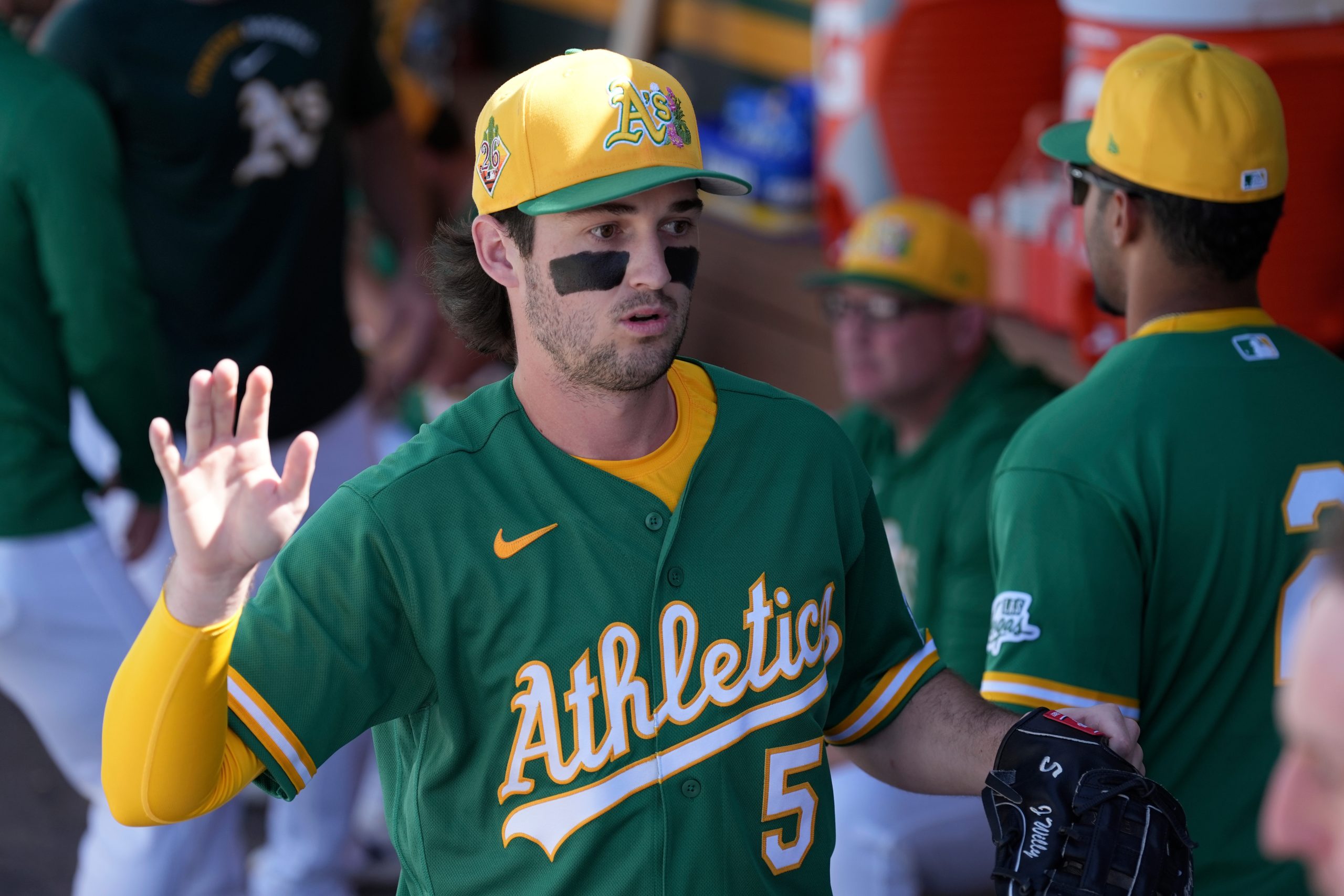
PHOENIX – Jacob Wilson turns 24 on March 30 and has a grand total of 578 MLB regular season plate appearances. Tyler Soderstrom is 24 and has 875 regular season plate appearances.
That didn’t stop the Athletics from signing both players to seven-year extensions in the offseason, worth a total of $156 million dollars. Both contracts also have club options for 2033.
The moves continued a recent trend of signing young ballplayers to long-term contracts well before they reach free agency. In essence, teams are betting on potential rather than paying players for past performance.
It’s a method primarily used by small-market teams to secure cost-certainty for the future, but it has also cost some players a lot of money, leading some within the game to wonder if the trend will catch fire or fizzle when more analysis is conducted.
“I think agents will try and block that,” Brewers manager and former ASU coach Pat Murphy said.
Payroll disparity in MLB is one of the premier problems the league faces. Small market teams often fight an uphill battle to contention, while teams like the Los Angeles Dodgers, New York Yankees, and New York Mets are always in the hunt because they spend more money on their rosters than anybody else.
This has sparked a trend among teams with less spending power: extend their young players early in their careers.
The Brewers signed outfielder Jackson Chourio to an eight year, $82 million contract before he’d even made his MLB debut. Including the club options, Milwaukee will control Chourio for 10 years.
Chourio was the No. 2 prospect in baseball on MLB Pipeline’s top 100 prospects at the end of 2024, ranking ahead of Pittsburgh Pirates pitcher Paul Skenes.
When Corbin Carroll signed his eight-year, $111 million deal with the Arizona Diamondbacks, he had 38 days of service time.
Economist and baseball author Andrew Zimbalist thinks that this trend is at least partly due to the advancement of analytics in baseball.
“They’re looking at all sorts of metrics that appear today that didn’t appear 10 years ago, 20 years ago, that reveal different propensities and tendencies and abilities,” he said. “We have seen that these new metrics do a pretty good job of predicting performance.”
Wilson’s deal with the Athletics is for seven years and $70 million. He was originally slated to become a free agent in the 2030 offseason, but this gives the Athletics two extra years of control, plus a club option for 2033.
“I think that we all want to be here.” Wilson said. “This is a group that we want to be a part of, this is a team that we want to be a part of, for the next, you know, multiple years.”
Soderstrom’s extension nearly matches Wilson’s. It’s for seven years, $86 million. However, Soderstrom is one year worth of service time further into his career than Wilson. He was set to become a free agent after the 2029 season.
Like Wilson, the Athletics have him signed through 2032, with a club option for 2033. That’s possibly four extra seasons of control.
“We love the group of guys.” Soderstrom said. “We got a couple more guys and a couple more pieces of the puzzle that we want to lock up, but just [an] exciting time really. I’m excited to be a part of this organization.”
The Athletics have a vision. They extended Brent Rooker and Lawrence Butler prior to the 2025 season. Reigning American League Rookie of the Year Nick Kurtz is under team control through the 2030 season.
“I’ve had a vision since the ‘23 season of a nucleus coming together that will be together for a while,” Athletics manager Mark Kotsay said. “It’s a vision that I thought would come to fruition, and we continue to improve.”
However, there is a certain risk-reward element to these types of contracts that has proven to be team-friendly so far.
Atlanta Braves outfielder Ronald Acuña Jr. is the primary example of a player who likely left a lot of money on the table by taking an early extension.
Acuña signed an eight-year, $100 million contract before the 2019 season. He’s just now entering the final year of that contract, but there are also two club option years for 2027 and 2028.
Acuña has been one of the best players in the league since he signed this contract, but hasn’t been compensated or had the opportunity to be compensated like it. He won the MVP award in 2023. While he’s suffered from injuries, he has a 28.6 career WAR.
Had Acuña not signed this contract, he would have gone into free agency after the 2024 season. That was the same offseason in which Juan Soto, a comparable talent to Acuña, signed a 15-year, $765 million contract with the Mets.
Soto is a client of agent Scott Boras. Boras’ clients have generally been a bit more reluctant to sign early contracts, and Boras also loves opt-outs. Even Soto has an opt-out after 2030.
“We invite clubs to offer what they choose to offer and present it to the player with analysis,” Boras told the Baltimore Banner. “We provide the player a complete review of all relevant contract parameters. Note that teams have control over many of these players for five or six years, so their purpose of offering a contract isn’t control. It’s cost containment. Clubs believe they can benefit substantially and save millions by signing a player in the first or second year of their major league contract.”
Even before hitting free agency, Soto was making more than Acuña, as he made $23 million in his second year of arbitration, and $31 million in his last year of arbitration. Acuña has never made more than $17 million in a season.
The megadeals signed by players like Soto, Shohei Ohtani and Vladimir Guerrero Jr. only strengthen the incentive for a team to get a contract done early.
“The explosion of these high-end deals the last couple of years, and they keep going higher and higher, make it a better bet for the teams that either they sign them during their pre-arbitration days or arbitration days, or they wait until free agency and have to pay a much higher price,” Zimbalist said. “So you take a little more risk today, because we don’t know as much about the player, but in return, we can blunt the Shohei Ohtani or Aaron Judge effect at the top.”
With new CBA negotiations coming up after the 2026 season, contracts and salaries most likely won’t be leaving the news cycle any time soon.
“I think the owners are planning an assault on the system,” Zimbalist said. “They’re going to go after salary cap type of constraints, and they would like to get as many players on their side of the fence as possible.”
This new trend in contracts likely means that the free agency pool in any given year will get smaller. There will be less big-name players facing the uncertainty of free agency. If the owners want a salary cap and parity, it isn’t the worst idea to sign players early and shrink yearly free agency pools.
“By making those kinds of earlier deals, I think you’re buying some votes,” Zimbalist said. “You’re pulling some people onto your side of the divide.”
Related

Source link