Mahmoud Khalil remains in limbo but ready to fight : NPR
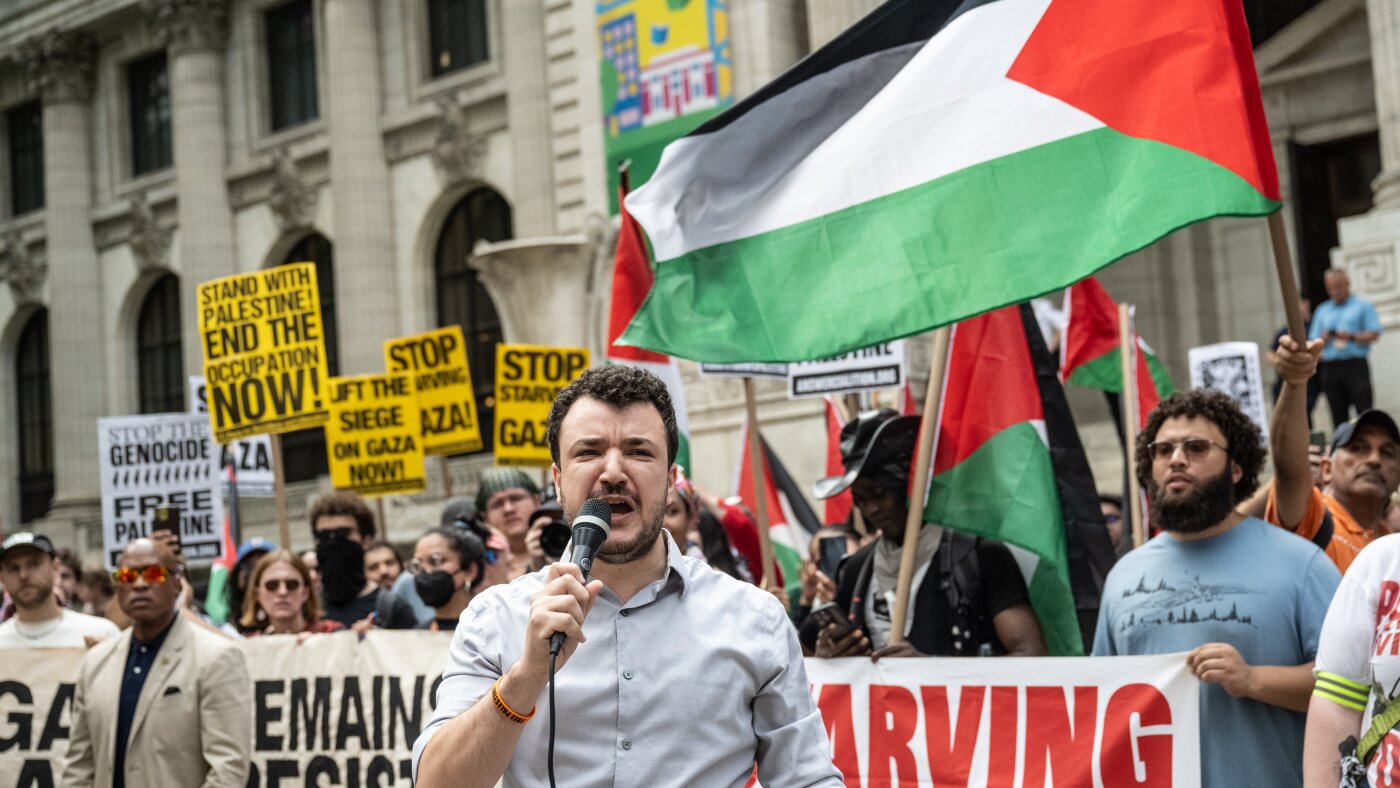

Mahmoud Khalil, the former Columbia University graduate student known for his role in the 2024 Columbia University pro-Palestinian protests, is now at the center of a legal battle against the Trump administration’s deportation policies.
Stephanie Keith/Getty Images
hide caption
toggle caption
Stephanie Keith/Getty Images
Last year, Mahmoud Khalil helped his wife pick out a name for their baby while he sat in immigration detention.
For more than 100 days, Khalil waited in immigration custody to learn if he would be allowed to live in the U.S. with his son, whose birth he missed, or be sent to a country he had never lived in.
A year after Khalil was detained outside his New York apartment, his legal odyssey continues.
The detention last March of Khalil, then a Columbia University graduate student, marked the start of a nationwide effort to deport noncitizens who speak out about Israel’s war in Gaza. He now sits at the vanguard of a legal battle over immigrants’ due process and civil rights pitted against the Trump administration’s mass-detention and deportation policies.

“One year after, the government has not charged me with any crimes or presented any evidence that I committed wrongdoings whatsoever,” Khalil told NPR in a recent interview. “I was absolutely targeted for what I represent, which is a student movement that erupted against the U.S. support for Israel.”
Most recently, New York Mayor Zohran Mamdani asked President Trump to drop the cases against Khalil. Khalil’s experience showcases the impact of Trump policy’s to detain and deport people in the country.
The Homeland Security Department and the White House did not respond to requests for comment on the status of Khalil’s case.
Life is different now for this legal permanent resident. He wears a baseball cap to cover his face.
He looks over his shoulder while walking on the street. He doesn’t go out alone with his son for fear he could be detained again.
Khalil’s legal fight became a full-time job
Over the last year, Khalil has made his legal defense his job — learning the ins and outs of the already complex immigration law system, and the complicated ways the Trump administration was trying to strip him of his permanent resident status. He is represented by more than 20 lawyers as his case winds itself through the federal court system, as well as within immigration courts, which are housed under the Justice Department.
At first, the administration deployed a rarely used statute to have Khalil detained. Secretary of State Marco Rubio declared Khalil’s presence in the U.S. had “potentially serious adverse foreign policy consequences.”
His lawyers pushed back.

“There are procedures that the Secretary of State is supposed to follow in order to use this statute against a person,” said Amy Greer, one of Khalil’s attorneys. “We have never received any evidence that that procedure was followed.”
A federal judge in New Jersey sided with Khalil — saying the way the Trump administration acted was likely unconstitutional, because it penalized him for his protected political speech.
The administration has since tried a new strategy to revoke Khalil’s green card: They say Khalil lied on his green card application by leaving out information about work he did for the British Embassy and the U.N. agency that works with Palestinian refugees.
Khalil and his lawyers say those are baseless claims — that his work for the U.N. was as an intern supervised by Columbia University. They’ve appealed to the board that hears immigration court appeals.

“They chose immigration proceedings against me rather than any other avenue,” Khalil said. “Basically, by weaponizing immigration, they can deny me due process.”
In January, a panel in the Third Circuit Court of Appeals found that the judge who determined Khalil’s detention was likely unconstitutional did not have the authority to address the merits of Khalil’s case. The appeals court decided that Khalil, and all people facing immigration proceedings, must first complete their immigration proceedings before having their case heard by a federal court.
Khalil’s legal team plans to challenge this latest ruling, which could allow the government to place him once more in immigration detention while his case plays out before an immigration judge.

Immigration attorneys look to Khalil’s case as precedent-setting
A ruling this year could have implications far beyond Khalil.
“The First Amendment is not a dial. It’s either on or it’s off,” said Eric Lee, an immigration attorney tracking the case. “The First Amendment is already under threat or fatally undermined once we accept a situation where the rights of any immigrants to speak are being restricted because the First Amendment applies to all the people in this country.”

Lee pointed to other similar cases — some of which have found success. Earlier this year, a federal immigration judge terminated deportation proceedings against Mohsen Mahdawi, another pro-Palestinian activist detained last year. Another immigration judge terminated removal proceedings for Rümeysa Öztürk, a student and pro-Palestinian activist whose detention came under the national spotlight.
But Lee said not all defendants have won their legal fights, and they, like Khalil, are stuck in limbo.
“These cases are at the forefront of the battle over the First Amendment,” Lee said.
Khalil said he is prepared to see it go the distance.
“This case is not just about me; it’s about whether the government can detain a lawful resident for political speech,” Khalil said. “I fight because no one should go through all of this, just for speaking out, and speaking up against injustices.”
Source link