IndyCar racing returns to Phoenix Raceway for 1st time since 2018
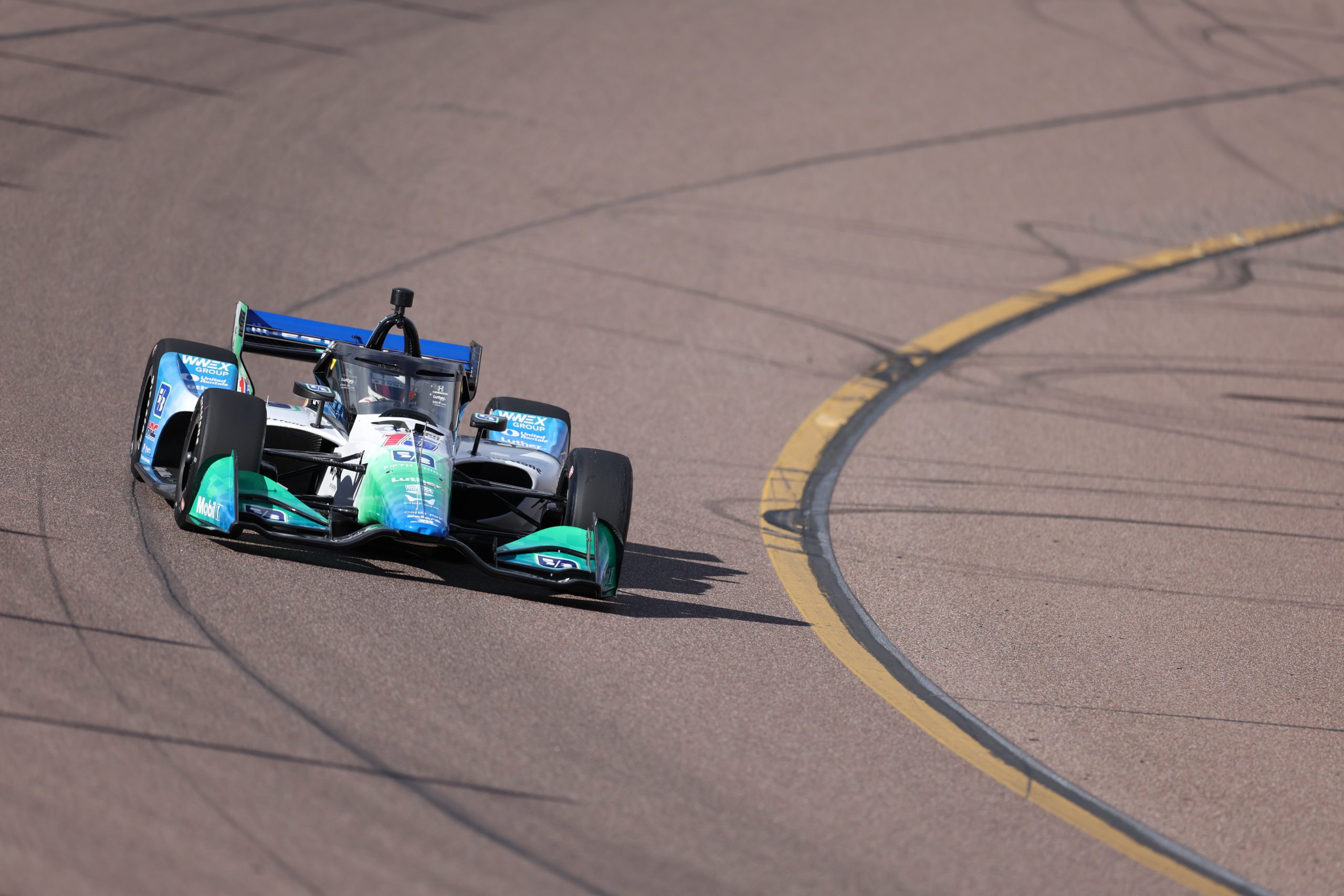
AVONDALE – Near the end of the Valley’s southwestern sprawl, where urbanization meets the seemingly endless, still untamed desert, lies a venue dedicated to speed that has provided entertainment, excitement and engagement for 62 years.
It’s known as Phoenix Raceway.
Since its opening in 1964, the track has been a Western hub for closed- and open-wheel auto racing in the United States. NASCAR has held annual races at the track since 1988, and predecessors to the modern IndyCar series kept open-wheel running at the track from its inaugural year to 2005.
Apart from a three-year stretch from 2016-2018, IndyCar hasn’t been back since.
Until now.
The IndyCar Series is returning to Phoenix Raceway on March 6-7 for a doubleheader weekend alongside NASCAR, giving Southwest motorsports fans something they’ve been dreaming about.
“The first question that I was getting from all our fans when I started is, ‘When are you bringing IndyCar back?’” track president Latasha Causey said. “The fact that we are able to do it now, and not only bring it back on its own, but bring it back as a doubleheader is great.”
Causey, a Valley native who became the first Black woman to run a NASCAR-owned track in 2022, wasn’t part of the initial conversations to bring IndyCar back to Phoenix Raceway – those were primarily between NASCAR and IndyCar themselves – but was on board nonetheless.
“They were looking for the oval,” Causey said. “And we have that, and we have that available, and we were open. When I got the phone call of, ‘Would you be willing to do this?’ It was an immediate yes for me.”
Even with all parties hoping for the event to take place, there were logistical challenges to running an IndyCar race while NASCAR is running a Cup Series, O’Reilly Auto Parts Series and ARCA race over the same weekend that had to be taken into consideration.
Not only do all of the series need their time on track, but safety technology like the SAFER Barriers (Steel And Foam Energy Reduction Barrier), which line the circuit, have to be up to standard for both series.
“We have gone through, with competition on both sides, IndyCar and NASCAR, to really be in the weeds of making sure that we are prepared and that we are ready,” Causey said.

To help make sure that IndyCar officials and drivers were ready for the challenge, the series put on the Unser IndyCar Open Test at Phoenix Raceway Feb. 17-18, allowing valuable miles to be driven and data to be collected.
A total of 4,853 laps were completed by the 25 full-time IndyCar drivers and their teams over the two days, with Ed Carpenter Racing’s Alexander Rossi posting the fastest overall time at 20.6254 seconds with a top speed of 174.542 MPH.
“We got through everything we wanted, and when you can do that, it’s a good day,” Rossi said through a press release.
The IndyCar veteran is one of five full-time drivers on the 2026 grid to have competed at Phoenix Raceway when the series was last at the track in 2018. He finished third that day, his best ever finish at the track, but it wasn’t the best finish of the five.
Team Penske’s Josef Newgarden, the 2017 and 2019 IndyCar Champion, finished on the top step of the podium in 2018, a place where Chip Ganassi Racing’s Scott Dixon, a six-time champion, stood two years earlier.
With a subsection of the grid not only familiar with the track but also carrying past success under their belts, it was imperative for other drivers to get up to speed quickly. That was something Team Penske driver David Malukas was able to do on the first day of testing, posting the fastest time at 20.8569 seconds with a top speed of 172.605 MPH.
“We know that we have pace,” Malukas said. “The car is good, and we’ve kicked off our oval setup with the team on a strong suit. (I) feel confident, but is it (going fastest) what we were aiming for today? No, we just ran through our test plan and we managed to get the time up on the board.”
Malukas was one of a handful of drivers to compare Phoenix Raceway to World Wide Technology Raceway, located in the St. Louis metropolitan area. The track, commonly referred to as Gateway, is known for its unique asymmetrical design, where turns one and two are tighter and have steeper banking than turns three and four.
Phoenix Raceway’s differences between turns one and two and turns three and four are less extreme, but still evident. Turns one and two feature lower banking and a more traditional radius, while turns three and four have more banking and are closer to 90 degrees, something that Arrow McLaren driver Nolan Siegel compared to a road course.
“(It) is a very interesting combination,” Siegel said. “And an interesting challenge to have the two of them.”
Luckily for the drivers, they have tools at their disposal on oval courses to attempt to deal with the different corners on the track.
First, drivers can adjust what’s known as the weight jacker by using buttons on their steering wheels. Racer.com describes the weight jacker as a hydraulic ram that can raise and lower the rear suspension, reducing understeer or even inducing oversteer.

Drivers can also adjust their front and rear anti-roll bars using levers inside the cockpit, changing how stiff the car is and impacting whether it oversteers or understeers.
“(It) definitely increases the workload on the driver,” Siegel said. “But at the same time, if you have a problem, you do have an opportunity to try and make it better for yourself and try and fix it. I think that’s a really cool aspect to the long runs in IndyCar.”
Because IndyCar hasn’t been to the track since 2018, no one really knows what to expect from the race itself.
Rossi, Newgarden and Dixon, alongside Rahal Letterman Lanigan Racing’s Graham Rahal and Andretti Global’s Will Power, could have the advantage due to their previous experience at Phoenix Raceway, but drivers like Álex Palou, who’s won the championship in four of the last five seasons, Kyle Kirkwood, who won at Gateway a season ago, and more can’t be counted out.
Kirkwood, in particular, had a fairly impressive test, finishing with the seventh-best time of 20.7302 seconds, reaching 173.660 MPH in the process. His laps, like most other drivers’, didn’t lead him to getting his elbows out on track, but one instance of close running gave him a clue as to what type of race could await the fans on Saturday.
“The initial insight is it’s going to be probably a one-lane track,” Kirkwood said. “But it’s going to be a track where you can get runs on people and still make passes happen. If you look back at the 2018 race, it seems like it’s going to be very similar to that, which was actually a pretty good race.”
Related

Source link