How to Hire a Payroll Specialist or Manager in 6 Simple Steps

To hire a payroll specialist, small businesses should define the role needed, write a clear job description, post the role, screen candidates, conduct structured interviews, check references, and onboard the new hire. Most small businesses hire a payroll specialist first. According to Indeed’s latest salary data, payroll professionals in the U.S. typically earn between $43,495 and $91,858 annually.
These professionals, whether specialists or managers, are responsible for processing payroll and ensuring employees are paid accurately and on time. They also work closely with accounting and HR teams to manage tax remittances, benefits deductions, and payroll compliance.
To help you find the right fit for your company, we’ve outlined six simple steps along with a free downloadable checklist to guide you through the process of hiring a payroll professional.
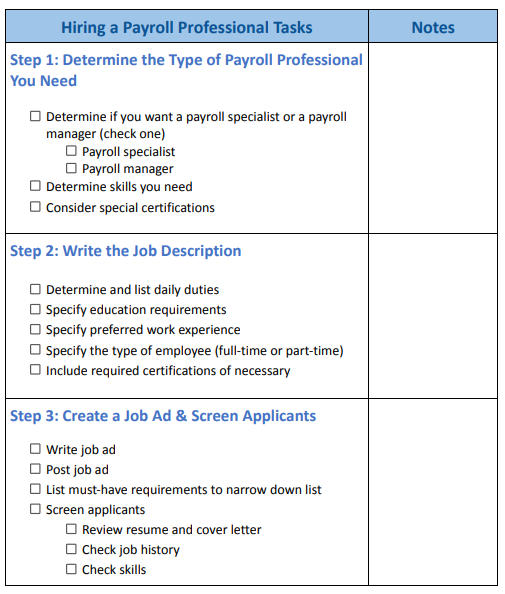
Thank you for downloading!
When should small businesses hire a payroll specialist?
Many small businesses start by managing payroll themselves or assigning it to an office manager or bookkeeper. However, as the company grows, payroll becomes more complex and time-consuming. Hiring a payroll specialist can help ensure employees are paid accurately and that your business stays compliant with payroll tax laws.
The table below can help you decide whether it’s time to hire a dedicated payroll professional.
If payroll tasks are starting to take time away from running your business, or if errors are becoming more likely, it may be time to bring in a dedicated payroll professional.
Explore some options in our guides to the best payroll software reviews or best payroll services for small businesses. Additionally, remember that you can hire a payroll professional on a part-time basis, even for smaller businesses, to alleviate the workload, ensure accuracy, and maintain compliance.
Step 1: Determine the type of payroll professional you need
Not all payroll professionals perform the same role. Some focus on processing employee pay and maintaining payroll records, while others oversee the broader payroll operation and ensure compliance.
In most small businesses, the first payroll hire is usually a payroll specialist, with a payroll manager added later as payroll processes become more complex.
Payroll specialist vs payroll manager
Payroll professionals often have different job titles, but they generally fall into two categories: payroll specialists and payroll managers.
A payroll specialist focuses on the day-to-day execution of payroll, such as calculating wages, verifying hours worked, applying tax withholdings and benefits deductions, and ensuring employees are paid accurately and on time.
A payroll manager, by contrast, oversees the broader payroll function. They typically manage payroll processes and systems to ensure compliance with federal, state, and local employment laws and improve payroll workflows.
Because payroll managers have higher salaries and oversee more complex operations, they are usually hired after a payroll specialist. For many small businesses with straightforward payroll needs, hiring a specialist first is the more practical and cost-effective option.
Skills to look For
When hiring a payroll professional, focus on the skills that ensure payroll is processed accurately and on time. Attention to detail is especially important for payroll specialists, since even small errors in wages, taxes, or deductions can affect employee trust and create compliance risks.
For payroll managers, strong process oversight and people management skills are equally important, as they are responsible for maintaining efficient payroll operations.
Look for candidates with a combination of payroll knowledge, technical skills, and communication abilities, such as:
- Experience with payroll software or HRIS platforms
- Intermediate or advanced Excel skills
- Accurate data entry and recordkeeping
- Ability to review timesheets and calculate overtime
- Attention to detail
- Critical thinking and problem-solving
- Clear communication and customer service
- Ability to collaborate with HR, finance, and management
Professional certifications can also strengthen a candidate’s qualifications. Organizations such as PayrollOrg (PAYO), formerly the American Payroll Association, offer credentials like the Fundamental Payroll Certification (FPC) for entry- or mid-level professionals and the Certified Payroll Professional (CPP) for experienced payroll leaders. While certifications are not always required, they demonstrate a deeper understanding of payroll regulations and best practices.
If a strong candidate doesn’t yet hold a certification, you can support their development through payroll training programs. See our guide on how to get the best payroll training for ideas on building those skills after hiring.
Step 2: Write the job description
Once you know which payroll role you need, the next step is to write a clear job description. A well-structured job description helps you attract qualified applicants and ensures candidates understand the responsibilities and expectations of the role.
Use the following elements to build your job description:
- Outline the responsibilities: Start with a short overview of the role and list the key duties, such as processing payroll, verifying timesheets, managing tax withholdings and deductions, and maintaining payroll records. Limit responsibilities to six to eight core duties so the role is easy to understand.
- List required skills and qualifications: Include the technical and soft skills needed for the position, such as payroll software experience, knowledge of payroll tax compliance, attention to detail, and Excel proficiency. It’s also best to separate required and preferred qualifications to attract more qualified candidates.
- Specify employment details: Indicate whether the position is full-time or part-time, the expected schedule, and the reporting structure. This helps ensure proper classification and compliance with overtime rules for nonexempt employees.
- Highlight your company and benefits: Since your job description will also serve as the basis for your job ad, include information about your workplace, benefits, and what makes your company a good place to work.
Need help creating a job description? See our guide on how to write a job description and download our template.
Step 3: Create a job ad & screen applicants
Once your job description is finalized, turn it into a job advertisement and post it where potential candidates will see it. In addition to your company website, consider posting on popular job boards or free job posting sites to reach a wider pool of applicants.
When writing the job ad, focus on the most important responsibilities, required skills, and key benefits. The goal is to quickly help candidates determine whether they’re qualified and interested in the role.
Compliance tip
Several states require employers to include a salary range in job postings under pay transparency laws. States such as California, Colorado, Washington, New York, Illinois, and Maryland require employers to disclose a good-faith pay range. If your business operates in (or hires remotely from) these states, confirm the rules before posting your job ad.
After posting the role, expect a steady flow of applications, especially for entry-level payroll specialist positions. To manage the volume efficiently, create a short list of must-have requirements (such as payroll software experience, payroll processing knowledge, or HRIS familiarity) and use it to filter candidates during the initial review.
Aim to narrow the applicant pool to 10 to 12 strong candidates for interviews. Prioritizing applicants who meet your core requirements helps you focus your time on the most qualified prospects while avoiding unnecessary screening calls.
Step 4: Conduct interviews
Interviews help you determine whether a candidate has the technical knowledge and attention to detail needed to manage payroll accurately. Start with a brief phone or video screening to confirm basic qualifications, communication skills, and interest in the role before scheduling full interviews.
When interviewing candidates, use a structured process so each applicant is evaluated consistently. Ask the same core questions and take notes during each interview to make it easier to compare candidates later.
Here are some useful questions to ask payroll candidates:
- What payroll or HRIS systems have you worked with?
- Can you walk me through your typical payroll process?
- How do you coordinate with HR to ensure benefits deductions are accurate?
- What payroll laws or compliance issues do you pay the most attention to?
- Tell me about a complex payroll issue you’ve handled. How did you resolve it?
- Have you ever discovered a payroll error? How did you fix it?
- How do you handle situations where an employee believes they were paid incorrectly?
Practical interview tips
- Ask candidates to walk through a real payroll scenario they’ve handled to assess problem-solving ability.
- Look for candidates who explain how they verify calculations and catch errors, since payroll accuracy is critical.
- In small businesses, payroll often works closely with HR and accounting, so evaluate how well the candidate can collaborate across teams.
A structured interview process helps you identify candidates who can handle payroll accurately, communicate clearly with employees, and maintain compliance with payroll regulations.
Step 5: Call references & run a background check
After completing interviews, review your notes and narrow your shortlist to one preferred candidate or a small group of finalists. Before making an offer, conduct reference checks to confirm the candidate’s reliability, accuracy, and professionalism.
Request at least two to three supervisory references, ideally former managers who directly oversaw the candidate’s payroll work. Managers can provide better insight into the candidate’s attention to detail, ability to meet payroll deadlines, and how they handled payroll errors or employee concerns.
For entry-level candidates, you can also ask about internships, coursework, or supervisors from part-time roles.
When speaking with references, focus on questions that reveal how the candidate performs in real payroll situations, such as:
- Did the candidate process payroll accurately and on schedule?
- How did they handle payroll errors or discrepancies?
- Were they dependable during critical payroll deadlines?
- What was the biggest challenge you encountered when managing this person?
- Would you hire or work with them again?
Pay attention not only to what references say, but also how confidently they respond. Hesitation or vague answers can sometimes signal performance issues.
Because payroll professionals handle sensitive employee and financial data, it’s also wise to run a background check before finalizing the hire. With the candidate’s written consent, you can partner with a background check provider to verify identity, employment history, and—where appropriate—criminal records.
Read more on other reference check questions you can use during your screening.
Compliance tip
Some states require employers to run background checks only after making a conditional job offer under “ban-the-box” or fair hiring laws. States such as California, Colorado, Hawaii, Massachusetts, New Jersey, and Washington have rules limiting when employers can review criminal history. Check your state and local laws before initiating a background check.
Step 6: Make an offer & onboard
After completing your interviews and reference checks, contact your top candidate to extend the job offer. Use this conversation to confirm key details such as salary, start date, and work schedule, and answer any final questions the candidate may have before formalizing the agreement.
Once you reach an agreement, send a written offer letter outlining the terms of employment. At a minimum, the letter should include:
- Job title
- Salary or hourly pay and pay frequency
- Start date
- Reporting structure
You may also want to include the full job description so the candidate clearly understands their responsibilities and expectations in the role.
Give the candidate two to three business days to review and sign the offer letter. This allows them time to consider the offer while keeping the hiring process moving.
After receiving the signed offer letter, begin the onboarding process. For payroll roles, onboarding may include granting access to payroll systems, reviewing payroll procedures, and training the new hire on your company’s payroll schedule, compliance requirements, and internal controls.
Once you receive the signed offer letter, you can proceed with the onboarding process.
Common mistakes when hiring a payroll professional
Hiring the right payroll professional can help your business avoid costly errors and compliance problems. However, many small businesses run into payroll issues because they underestimate the complexity of payroll management. Being aware of these common mistakes can help you make a better hiring decision.
Hiring a bookkeeper without payroll compliance experience
While many bookkeepers can process basic payroll, payroll compliance involves more than entering numbers into software. Payroll professionals must understand wage laws, tax filings, benefits deductions, and reporting requirements. Hiring someone without this experience can increase the risk of payroll errors or missed tax obligations.
Waiting too long to hire payroll support
Some businesses delay hiring a payroll specialist until payroll issues start affecting employees or tax filings. By that point, errors may have already occurred. If payroll tasks are consuming significant time or becoming difficult to manage, it may be time to bring in a dedicated payroll professional.
Underestimating multi-state payroll complexity
Hiring employees in different states can significantly complicate payroll. Each state has its own tax rates, wage laws, filing deadlines, and reporting requirements. A payroll professional with multi-state experience can help ensure compliance and prevent costly penalties.
Failing to establish internal payroll controls
Payroll errors and fraud can occur when there are no checks and balances in the payroll process. For example, allowing the same person to both process and approve payroll increases risk. Establishing basic internal controls, such as review procedures or payroll approval workflows, can help maintain accuracy and accountability.
Avoiding these mistakes can make the hiring process smoother and help ensure your payroll operations remain accurate, compliant, and efficient as your business grows.
When Should Small Businesses Hire a Payroll Professional?
As your small business expands, hiring administrative staff becomes essential, particularly for managing crucial aspects like payroll. The decision to hire a payroll professional depends on your specific needs, such as managing employees across multiple states.
Assess your payroll requirements, considering the benefits and costs associated with hiring a payroll specialist or manager. You can also use payroll software to help you with your payroll needs. Explore some options in our guides to the best payroll software reviews or best payroll services for small businesses. Additionally, remember that you can hire a payroll professional on a part-time basis, even for smaller businesses, to alleviate the workload, ensure accuracy, and maintain compliance.
How to hire a payroll specialist frequently asked questions (FAQs)
A payroll specialist is responsible for ensuring employees are paid accurately and on time. Their duties typically include processing payroll, verifying timesheets, calculating wages and overtime, managing tax withholdings and deductions, maintaining payroll records, and resolving employee pay issues. They may also assist with payroll tax filings and compliance reporting.
Payroll specialists need a combination of technical, compliance, and communication skills. Common requirements include experience with payroll software or HRIS systems, knowledge of payroll tax laws and deductions, strong attention to detail, and the ability to review payroll data for errors.
Many employers also look for candidates with Excel skills and experience collaborating with HR and accounting teams.
The average salary for a payroll specialist can vary depending on factors such as experience, location, and company size, but in the United States, the average salary ranges from around $54,000 and $81,000 per year.
Not always. Many small businesses initially handle payroll using payroll software or outsource it to a payroll service provider. However, as payroll becomes more complex due to company growth, multi-state operations, or complex deductions, hiring a payroll specialist can improve accuracy and efficiency.
Yes, a bookkeeper can handle payroll in some small businesses, especially if the company has a small team and uses payroll software that automates tax calculations and filings. However, as payroll becomes more complex (e.g., managing multi-state employees, benefits deductions, or compliance requirements), many businesses hire a payroll specialist to reduce errors and ensure payroll laws are followed.
Payroll typically sits between HR and accounting. HR teams often manage employee information, benefits deductions, and time tracking, while accounting teams oversee payroll expenses, tax payments, and financial reporting. In small businesses, payroll may be handled by one person or department, but larger organizations often divide payroll responsibilities between HR and finance.
Bottom line
Hiring the right payroll professional helps ensure employees are paid accurately and that your business stays compliant with payroll tax and labor laws. As your company grows, managing payroll becomes more complex and time-consuming. Following a structured hiring process, like defining the role, screening candidates carefully, and verifying their experience can help you find a payroll specialist or manager who keeps payroll running smoothly and supports your business’s growth.
Source link