H55 battery technology helps power the advancement of the RTX hybrid-electric Flight Demonstrator | News
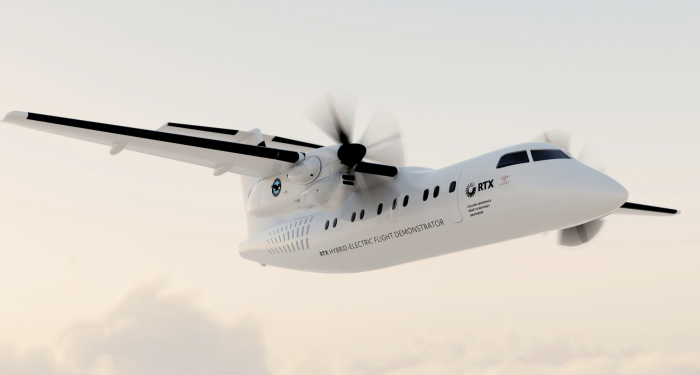
H55 today announced further progress in the development of the 200 kWh Energy Storage System (ESS) for the RTX Hybrid-Electric Flight Demonstrator, since the project reached the important milestone of the first full power system test, conducted in June 2025.
The demonstrator, led by Pratt & Whitney Canada and RTX’s Collins Aerospace, aims to demonstrate a 30% improvement in regional aircraft fuel efficiency using a hybrid-electric propulsion architecture that combines an advanced thermal engine, a 1-megawatt electric motor and the H55’s battery system.
Pratt & Whitney Canada built on the H55’s battery architecture and safety mechanisms as the certifiable basis for the demonstrator’s propulsion system. H55’s energy storage system – validated through extensive flight operations – provided the compliance and safety baseline that allowed the program to move forward quickly.
Commenting on H55’s partnership with Pratt & Whitney Canada, Rob Solomon H55’s CEO said: “There is a meaningful distinction between being selected as a component supplier and being chosen as a certification foundation. Not only did Pratt & Whitney Canada purchase our batteries; they built their demonstrator’s compliance baseline on an architecture that has allowed the H55 to fly more than 2,000 hours without incident and validated through EASA test campaigns. That’s the culmination of eight years disciplined certification work makes it possible: when a regional aircraft scale program needs to evolve quickly, they reach for the system that has already proven itself. This milestone – the first full-power ground test of a hybrid-electric propulsion system at this scale belongs to the entire team.”
The H55’s ESS is specifically designed for the requirements of aviation certification. The system is lightweight in design, modular to allow flexible aircraft integration and weight distribution, and based on a cell architecture that has already completed relevant European Union Aviation Safety Agency test campaigns.
The technology builds on H55’s broader experience in the development of electric propulsion systems for aviation. The company has conducted extensive safety validation campaigns for its battery modules – an essential step towards certification of the next generation of electric propulsion architectures.
Commenting on the importance of this development for the H55, company CTO and co-founder Sébastien Demont said: “This integration milestone represents a defining moment for the H55 and for electric aviation as a whole. The certifiable battery architecture we developed for CS23 aircraft has proven its scalability: the same cell-level safety philosophy, the same engineering discipline, now powers a battery system that is at the heart of a CS25 hybrid-electric demonstrator alongside Pratt & Whitney Canada. That’s not us” By adapting a concept, we scale a proven, validated platform. This is what it means to build technology that is certifiable by design.”
The H55 emerged from the groundbreaking Solar Impulse project, which demonstrated that electric propulsion could support long-duration flight. Building on that heritage, H55 has since developed and flown multiple electric aircraft platforms, gaining operational experience that continues to inform the development of next-generation propulsion systems.
With the RTX Hybrid-Electric Flight Demonstrator now moving toward aircraft integration and flight testing on a modified De Havilland Canada Dash 8-100, the H55’s battery technology will support hybrid-electric propulsion validation at regional aircraft scale.
The program also represents a significant step in expanding the H55’s technology from smaller electric aircraft platforms to the Part-25/CS-25 category of regional transport aircraft. By supporting a hybrid-electric propulsion system operating at a regional aircraft scale, the demonstrator allows the H55 to further validate its energy storage system architecture in an environment representative of future commercial applications.
The entry into the regional aircraft category represents a significant expansion of the addressable market for the H55 propulsion technology as hybrid-electric architectures are increasingly considered for next-generation regional aircraft platforms.
As aircraft manufacturers evaluate hybrid-electric propulsion to improve efficiency and reduce emissions, scalable battery systems that can meet aviation certification requirements are expected to play a central role in the architecture of future regional aircraft.
Rob Solomon added, “Programs like this allow us to demonstrate that the same certifiable battery architecture developed for smaller aircraft can be scaled to the regional aviation market. That transition represents an important step in unlocking the commercial potential of electric propulsion.”
This important milestone highlights the growing maturity of electric propulsion technologies and their role in enabling more efficient and low-emission aviation. As hybrid-electric aircraft enter service, energy storage systems will also become a critical part of the aircraft life cycle, creating long-term opportunities for certified propulsion technology providers.