First application of riblet-shaped paint to ZIPAIR aircraft | News
Japan Airlines Co., Ltd. (headquarters: Shinagawa-ku, Tokyo; president: Mitsuko Tottori; hereinafter “JAL”), the Japan Aerospace Exploration Agency (headquarters: Chofu City, Tokyo; president: Hiroshi Yamakawa; hereinafter “JAXA”), O-Well Corporation (headquarters: Nishiyodogawa-ku, Osaka; president: Yasuharu Kawato; hereinafter “O-Well”), and ZIPAIR Tokyo Inc. (Headquarters: Narita City, Chiba, President: Shingo Nishida, hereinafter “ZIPAIR”) has applied the ribbed (*1) coating to the side of the fuselage of Boeing 787-8 aircraft (JA851J) for the first time. The aircraft entered service on international routes from January 27, 2026.
Through this initiative, JAL, JAXA, O-Well and ZIPAIR will continue to work together to advance aircraft decarbonization by reducing drag during cruising, improving fuel efficiency and reducing CO2 emissions.
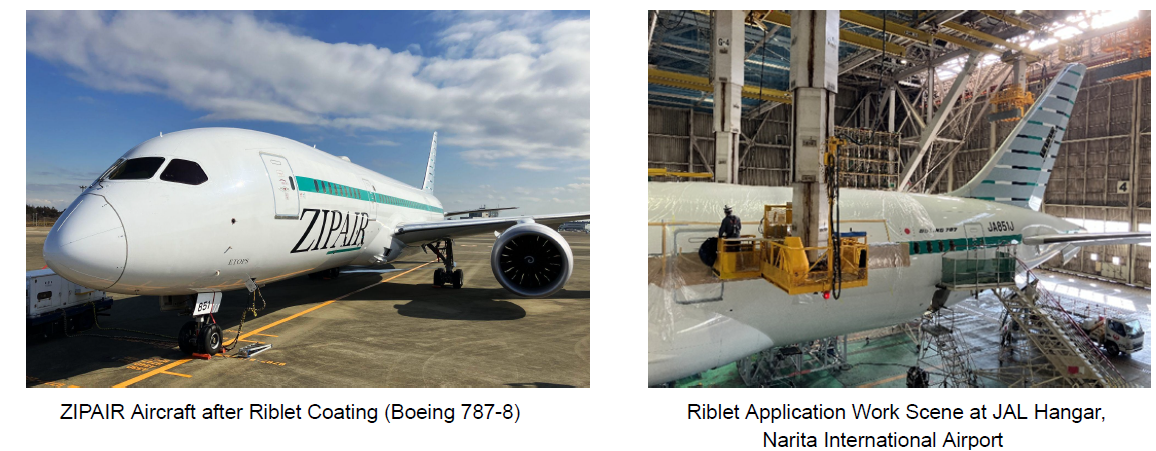
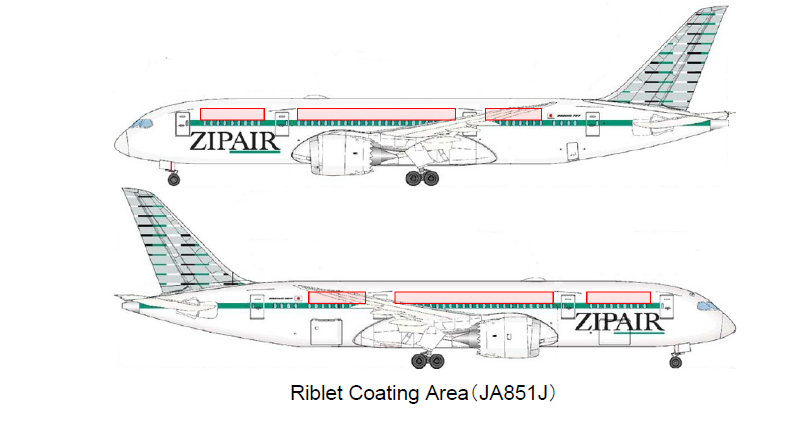
ZIPAIR, a medium to long-haul low-cost airline (LCC) of the JAL Group, received a CO2 neutrality certification in May 2025, verified under the international standard “ISO 14068-1:2023” and promotes the reduction of CO2 emissions. As part of these efforts, the riblet coating was applied.
This application was first implemented on an aircraft of ZIPAIR, the low-cost airline (LCC) of JAL Group. As before, the ribbed coating was applied to the fuselage of the aircraft using the continuously improved “Paint-to-Paint method” (*2).
This time, the quality and efficiency of the application have been improved by the new introduction of plate positioning mold and improving the shrinking mold of the rib forming plate. The application was successfully completed at Narita International Airport, ZIPAIR’s maintenance base, next to Haneda International Airport.
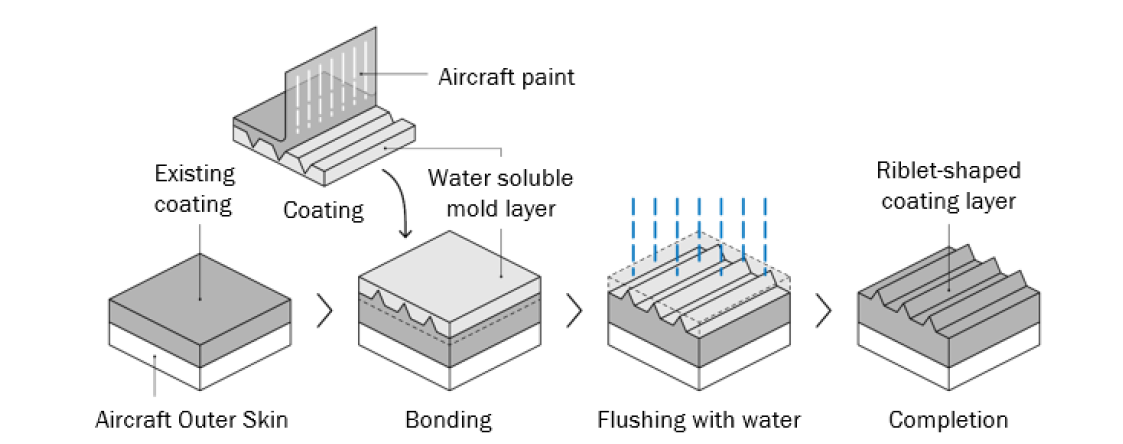
Paint-to-Paint Method: A method in which a textured coating is applied to the existing paint film using a water-soluble mold
In addition, the application on JAL’s Boeing 787-9 aircraft (JA868J) (*3), which has been flying with large-scale riblet coating since January 18, 2025, was extended to the upper fuselage in November 2025 and continues to operate on international routes. According to JAXA’s estimated drag reduction analysis using ribs, the expanded coating on the upper hull improved the drag reduction while sailing from 0.24% to 0.31%, resulting in an expected annual reduction of approximately 154 tons of fuel consumption and 492 tons of CO2 emissions (*4).
In addition, a new rib shape with better drag reduction – the sharp single-chamfered riblet (*5) – is being researched and developed and its in-flight durability is being evaluated.
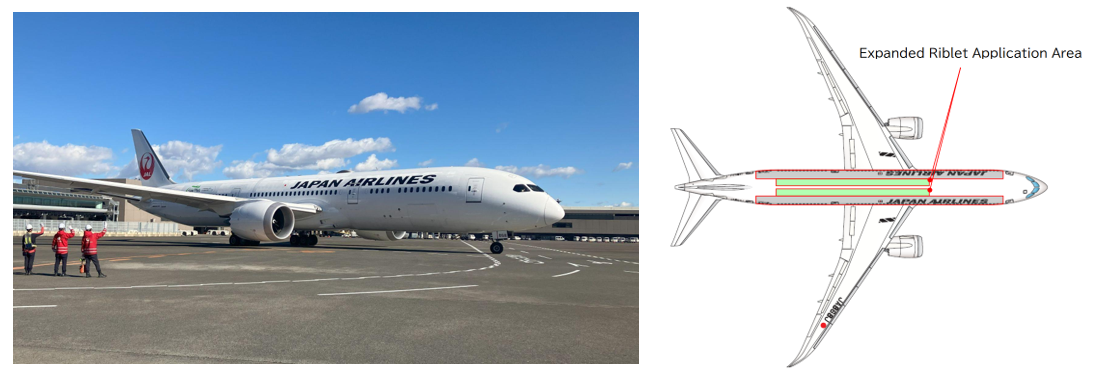
This initiative has been promoted through the joint demonstration programs under the JAXA Space Innovation through Partnership and Co-creation (J-SPARC) program (*6). We will continue to verify the durability and aesthetics of the rib-shaped coating, as well as its effects on improving fuel efficiency on long-haul international flights, and expand the number of aircraft and application areas, further promoting the decarbonization of aircraft.
(*1) Riblet: Fine groove structure inspired by the shape of shark skin, which reduces water resistance. By forming a fine groove structure on the outer panel of the aircraft along the airflow during flight, the drag can be reduced.
(*2) Paint-to-paint method: A method in which a textured coating is applied to the existing paint film using a water-soluble mold. Joint patent of O-Well and JAXA (patent no. 6511612).
(*3) January 24, 2025 Press release: World’s first aircraft with large-scale riblet coating introduced on international routes
https://press.jal.co.jp/en/release/202501/008590.html
(*4) The predicted effect of flying the route for one year, calculated based on JAXA’s estimated drag reduction percentage and fuel consumption on the Narita-Frankfurt route in the past year.
(*5) With a cross-section similar to that of a single bevel kitchen knife, the sharp single bevel rib exhibits an improved reduction in skin friction resistance of approximately 6 to 6.5 percent, while conventional ribs achieve approximately 5 percent. (Japanese Patent No. 7770011: Riblet Structure and Object, US Patent US 12,415,596 B2: Riblet Structure and Object) Japanese Patent)
(*6) “Space Innovation through Partnership and Co-creation (J-SPARC)” is one of JAXA’s industrial promotion programs, under which the project entitled “Development of Advanced Aircraft riblet” is jointly demonstrated,
https://aerospacebiz.jaxa.jp/en/solution/