Dillons Brooks leans into villain role as Suns face Thunder
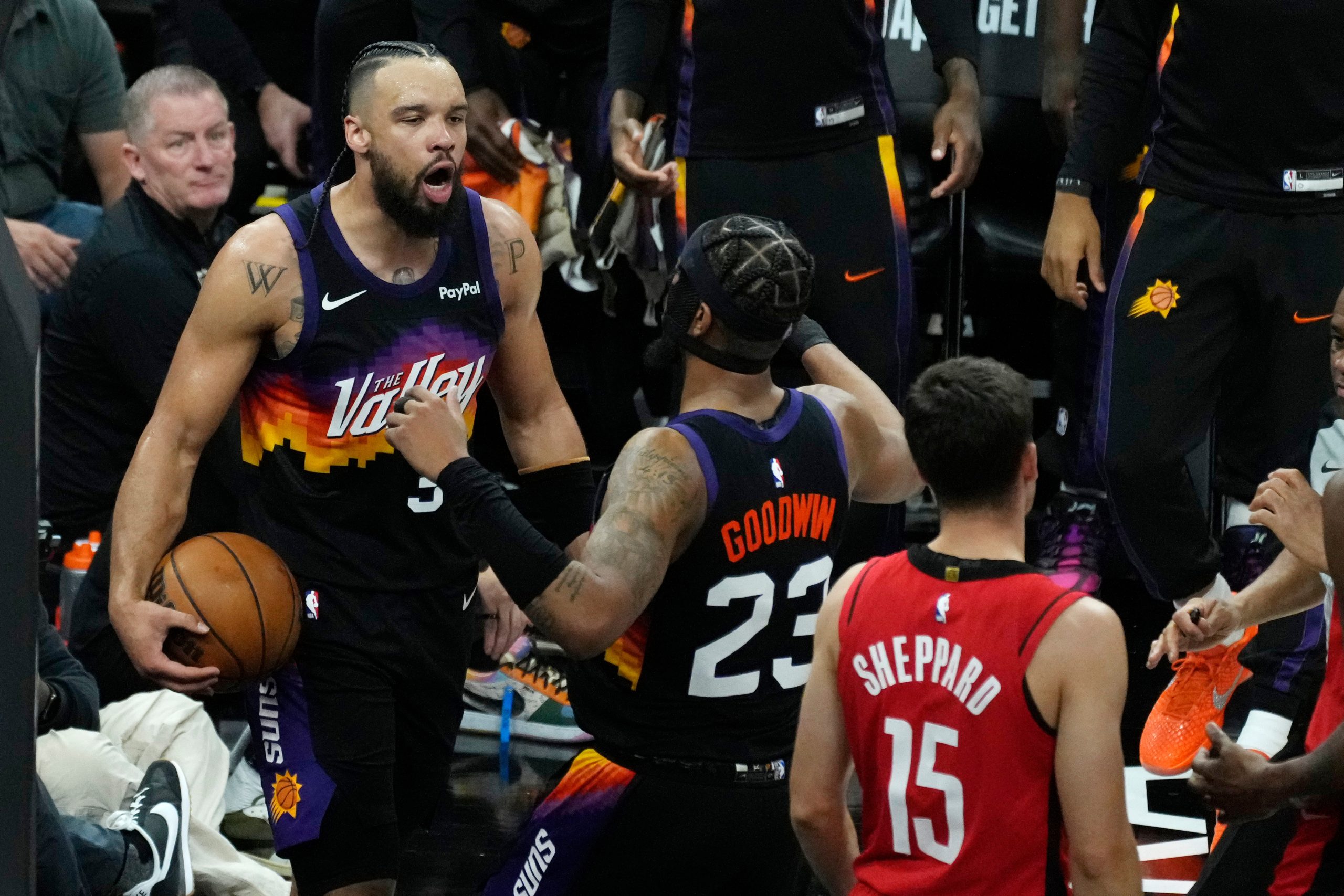
PHOENIX – Dillon Brooks knows what you think of him.
For his entire career, the Phoenix Suns forward has heard the boos, the taunts and the social media comments. He knows the one word that follows him around wherever he goes: villain.
Brooks doesn’t run from the noise. He uses it and accepts his role as the proverbial bad guy.
“I know that if you just met me, or if you’re playing against me, you probably just think I’m a troll or an asshole or whatever,” Brooks wrote recently in a piece for the Players’ Tribune entitled “No Way in Hell They Wanna See Us.” “But there’s a method to the madness. You can ask any teammate I’ve ever played with, and I’m pretty sure they’d tell you, ‘That motherf– drove me crazy sometimes, but I loved playing with him.’”
Love them or hate them, there are some athletes who simply love to be hated.
Brooks’ love for being the villain is clearly embodied in his style of play, constantly jawing at opponents and pushing the limits of physicality allowed in the NBA – a style that has been on full display in the 2026 NBA playoffs against the defending champion Oklahoma City Thunder.
Through the first three games of the series, Brooks has averaged five fouls per game and was a part of a double-technical foul assessed to him and the Thunder’s Luguentz Dort in Game 2.
Another staple of Brooks’ mentality is his unwavering confidence. Following the Suns’ Game 3 loss, in a game where reigning MVP Shai Gilgeous-Alexander posted 42 points on a staggering 15-of-18 shooting, Brooks stayed true in his belief in himself and his team.
“(Gilgeous-Alexander) is efficient,” Brooks said. “I got him in Game 4.”
Despite Brooks’ villainy drumming up headlines, the real story around him in this series has been his outstanding offensive production. Despite having never been a true No. 1 scoring option, Brooks is leading the Suns in scoring with 27 points per game this postseason – something that has caught the attention of Thunder coach Mark Daigneault.
“(Brooks) is a really good player,” Daigneault said. “He’s a guy that attacks the game. He’s got a great mentality. … He’s not afraid to attack the game defensively and be an irritant with opponents – and I say that as a compliment.
“He’s clearly a guy that has worked on his game because he has shown marked improvement, year after year, and he’s had a great year for (the Suns). … I think he deserves credit for how he’s jolted their team on both ends of the floor, just with his intangibles. He’s a guy that we have great respect for.”
Brooks’ career offensive performance is not limited to the series against the Thunder. Throughout the regular season, he was one of the Suns’ key offensive pieces.
Brooks, who came to the Suns in the 2025 offseason as part of the blockbuster deal that sent Kevin Durant to Houston, averaged a career-high 20.2 points per game in the 2025-26 regular season.
Brooks’ transformed offensive game helped lift the Suns well past preseason expectations. The team finished with a 45-37 record – much higher than their projected preseason win total of just 30.5. Despite revolutionizing his scoring and shot-making abilities, Brooks has stayed true to his nature as a villain, a polarizing style that opponents hate to face, but teammates and coaches love.
“The edge and competitive spirit that (Brooks) plays with is unmatched,” Suns coach Jordan Ott said. “We knew that competitive spirit would lift our group. … He lifts our group on the floor when he’s there, in the building when he’s there. Every night, to go to war with someone like that … it’s good to have him on our team.”
Despite the praise Brooks receives from those close with the Suns, it’s clear that league referees do not have the same appreciation.
In the 2025-26 regular season, Brooks led the NBA in total technical fouls with 17, despite only appearing in 56 games. In addition to the fines associated with these technical fouls, Brooks received a one-game suspension following his 16th technical on Feb. 11.
In the game following this suspension, Brooks suffered a fractured left hand that ultimately kept him sidelined for over a month. The time off was not enough to curb his competitive edge, as Brooks received a technical foul just one minute and 29 seconds into his first game back.
In the article Brooks wrote for The Players’ Tribune, he shared stories from his upbringing, including his lifelong love for players such as Joe Dumars, Vin Baker and Dennis Rodman – the villains of their era. Brooks spent much of his life looking up to these hard-nosed competitors, deciding that was the type of player after whom he wanted to model his game.
Brooks believes that while he brings the same physical edge and intensity as those NBA legends, the main thing he brings to the table for a team is infectiousness. On every team he plays for, Brooks said he tries to be the anchor for competitiveness.
Though loved by teammates, Brooks’ intensity is often met with hostility, not only from opponents, but from NBA fans.
Across social media, many fans have been quick to share strong opinions and use the word “hate” when sharing their thoughts on Brooks, or other players with similar villain mentalities.
While fans hating him because they disagree with his playing style fuels Brooks, that mentality is largely dismissed by Arizona State University philosophy professor Shawn Klein.
Klein, who specializes in the philosophy of sport, believes that the hate many fans have for players like Brooks is entirely superficial, despite how real rooting interest for sports teams may feel.
“It’s hard for me to believe that fans truly hate any of the athletes they watch,” Klein said. “They say they hate them, but is it the same kind of hate you feel in the real world? Is it the same kind of hate you would have for, say, an enemy in a battle who is intent on hurting you or killing you? Obviously not.”
In addition to his belief that people tend to overstate the intensity of their emotions when it comes to sports fandom, Klein also believes that those emotions, even confined within the context of sports, can be superficial.
“I’m sure Suns fans who say they love (Brooks) now that he’s in Phoenix hated him when he was on the Rockets or the Grizzlies,” Klein said “I think as fans, and as human beings, there is this kind of fluidity, or, for lack of a better term, tribalness, when it comes to liking things that are familiar to us.
“When they’re on our side, we love them, we’re rooting for them, and we’re going to put up with, or flat out overlook, some of that villain behavior and antics. Whereas, if we were rooting against them, we wouldn’t.”
While many fans are quick to dislike players like Brooks due to their extracurricular antics, it is their drive and competitiveness to be a winner that attracts many others.
When Brooks arrived in Phoenix, media outlets such as The Athletic called the 2025-26 season a “rebuilding year” for the Suns. Brooks disagreed with these assessments, viewing Phoenix’s position as one in which he could thrive and compete.
“I’m going to Phoenix,” Brooks wrote in The Players’ Tribune. “I saw what people around the league were saying. The Suns are blowing it up. They’re gonna be rebuilding for years. They want picks. My mentality was, ‘f— that, let’s win.’”
Suns fans were quick to accept Brooks and his winning mentality, leaning into his villain persona in the process. Fans bought his jersey, packed out the Arizona Mills mall to attend an event Brooks labeled as the “villain meet & greet,” and a mural of Brooks was even painted in downtown Phoenix.
Suns fans’ devotion to Brooks was on display in Game 3 of Phoenix’s series against the Thunder. Late in the game, even though the Suns were down double-digit points in a must-win contest, Brooks received loud “MVP” chants from the home crowd while he was at the free throw line – a clear reciprocation of Brooks’ commitment to Phoenix.
“When guys get traded, they always say, ‘This is the perfect fit.’” Brooks wrote in The Players’ Tribune. “I’d be bullsh–ing if I said I knew it at the time. But I damn sure know it now. Phoenix is my spot. I want to set the culture here for 20 years. I want to retire a Sun.”
Helping his team become a consistent postseason presence would be a step in the right direction. That starts with a do-or-die game against the defending champs.
“(The Thunder have) been together for quite a while, through ups and downs, and they know how to fight,” Brooks said. “We’ve got to come ready for Game 4.”
Related

Source link