Could Settlers of Catan make you a better strategist?
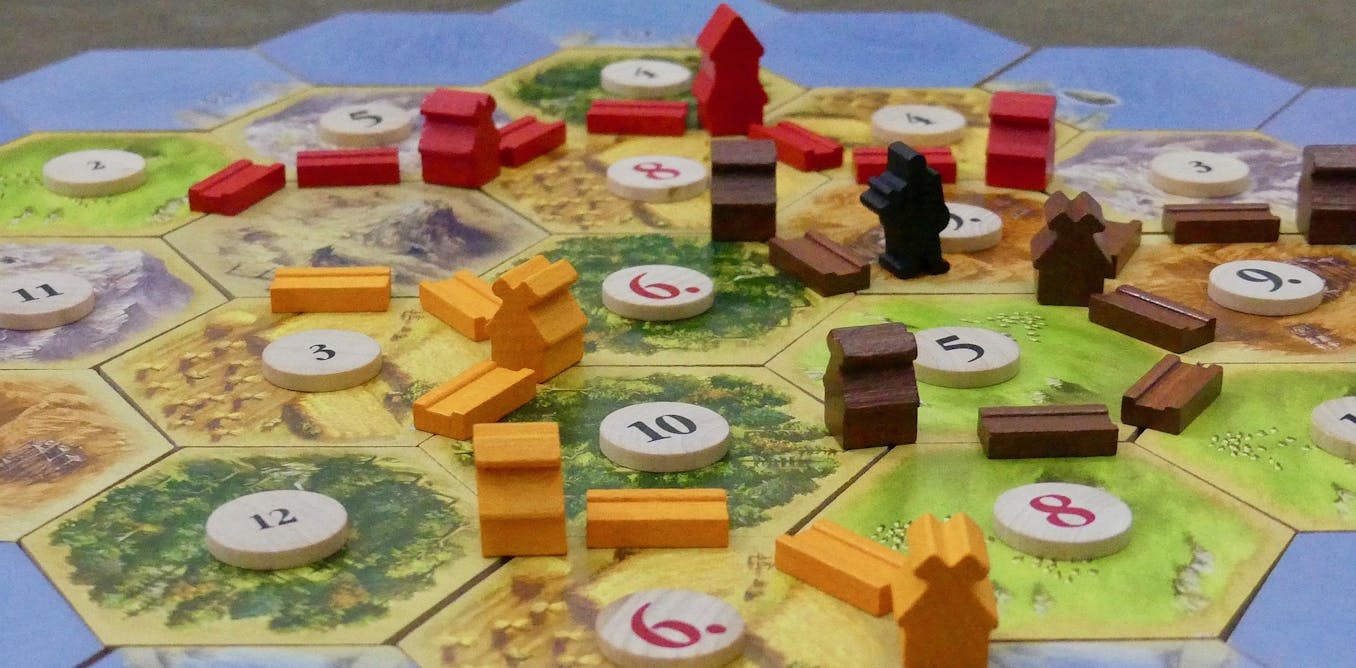
Christmas is just around the corner and you may be wondering how to spend those long, lazy afternoons. If you’re tired of the same old Monopoly, it might be time to try Settlers of Catan.
It is a strategy board game for three to four players who compete to be the dominant force on the island of Catan. Settlers of Catan has fundamentally changed the board game industry since its launch in 1995, selling more than 40 million copies and spawning dozens of spin-offs.
Catan offers the strategic thrill of Monopoly, without the endless arguments or (occasional) tears. Instead of bankrupting your family, you can build roads, trade resources and collect victory points.
It is also an effective tool for developing strategic capabilities. These are skills that can be used to solve complex problems and plan for future success.
Strategic thinking is essential today as we deal with social challenges, job insecurity and rapid technological change. While companies spend a lot on consultants and training programs, you can build these skills at home.
How can Catan make me a better strategist?
Game-based learning is a fun way to learn key business principles.
The island of Catan provides an artificial environment that mimics our social and business world. Players manage and trade resources to expand their territory by building houses, roads and cities to earn victory points. The first to reach 10 points wins.
Catan provides a safe, fun and challenging environment to facilitate strategic thinking in the classroom, improve communication and risk-taking, develop self-expression and prepare students to deal with uncertainty in the real world, while promoting decision-making and resilience.
As LinkedIn co-founder Reid Hoffman said in an interview:
People say, ‘Where do I get my business strategy?’ It comes from playing games […] How much do you build up for yourself, how much do you position yourself in relation to other people? [Catan is] the game that is closest to entrepreneurship of all board games.
Lessons for business and life
I am a strategic management teacher and an avid Settlers of Catan player. In my class we investigate how strategic theories connect to gameplay. We look at how players practice strategic thinking to not only win the board game, but apply these lessons to personal and business strategy.
Catan is easy to learn, but it’s never the same twice, and this reflects the real, messy social and business world.
In Catan, strategy is more important than luck. You will need to leverage your unique strategic capabilities. Everyone has different skills and capabilities, such as the ability to innovate, analyze, communicate, plan, manage or perhaps even empathize. Identifying and leveraging what makes you unique can give you a competitive advantage over competitors.
These are some of the most important lessons:
1. Analyze the context. To win Catan, or to achieve your personal, professional or business goals, you must first analyze the environment. This step is critical whether you are deciding where to establish your settlements, starting a business, or planning for your career.
Start by considering your skills and resources: what are your strengths and weaknesses? Then analyze the environment for opportunities and threats. This can help you research market conditions and future trends to better inform your plans and leverage your strengths.
2. Have a strategy, but learn to adapt. Many players compete to build houses, cities and connecting roads. But strategists would try alternate routes. Don’t get stuck in the status quo. Let the other players fight for the same resources, while you quietly implement a differentiation strategy.
In business, differentiation means offering something to customers that your rivals don’t think about, can’t think of, or never have thought about.
3. Manage your resources. Catan does not have infinite resources, and each turn you have to decide how to use your resources. But every choice means giving up another possibility.
Resource management is fundamental to business and personal budgeting. You or your organization will not have unlimited resources, and you must be strategic about whether or not you do so give out your resources, to rescue for future prospects, or invest. Think about every decision and don’t forget the bigger picture.
4. Negotiate strategically. You can’t win alone, and nor should you. You will have to plan, adjust and form or break alliances. Just like playing games, we need to collaborate with others in our personal lives or in our businesses.
Catan teaches us to do research before we act. Understand the rules. Investigate the other party. Be clear about the exchange. Some players think two or three steps ahead when proposing a trade, perhaps because they have access to unique resources. Ask yourself: have you analyzed your competition? Are you exposing yourself to future threats?
Above all, stay resilient
Being resilient means having the ability to recover or bounce back from adversity. Catan is full of risk and uncertainty. Life and business are just as unpredictable, and we don’t always win, but we can take advantage of our personal, social, or psychological resources to prepare for future victories.
A good example is Sir James Dyson, the founder of the Dyson Vacuum, who spent 15 years perfecting his design without giving up:
It didn’t happen overnight, but after years of testing, tweaking, fisticuffs and after more than 5,000 prototypes, it was there.