Consumers rely on AI more than any other task when planning trips | News
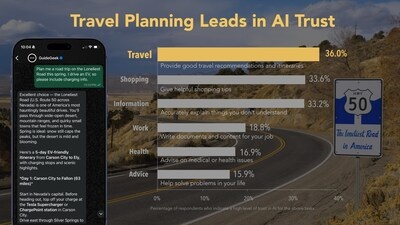
Consumers say they trust generative AI more to plan trips than they rely on the technology to help with other common tasks. This finding comes from a survey of more than 1,000 consumers by travel publisher Matador Network, which operates the GuideGeek AI platform for travel.
When asked to rank on a scale of 1 (no confidence) to 5 (complete confidence) how much they trust AI to help with a variety of tasks, respondents indicated that travel planning topped all other applications of AI in the survey. More than a third (36%) say they have complete confidence (5) or almost complete confidence (4) in AI to help plan trips. The list of tasks included shopping, working and other common uses of artificial intelligence.
How much do travel consumers trust AI?
Percentage of respondents who say they have a high level of trust in AI for the following applications:
36.0% – Travel: provide good travel advice and itineraries
33.6% – Shopping: provide useful shopping tips
33.2% – Information: accurately explain things you do not understand
18.8% – Work: Write documents and content for your work
16.9% – Health: Advising on medical or health issues
15.9% – Advice: Help solve problems in your life
“Since we first launched GuideGeek three years ago, I’ve seen travel as one of the most effective ways to use AI, as well as one of the most fun and lowest-stakes,” said Ross Borden, CEO of Matador Network. “It makes sense that people trust AI more than anything else when planning trips. With just a little high-level information about who you are and what you care about, AI can remove 95% of the noise from the trip planning process.”
Since launching in 2023, GuideGeek has quickly scaled to over 1 million users for its free travel AI tool. Travelers can message the AI on WhatsApp, Instagram or Facebook Messenger for instant, customized itineraries and trip recommendations, based on GuideGeek’s more than 1,000 travel data integrations.
“It gave me ideas about where we could go, which was helpful because my son is autistic,” says Morna Brown of Orlando, Florida, about her recent trip to Honolulu. “It suggested different places we could go and activities he might like. An itinerary was even created based on the activities we had booked and places we could see nearby. It was by far the best trip I have taken in a while. It was my son’s best trip ever.”
Increasing accuracy and opportunities for travel brands
Within a year of launch, GuideGeek improved the accuracy of its answers to over 98%. As a result, many of the world’s leading Destination Marketing Organizations (DMOs) and other travel brands have collaborated with GuideGeek on custom AI tools such as NYC Tourism + Conventions, Tourism New Zealand and the Aruba Tourism Authority.
“When GuideGeek first started working with DMOs, AI was new and many people were encountering it for the first time,” says Matador Network Director of AI Advocacy Greg Oates. “AI has become a routine part of many people’s lives in many different ways. Given that trust in AI among travel consumers is so high, there is a real opportunity for travel brands to focus on new AI integrations and conversions to better serve their business objectives.”