Composers point to setbacks in diversity under the Trump administration
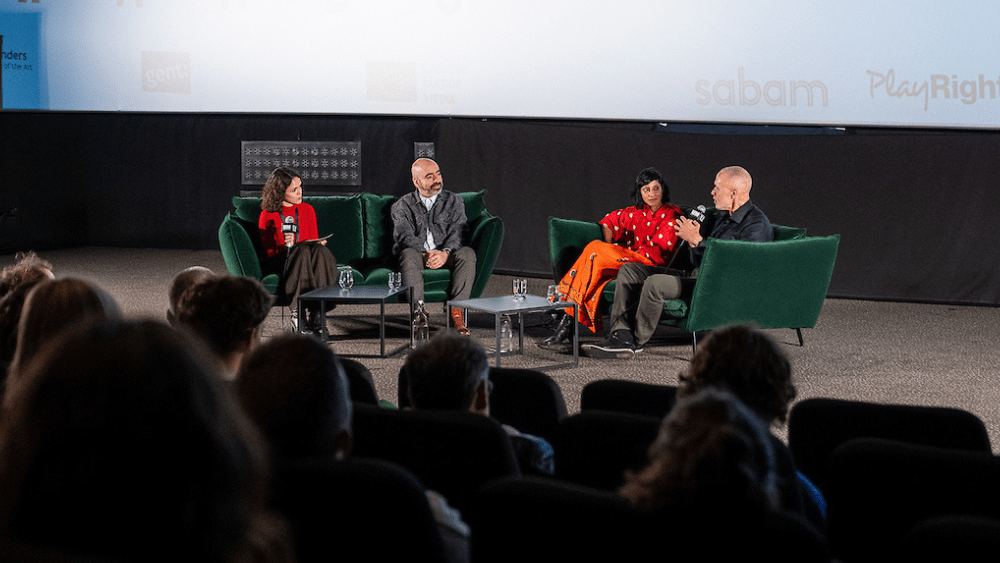
The Composers Diversity Collective, this year’s winners of the World Soundtrack Awards Industry Award, spoke on a panel during the Music Days at Film Fest Ghent about their work and what still needs to be addressed in terms of diversity within the field.
Members in attendance included founder Michael Abels (“Get Out”) and co-chairs Sandro Morales-Santoro (“Venom’s Secret Files”) and Amritha Vaz (“They Charge for the Sun”).
The WSA Industry Award is presented in recognition of individuals or organizations whose efforts have made a lasting and meaningful contribution to the film music industry. The CDC’s mission is to overcome barriers in finding “culturally diverse music makers, music supervisors, audio engineers and musicians, to increase our own awareness of each other and to dispel misconceptions about the stylistic range of each minority composer.”
When asked if he was among the winners this year, Abels said he considered it a “huge honor” to be in Ghent. “It’s brave of the World Soundtrack Awards to make this statement. We want to be a resource and a community, so having an international profile in any way is absolutely what we’re all about.”
Abels recalled the early days of the collective, saying he was “pushed into this whole music world” after the success of his very first score for Jordan Peele’s Oscar-winning “Get Out.” “I would go to events and there weren’t many people that looked like me, and if there were, we would make eye contact like, ‘I see you,’” he added. “We would say we had to hang out, and a lot of times that doesn’t happen, so we thought we had to pick a place and a time. We did that, thinking that if we had 10 people it would be a success, and there were 50 people there. I think it spoke to the need for community and feeling like we were part of something. It came from that spirit of seeking community and representation.”
Vaz echoed that thought, saying there was a desire to “see ourselves reflected in each other,” but the collective also came from another reality that people of color often face in the industry: “We kept hearing, ‘Oh, we’d love to hire a person of color, but there just aren’t any people who are composers.’ This led to us wanting to have a directory because we looked around and saw that there were composers from all kinds of backgrounds who were great. Our motivation was to build awareness of our presence, not only among us, but also within the industry.”
Morales-Santoro, an immigrant from Venezuela, recalled feeling like his dream of making films was “impossible.” “Then I saw Gustavo Santaolalla, an Argentinian composer, win back-to-back Oscars for incredible scores, and that made me feel like maybe someone like me could work in this industry. Now, 20 years later, even with all the work we do, it’s still hard to find composers with my background scoring studio films. It’s a bit sad and disappointing.”
An overarching theme in the conversation was the sense of decline that composers of color have felt over the past year when it comes to diversity. “It seemed to me that in the last ten years there have been a lot of opportunities to tell stories outside the mainstream,” Abels said. “Now we’ve seen the culture change. I don’t think that many projects are getting the green light. It’s not just about the composing community. It’s a way of saying, if not openly, that diversity and inclusivity are not as important as we thought 10 years ago. That’s really frustrating and sad.”
Vaz added that composers were often left out of diversity and inclusion projects as they often embraced on-screen representation, with behind-the-scenes roles being an afterthought or not fully considered. “Even that one [diversity and inclusion] initiatives that deliberately sought representation like ‘Crazy Rich Asians,’ the composer was not of Asian descent,” she said. “The same goes for the live-action of ‘Mulan.’ Because we are behind the scenes, we are not always thought about in the same way as people in front of the screen.”
Asked what it feels like to defend diversity under the Trump administration in the US, Morales-Santoro called it “challenging.” “The political changes are bringing what feels like a cultural change to the country. But our job and our mission remain the same. We continue to fight for the space we have won and to make lasting change away from power. Over the past ten years we have managed to get many very talented composers into the industry. You see members like Amanda Jones doing incredible shows like ‘Murderbot’ and Michael Abels joining ‘Star Wars’ works.’ It’s incredible.”
“There is a recognition on our part that studios tend to avoid risk, which is understandable to some extent because of the budgets at play,” he added. “When risks are taken and you know budgets are put in the hands of incredible creatives, magic happens. To avoid risk, what ends up happening is a very small group of composers are hired over and over again. The reality is there’s only so much one person can do in one year. When you look at the people who write all that music, you see a lot of diversity. The names that get the credit tend to be very uniform, and then there’s a lot of diversity among.”
Vaz added by saying, “studios don’t do anyone any favors.” “They want the best, they want everything to run smoothly, they want you to get results. Anyone who gets into that position has certainly earned it. I think the concept of a diversity hire is kind of an insidious idea that people who are outside the mainstream don’t deserve to be there. I would point out that, in terms of numbers, there are so few of us left in TV and film. We have a long way to go before people just call us provide diversity hires.”