Boston is betting on office space to ease housing shortages – and more than a dozen projects are in progress
Boston’s real estate market is showing its trademark resilience — and now a wave of new housing is set to emerge from the city’s vacant office buildings.
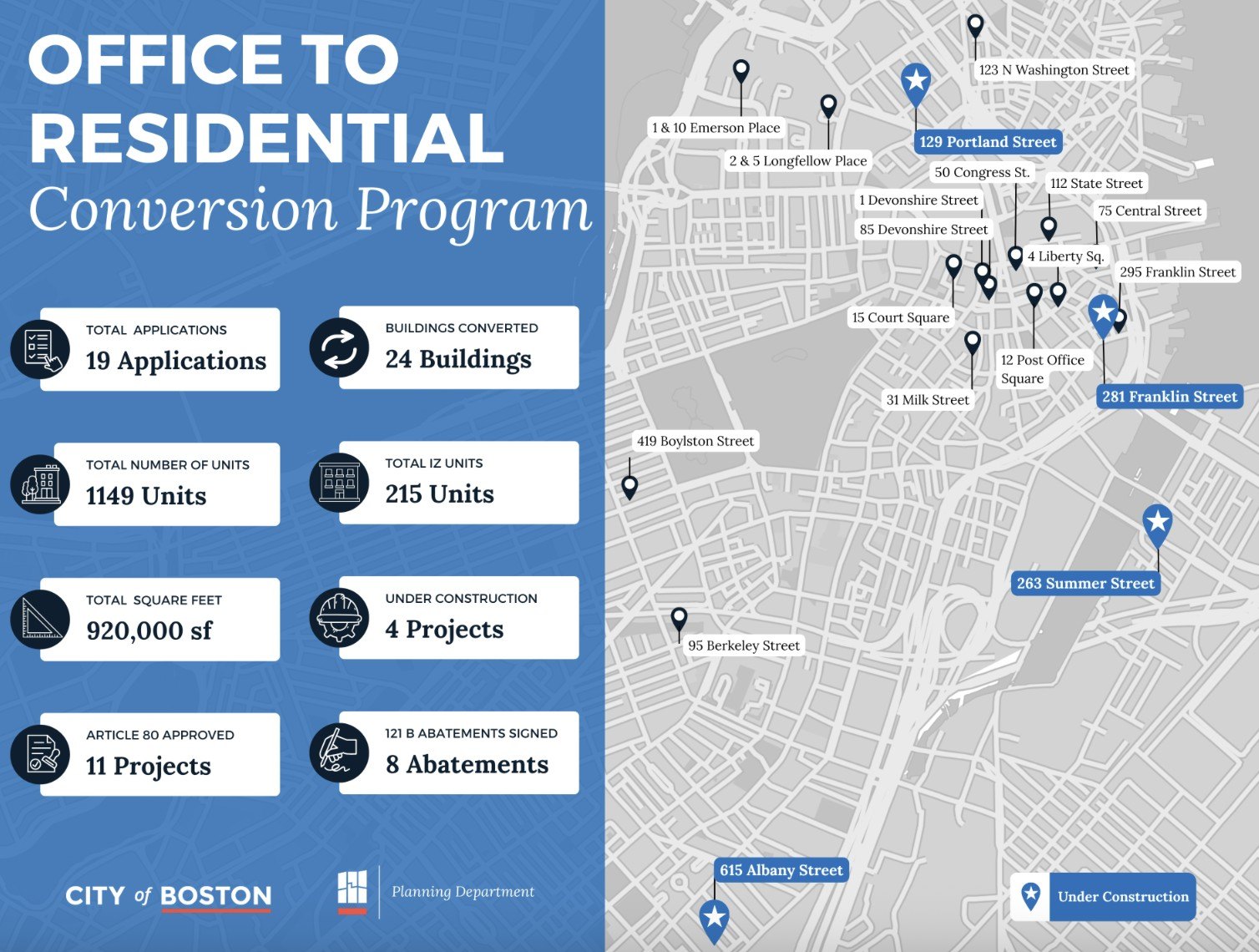
With 19 office-to-home conversions approved and several already under construction, Boston is betting big on adaptive reuse to address the housing shortage and revitalize the downtown.
“The Boston market remains incredibly resilient,” George Sarkisco-founder of The Sarkis Team at Douglas Elliman, says Realtor.com®. “We continue to see strong demand, especially in prime neighborhoods like Back Bay, South End and Seaport, where inventory continues to lag behind buyer interest.”
Sarkis says that while higher interest rates have cooled some activity, prices remain high because supply cannot keep up with demand.
“The combination of Boston’s strong economy, world-class universities and job growth keeps the market competitive,” he adds. “We are overdue for innovative solutions to create new housing options – and this is a smart solution.”
Boston’s Office to Residential Conversion Program is designed to do just that. It offers developers generous incentives — including a 29-year, 75% residential tax abatement, downtown zoning and an expedited Section 80 permitting process — to make the calculation of conversions work.
“The initiative has the potential to make a real difference if implemented effectively,” said Sarkis. “Adaptive reuse of underutilized office space could alleviate pressure on the market, especially in the city center where vacancy rates have increased.”
The benefits could extend beyond housing, he adds. “Increasing residential density in the city’s core could revitalize business districts and support local shops and restaurants. These renovations not only add housing, but also help revitalize neighborhoods.”
From labs to living rooms
The city has granted permits for several office-to-residential conversions, this time at 615 Albany St. in the South End.
Developers are transforming a former Naval Blood Research Laboratory into 24 apartments as part of the broader effort to convert underutilized commercial space into housing, according to Boston.com.
The five-story, 19,200-square-foot office building will become a six-story, 20,000-square-foot residential building with 12 studios, one 1-bedroom, six 2-bedrooms and five 3-bedrooms. Twenty percent of the units will be income limited.
The City of Boston’s Planning Department approved the project in September 2024, and according to Boston.com, developer Gregory McCarthy purchased the property in July 2023 for $3.4 million.
It is the first project in the program to add an additional floor, while remaining consistent with the historic character of the South End.
“This program provides solutions to multiple issues that are critical both now and for Boston’s future,” McCarthy said in a news release.
McCarthy, who is also leading the conversion projects at 129 Portland St. in the Bulfinch Triangle and 263 Summer St. in Fort Point, is among a growing group of developers reshaping Boston’s post-pandemic office landscape.
Office vacancy rates in downtown Boston are hovering around 20% and are expected to rise toward 30%, according to Boston.com, while residential vacancy rates remain close to 4%. City officials see the conversion strategy as a way to turn those empty floors into homes.
Mayor Michelle Wu has placed the initiative at the center of Boston’s downtown revitalization plan.
“Boston is laying the foundation for a stronger, more vibrant downtown through our commitment to housing, public safety and economic growth,” Wu said in a city statement. “We are transforming underused office space into homes for more than a thousand new residents.”
The city aims to create 1,000 new homes and convert 1 million square feet of office space by 2026, and developers can apply for the program through December.
These are some of the projects currently under construction:
- 263 Summer St. in Fort Point, which will create 77 homes in a historic warehouse
- 129 Portland St. in the Bulfinch Triangle, with 25 homes
- 615 Albany St. in South End, with 24 homes
The first completed renovation, at 281 Franklin St. in the Financial District, opened in September with 15 new apartments.
Balance between opportunities and challenges
Sarkis says this approach could transform downtown Boston, but it will take patience and planning.
“Many office buildings are not designed for residential use, so converting them can be technically complex and expensive,” he says.
“Developers also face zoning restrictions, permitting delays and high construction costs that can limit feasibility. For this to work, the city will have to remain flexible and continue to support these projects.”
He also sees the potential for broader market equilibrium.
“Downtown, the financial district and parts of the West End could benefit significantly, given the number of older office buildings that no longer meet modern workplace needs,” Sarkis says. “But Boston also needs housing in suburbs like East Boston, Dorchester and West Roxbury for families and first-time buyers who want more space and value. The key is balance.”
As office workers spend fewer and fewer days downtown, Boston’s adaptive reuse program offers an opportunity to reimagine what the city’s core can be. For Sarkis, the conversions are more than a development trend: they are a signal that Boston is adapting to the realities of a changing economy.
“Boston has always found ways to evolve,” he says. “These projects show that the city can honor its history while meeting the housing needs of the future.”