‘Blood & Sweat’ explores the co-pro reality between Japan and Finland in Tokyo
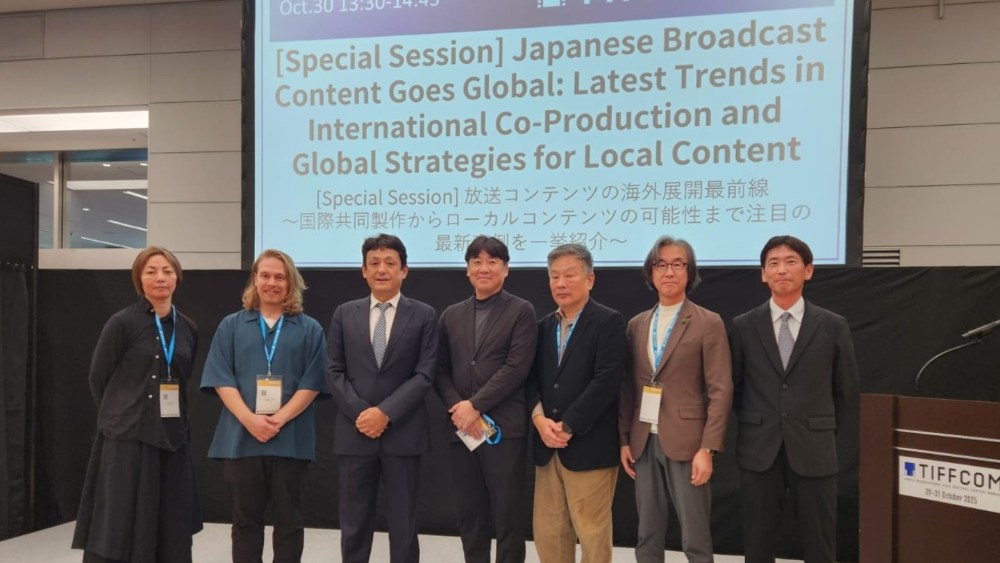
Added time for script delays, different ideas about days off, and extra crew costs. Producers of “Blood & Sweat,” an upcoming eight-episode crime series produced by Japan’s AX-ON and Finland’s ICS Nordic, offered a candid look at the challenges facing international co-productions during a TIFFCOM seminar.
TIFFCOM is the market division of the Tokyo International Film Festival.
The series, starring Anne Watanabe (“Cube,” “Stay Mum”) and Jasper Pääkkönen (“BlacKkKlansman,” “Vikings”), follows two detectives from opposing cultures who jointly investigate a series of murders.
The nine-month script development process required intense back and forth between writers and producers. According to AX-ON producer Daniel Toivonen, episode scripts were first written in English, translated into Japanese, and then had to undergo further reviews to ensure the dialogue was culturally specific and appropriate.
“Initially the script was written in English, and we had that translated, but directly translated word for word, and then we had the actors say those lines, to see if there was any discomfort, and from there we rewrote, which took time,” Toivonen said.
Different work cultures and styles also caused problems during filming. According to Toivonen, Finnish crews operate under strict union rules that prioritize work-life balance, in stark contrast to Japanese filmmaking practices. Labor costs are also higher in Finland than in Japan.
“We were very strict about time management. In Japan, going over a few minutes is fine, but in Finland the camera turns off on time, sharply,” says Toivonen.
According to Finnish law, the filming schedule was limited to a maximum of four 12-hour days per week. In practice this meant that shooting took place from Monday to Thursday, followed by a preparation day on Friday.
“Four days a week doesn’t work in Japan, so we might work six days a week, or have a longer working day,” Toivonen explains. “And also with a Finnish crew and a Finnish director [shooting in Japan]we needed more employees who could speak English, and that meant more budget.”
Creative decisions are also more reserved for Finnish manufacturing culture than their Japanese counterparts. According to Toivonen, Finnish directors tend to delegate decision-making to department heads to a greater extent than Japanese directors. For example, when asked about costume ideas, a Finnish director working on the series reportedly replied, “This is Garderobe’s job, and that’s why I want to respect her thoughts.”
In addition, the seminar also introduced the Local Content Bank (LCB), an initiative to help centralize and streamline Japanese content for the global market.
Led by regional broadcaster Miyazaki Telecasting Company, the online platform allows Japan’s wide variety of small and regional television stations to upload their extensive program library, which is then broken down and recategorized (via AI) into individual pieces of content.
Other users of the platform can then reformat and merge this content for new programming and lengthy playlists.