Bali will welcome a record number of visitors this Christmas

Bali is entering the end of year holidays rising demand for travel and an intensified security and logistics posture as authorities prepare for what local officials describe as one of the busiest Christmas-New Year periods in recent memory.
The main figure that drives operational planning is 1.5 million travelersa volume forecast for the Christmas and New Year period (known locally as Nataru) at I Gusti Ngurah Rai International Airport, the island’s main aviation gateway.
The airport predicts 1.5 million passengers as Nataru’s operations expand
According to a statement from PT Angkasa Pura Indonesia, the airport’s operator, an estimated 1.5 million passengers are expected to be operated during the Nataru peak, prompting the activation of a Integrated service post to coordinate stakeholders and manage real-time operations.
The station has been in use since mid-December and is expected to operate until early January, with a particular focus on congestion control, flight punctuality and passenger flow at the terminal’s touch points.
Operationally, the airport plans to do this 9,304 aircraft movements during a period of 21 dayson average more than 440 flights per daysupported by requests for hundreds of additional domestic ‘extra flights’.
The airport expects the busiest day to fall before Christmas December 19 (almost 80,000 passengers), while the return peak is expected January 4.
General Manager Ahmad Syaugi Shahab described the holiday rush as a recurring but manageable stress test for the airport’s systems and partners. “Traffic peaks are common during the Christmas and New Year period… [and] this is a challenge that must be managed well” he said, citing months of internal and interagency coordination to ensure facilities, personnel, infrastructure and procedures are ready for the surge.
More police, traffic control and command posts along major entry points
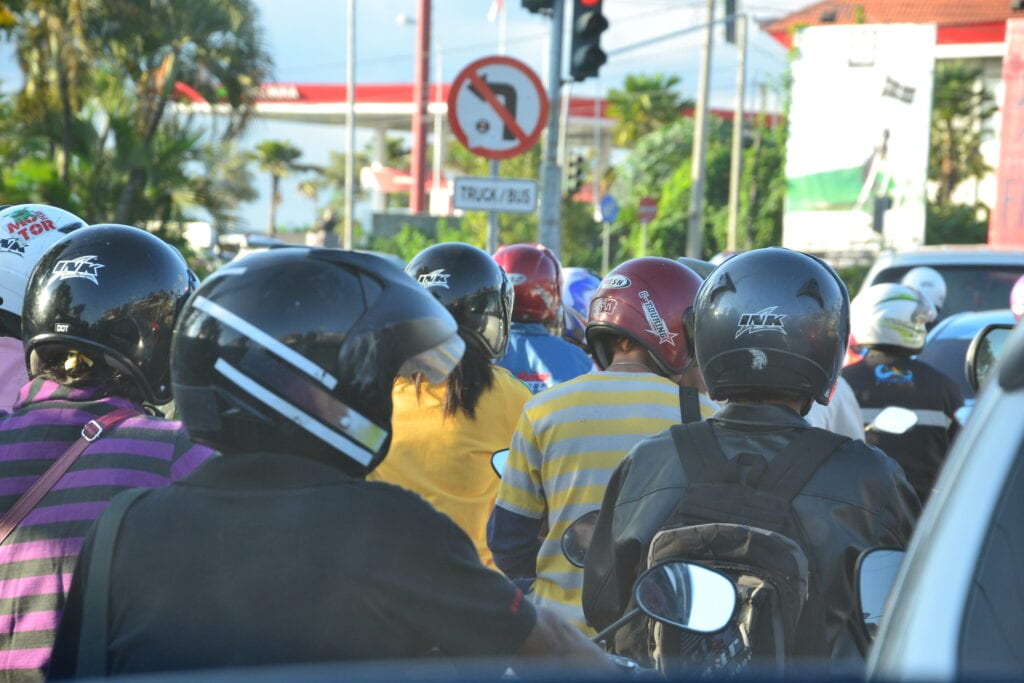
The increased travel volume translates into police and traffic enforcement with greater visibility– especially on routes connecting the airport to the island’s dense resort corridor. Bali’s airport operator says it has set up traffic checkpoints with airport police and other partners and may deploy them traffic engineering measures if conditions deteriorate, including signal adjustments and tow support.
Also local media reports from The Bali Sun describes a broader mobilization of Nataru command posts at key transport hubs, including the airport and major ports, as well as an increased presence of officers intended to keep traffic moving during the holidays.
The same coverage identifies Badung regency – home to Canggu, Kuta, Legian, Seminyak and Uluwatu – as the area likely to feel the heaviest pressure from visitor concentration and daily movement.
During a roll call of the Badung Regency Transportation Agency on December 22, the head of the agency emphasized that coordination is the key tactic to reduce gridlock and maintain service levels. “Cooperation and synergy are the key to smooth traffic management in Badung,” Anak Agung Ngurah Rai Yuda Darma told reporters.
Weather risks are now part of the holiday travel equation

Besides volume, the main complicating factor is seasonal weather. The airport activities are explicitly planned around disruption of the rainy seasonincluding drainage inspections, terminal maintenance, and real-time weather monitoring in coordination with BMKGthe Indonesian Meteorological Agency.
BMKGfor his part, has emphasized that his role during Nataru is to deliver results continuous weather information and early warnings to reduce risks to transport safety in all modes of transport. In an official press release attached to a national transport coordination post, BMKG leadership emphasized that information readiness is a security requirement, and not an optional add-on: “BMKG will continue to update weather information in real time as an important part of the national transport safety system,” said the head of the agency.
What travelers should do now
For visitors, the practical implications are simple but important: expect congestion, plan buffers and monitor weather warnings. With peak passenger days expected at the airport, travelers heading to flights should allow extra time not only for check-in and security, but also for road delays, especially on the corridors between resorts and airports that have historically been a bottleneck during the holiday season.
Officials and transportation companies are counting on integrated command posts, stakeholder coordination and tighter traffic management to prevent a repeat of last year’s worst gridlock. But the combination of demand on a record scale And volatility in the rainy season means that operating margins are small and traveler preparedness remains an essential part of the system working as intended.
The post may contain affiliate links; we may receive compensation if you click on links to those products. This may affect the way offers are presented. Our site does not contain all available offers. See our Disclosure and Privacy Policy for more information. The content on the page is accurate as of the date posted.