AI threatens to eat business software – and it could change the way we work

In recent weeks, a number of major software-as-a-service companies, including Salesforce, ServiceNow and Oracle, have seen their stock prices plummet.
Even if you’ve never used these companies’ software tools, chances are your employer has. These tools manage important data about customers, employees, suppliers and products, supporting everything from payroll and purchasing to customer service.
Now, new “agentic” artificial intelligence (AI) tools for business are expected to reduce dependence on traditional software for day-to-day work. These include Anthropic’s Cowork, OpenAI’s Frontier, and open-source agent platforms such as OpenClaw.
But how important are these software-as-a-service companies now? How quickly can AI replace it – and will the jobs of people using the software be safe?
The digital plumbing of the business world
Software-as-a-service systems run in the cloud, reducing the need for in-house hardware and IT staff. They also make it easier for companies to scale as they grow.
Software-as-a-service providers earn a stable, recurring income because companies “rent” the software, usually paying per user (often called a “seat”).

Austin Thistle/Unsplash
And because these systems become deeply ingrained in the way these companies operate, switching providers can be costly and risky.
Sometimes companies are locked into using them for a decade or more.
Digital colleagues
Agentic AI systems behave like digital colleagues or ‘bots’. Software bots or agents are not new. Robotic process automation is used in many companies to perform routine, rules-based tasks.
The more recent developments in agentic AI combine this automation with generative AI technology to achieve more complex goals.
This may include selecting resources, making decisions, and completing multi-step tasks. These agents can replace human effort, from handling expense reports to managing social media and customer correspondence.
What AI can do now
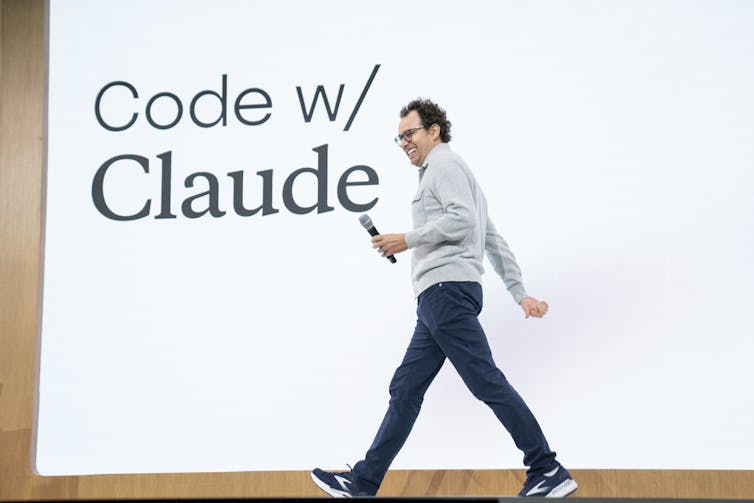
However, recent developments are even more ambitious. These tools now reportedly write useful software code. The increasing productivity in software development is attributed to the use of AI agents such as Anthropic’s “Claude Code”. Anthropic’s Cowork tool extends this from coding to other knowledge work tasks.
Basically, a user describes a business problem in plain language. Agentic AI then delivers a code solution that works with existing organizational systems.
If this becomes reliable, AI agents will resemble junior software engineers and process designers. AI agents like Cowork extend this to other entry-level work.
These developments have recently spooked the market (although many affected stocks have since recovered somewhat). Time will tell to what extent this decline is a temporary overreaction versus a real shift in the long term.
Don Feria/AP Content services for Anthropic
What impact will this have on employment and costs?
Since the arrival of OpenAI’s ChatGPT in November 2022, AI tools have raised profound questions about the future of work. Some predict that many white-collar roles, including those of software engineers and lawyers, will be transformed or even replaced.
Agentic AI appears to be accelerating this trend. It promises to let many knowledge workers build workflows and tools without knowing how to code.
Software-as-a-Service providers will also feel pressure to change their pricing models. The traditional model of billing per human user may make less sense if much of the work is done by AI agents. Suppliers may need to move to pricing based on actual use or value created.
Hype, reality and boundaries
It is likely that several forces will moderate or limit the pace of change.
First, the promised potential of AI has not yet been fully realized. For some tasks, using AI can actually degrade performance. The greatest gains are still likely to come from routine work that can be easily automated, rather than work that requires complex review processes.
Where AI replaces, rather than augments, human labor is where working practices will change the most. The nearly 20% decline in jobs for junior software engineers in three years underlines the effects of AI automation. As AI agents become better at higher-level reasoning, higher-level positions will also be at risk.
Second, to benefit from AI, companies must invest in redesigning jobs, processes and control systems. We have long known that organizational change is slower and messier than technological change.
Third, we must consider risks and regulations. A heavy reliance on AI can erode human knowledge and skills. Short-term efficiency gains can be offset by a long-term loss of expertise and creativity.
Ironically, the loss of knowledge and expertise could make it more difficult for companies to ensure that AI systems comply with company policies and government regulations. The checks and balances that ensure an organization can function safely and fairly will not disappear when AI arrives. In many ways they become more complex.
Technology evolves quickly
What is clear is that significant changes are already underway. Technology evolves quickly. Working practices and business models are starting to adapt. Laws and social norms will change more slowly.
Software companies won’t disappear overnight, and neither will the jobs of people who use that software. But agentic AI will change what they sell, how they bill, and how visible they are to end users.