What you ate in 1776 depended on who you were : NPR

Established in 1750, Middleton Tavern in Annapolis, Md., is one of the oldest continuously operating taverns in the U.S.
Anna Rose Layden for NPR
hide caption
toggle caption
Anna Rose Layden for NPR
ANNAPOLIS, Md. — Arthur Gross has been the chef at Middleton Tavern in Annapolis, Md., for 50 years. That’s a long time, even for a tavern that started serving food before the country’s inception.
Sometimes, in between preparing food in the kitchen, “I wonder to myself what would it have been like?” Miller said of the early days at the 276-year-old tavern.
In 1776, seafood such as rockfish and crab dominated the diets of many early colonists in Maryland.

Arthur Gross is the executive chef at Middleton Tavern. He’s worked at the restaurant for 50 years.
Anna Rose Layden for NPR
hide caption
toggle caption
Anna Rose Layden for NPR
And now, when Gross orders food for the restaurant, it features some of the same staples: 100 pounds of rockfish, 6 pounds of crab claw meat, 10 pounds of calamari rings and tentacles, crackers and lemon juice.

In Annapolis, where it’s common for historical reenactors decked out in short gowns, petticoats, caps and leather-buckle shoes to lead tourists around the historic streets, it almost feels like 1776. (If you squint a little and ignore the cars.)
As America celebrates its 250th anniversary, it’s hard not to imagine, along with Gross, how people’s diets shaped everyday life then.

A reenactor dressed in Colonial-era garb enters Waterfront Warehouse with a group of schoolchildren in Annapolis.
Anna Rose Layden for NPR
hide caption
toggle caption
Anna Rose Layden for NPR
When we think about signs of wealth today, “we think about cars and handbags or real estate,” said Dana Connett, the community programs coordinator at the nonprofit Historic Annapolis.
But in 1776, it was food. Two hundred and fifty years ago, social class defined the food that colonists and the enslaved ate.
Despite the revolution, a desperation to remain like England

Tables are set up with displays of upper-class dining at the William Paca House in Annapolis. Left: A table is set with fruit, nuts and cake. Right: Another table is set with dominoes and replica glasses of punch.
Anna Rose Layden for NPR
hide caption
toggle caption
Anna Rose Layden for NPR
Down the street from Middleton Tavern, the William Paca House & Garden offers an intricate view of the life of one of Maryland’s four signers of the Declaration of Independence. Paca, who served as Maryland’s governor in the late 18th century, lived with his family in the home from about 1765 to 1780.
The Founding Fathers and members of the gentry class relied heavily on recipes from France and England and even imported some of their food from Europe, food historians said. They were desperate to emulate the wealth and prestige of affluent Europeans.

At a dinner table in the Paca House, a representation of a spring meal sits on the table with original monogrammed silver condiment shakers. On this day, the Pacas would have eaten turkey soup, fried shad, collards, ham and asparagus, oysters and roast chicken.
The type of meat the colonists ate was a status symbol, and beef was the most sought-after, said Joyce White, a local food historian who set up the food displays at the Paca House. Chicken would be eaten on special occasions — to sacrifice a good hen rather than use it for its eggs would be a delicacy.
“If it’s your pig or cow coming from your plantation, you don’t want to waste it,” White said.

A replica of a kitchen used by enslaved people to prepare food, including rabbit, oysters and bread, is seen at the Paca House.
Anna Rose Layden for NPR
hide caption
toggle caption
Anna Rose Layden for NPR
Food was served on small plates, not the huge portions we normally see today, according to Adrian Miller. He’s the author of The President’s Kitchen Cabinet, which tells the stories of the African Americans who served presidents.
The diets of the early colonists differed based on regional availability, but seafood dominated many plates as well. “There was just like this treasure trove of seafood that was fresh, and it wasn’t polluted,” Miller said. So many oysters were eaten that they were included in the construction of houses and roads, he said.
On the coast of Maryland, terrapin would have been a popular food plucked right from the Chesapeake Bay, he said.
The Founding Fathers rejected a monarchy but dined like kings

Founding Fathers, including Thomas Jefferson and George Washington, helped shape food culture 250 years ago, according to food historians.
Library of Congress
hide caption
toggle caption
Library of Congress
Thomas Jefferson, George Washington and a few others defined the food of the time period, food historians said.
“The Founding Fathers were considered very much trendsetters, and a lot of them are Francophiles,” said Sarah Lohman, a food historian and author of Eight Flavors: The Untold Story of American Cuisine.
From Jefferson, recipes of macaroni and cheese and beef à la mode still exist, Lohman said. John Adams, on the other hand, was a “very simple man,” and he “got super irritated” with Jefferson because of his French wine and decadent food.

“Jefferson loved macaroni,” said Ashley Rose Young, another food historian, who is an American history curator at the Library of Congress. Historical records show Jefferson toying around with the schematics for a macaroni-maker, she said. Jefferson was also eating black-eyed peas, turnip greens and ham.

Thomas Jefferson’s drawing of a macaroni machine and instructions for making pasta, circa 1787.
Thomas Jefferson Papers/Library of Congress
hide caption
toggle caption
Thomas Jefferson Papers/Library of Congress
The Washingtons were known for fabulous roasts at their dinner parties, said Rose Young. Unlike Jefferson, however, Washington was very concerned about his image and wanted to avoid conspicuous presentations of luxury, according to Miller. “He didn’t want to come across as a monarch.”
Jefferson saw food “as important to bring people together,” Lohman said. She references “the meal that saved the republic,” also known as “The Dinner Table Bargain,” when in June 1790 Jefferson hosted a dinner party in New York that is credited with helping forge a crucial political compromise over disputes about the location of the capital and debts of states.

The wealthy also delighted in creative food sculptures — gelatin molded into playing cards and cheese or cream decorated with slivered almonds to look like a hedgehog.
“They liked to have whimsy at [the] table,” White said. “They liked to astonish their guests in ways that we don’t always do.” They even had a Parmesan cheese ice cream flavor.
Who was serving the Founding Fathers?

A handwritten inventory of Thomas Jefferson’s kitchen utensils at his Monticello estate written by James Hemings, who was enslaved and trained as a French chef.
Thomas Jefferson Papers/Library of Congress
hide caption
toggle caption
Thomas Jefferson Papers/Library of Congress
In the basement of the Paca House, a kitchen reveals the grueling work it took to get the food on the Pacas’ table. The Pacas were not cooking their own food, and neither were the Founding Fathers — they relied on the enslaved.
“A few of our biggest cuisine definers are Washington and Jefferson — famous enslavers,” Lohman said. Both men had well-known enslaved chefs: James Hemings, a chef for Jefferson, and Hercules Posey, Washington’s chef. Jefferson even took Hemings with him to Paris to train in French cuisine. Macaroni and cheese recipes exist to this day that likely came from Hemings.

A replica of dirty dishes being washed is seen in the quarters and kitchen used by enslaved people to prepare food at the Paca House.
Anna Rose Layden for NPR
hide caption
toggle caption
Anna Rose Layden for NPR
In the Pacas’ kitchen, a meal on a small wooden table resembles what an enslaved cook would have eaten: stewed kidneys, boiled hominy, pickled beets, collard greens, roasted sweet potatoes and black-eyed peas. As Connett pointed to the food on the plate, she said it would not be enough to satisfy hunger.
“When we’re remembering: What did the Founding Fathers eat? We have to remember all of the people in the kitchen,” Lohman said.
The kitchens would have been stiflingly hot, especially in the summer, Connett said. Food 250 years ago was cooked in hearths.
Miller said the rations for the enslaved could be cornmeal, sweet potatoes, rice, a jug of molasses and a couple of pounds of smoked, pickled, salted or dried meat, usually pork. A lot of the time, they had to supplement their diet by hunting, fishing and foraging.
These enslaved people provided the base for what American food is today, he said. “At some point, it’s pretty clear that once enslaved cooks had the basics, they were allowed to riff. … You start to see the hand of African cooks.” He points to red pepper and okra as examples of ingredients.
“Their influence was so pronounced that we don’t even think about it now as something foreign. It’s just American cooking,” Miller said.
Taverns and the average folk

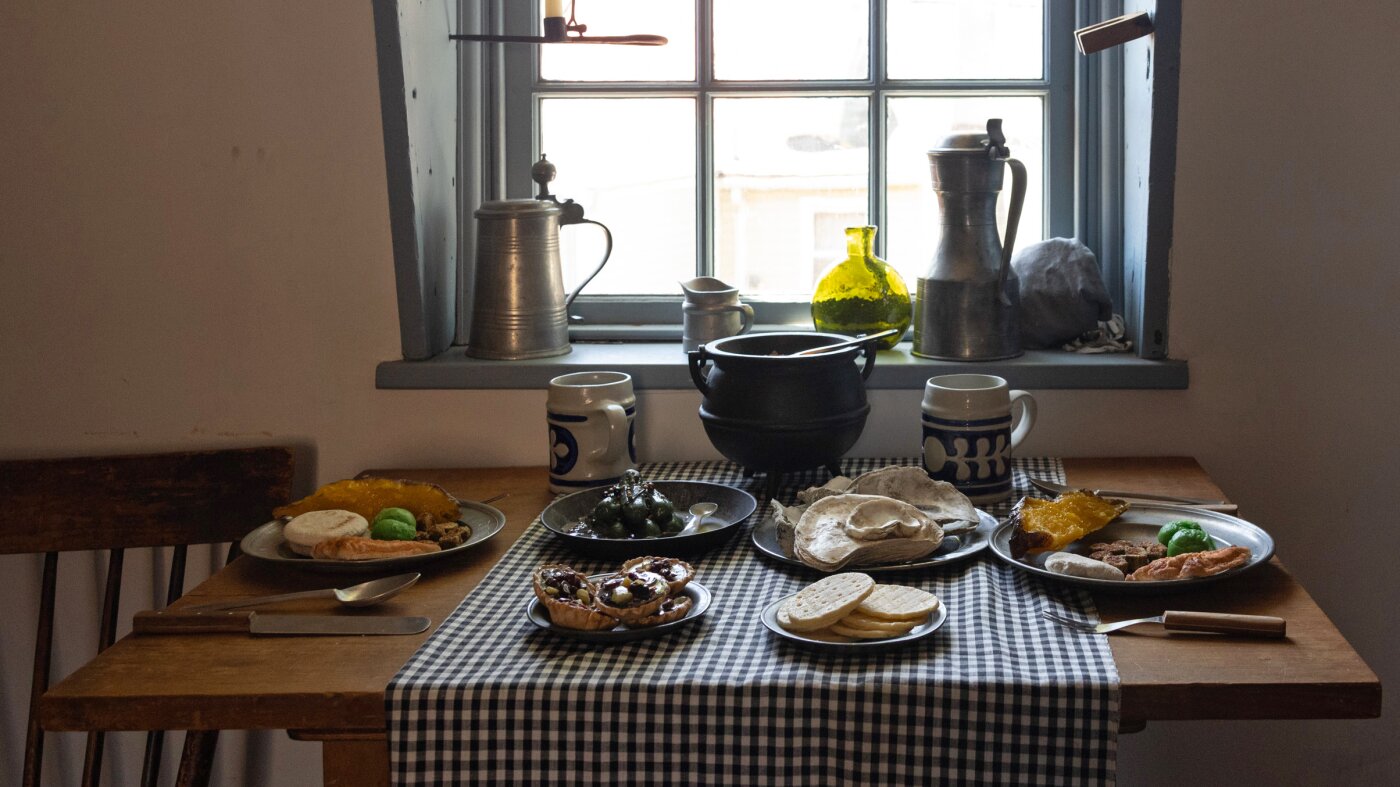
A table setting depicting a typical working-class meal in 18th century Annapolis is displayed at Hogshead Trades Museum in Annapolis.
Anna Rose Layden for NPR
hide caption
toggle caption
Anna Rose Layden for NPR
Buried in a row of tightly constructed homes on the historic Pinkney Street in Annapolis, a clear contrast from the large brick homes and lavish gardens a street over at the Paca House, Connett opens the door to the Hogshead Trades Museum.
The house depicts how average folk would live, she said. These working-class people were eating a lot of the same food as the wealthy, but without the processed and glamorous aspects like white flour or sugar.
Ironically, “poor people were eating the stuff that now people are paying a lot of money to have,” Miller said, referencing the current movement against heavily processed foods. They would also be eating more pork, ham, bacon and sausage, liver pudding and offal.
Near the docks of Annapolis, Middleton’s served as a popular meeting place for merchants and sailors needing refreshments after their arduous journeys, according to White. A Maryland Gazette advertisement from 1752 shows the tavern sold food imports like “Lisbon LEMONS,” “Sevil ORANGES” and “Jamaica LIMES.”
Taverns served as social and political centers and provided lodging for exhausted travelers.

A replica of a bean stew is displayed at Hogshead Trades Museum.
Anna Rose Layden for NPR
hide caption
toggle caption
Anna Rose Layden for NPR
Depending on the tavern, the food could vary from moldy cheese, soup and corn cakes to more luxurious options. It’s “the difference between going to a very high-class hotel restaurant today as compared to going to a McDonald’s or TGIF,” White said about the difference in taverns.
In terms of drinks, colonists didn’t have ways to purify their water, so people drank small beer or weak wine, Miller said.
“The amount of alcohol that was consumed at this time is staggering,” Miller said. “They were very open about how much they were drinking.”
American food, then and now
Miller sees the American palate as more international today than it was 250 years ago. “In 1776, it was very much European based … but now we’re just eating stuff from all over. We really have a world on the plate.”
Back at Middleton Tavern, rumors swirl about the Founding Fathers once enjoying oysters at the bar.

Arthur Gross laughs as he thinks about food from 250 years ago.
Anna Rose Layden for NPR
hide caption
toggle caption
Anna Rose Layden for NPR
Gross, the chef of 50 years, tries to keep himself from thinking too much about the past. Like many chefs before him, he’s dealing with the present — procuring the tavern’s supply of food for the coming days.
“I come in here almost every day, and the building is just old,” Gross said, laughing.
Source link