Marketing Technology Stack: Tools & Examples

A marketing technology stack is the set of tools your business uses to plan, create, publish, manage, and measure marketing campaigns. For small businesses, a practical martech stack usually includes tools for business email, project management, email marketing, lead capture, landing pages, social media scheduling, SEO research, content publishing, and design.
The best marketing technology stack depends on your goals, budget, team size, and marketing channels. A local service business may only need email, a simple website, social media scheduling, and a CRM, while a content-led business may need SEO research, blog publishing, design tools, and project management software.
I built this small business marketing technology stack around affordable, beginner-friendly tools that support the main jobs most marketing teams need: creating campaigns, capturing leads, publishing content, managing projects, and tracking results.
This starter marketing technology stack costs nearly $270 per month if you use each tool’s paid starter plan. You can reduce the cost by starting with free plans, free trials, or free tools in categories where you do not need paid features yet.
To build this marketing technology stack, I evaluated tools that support the core marketing tasks most small businesses need: collaboration, project management, social media scheduling, email marketing, lead capture, landing pages, SEO research, content publishing, and design.
I prioritized affordable tools with free or low-cost starter plans, beginner-friendly setup, useful integrations, and enough features to support growth. I also considered whether each tool solved a distinct marketing need, so the stack would reduce manual work instead of adding more disconnected software.
I’ve spent the past decade working in digital marketing for retail and ecommerce businesses, creating websites, building social media campaigns, and helping brands grow their online presence. Alongside hands-on testing, I also draw on more than a decade of ecommerce and retail experience, including work with Amazon and Shopify. I regularly evaluate marketing and ecommerce tools for Fit Small Business, and all my recommendations follow Fit Small Business’ strict editorial standards and are tested, verified, and scored using the full methodology below.

Retail Software Expert at Fit Small Business
Best marketing technology stack tools compared
What should be in a marketing technology stack?
A marketing technology (martech, in short) stack should include tools that support how your business attracts, converts, and retains customers. At a minimum, most small businesses need tools for collaboration, content creation, lead capture, email marketing, landing pages, social media, and reporting.
You do not need to buy every category at once. Start with the tools that support your current marketing goal, then add more as your campaigns, channels, and team grow.
Google Workspace: Best for collaborating with teams

Pros
- Easy to use, reliable, and takes about 10 minutes to set up.
- The only business email platform (so far) with real-time collaboration on documents. You can collaborate on projects with teammates in real time.
- It’s entirely cloud-based, so documents save automatically.
Cons
- Its email tools are mostly basic, with no advanced email automations beyond scheduled emails, for example.
- Storage can fill up pretty easily, especially if you’re only on the Business Start plan. You only get up to 30GB for email and cloud storage.
No platform defines business email and productivity like Google Workspace (except perhaps, some would argue, Microsoft 365). But it’s long been our top business email provider for small businesses because it offers all the productivity essentials: documents, spreadsheets, presentation decks, and video conferencing — all while being super easy to set up and use.
Google Workspace is also entirely cloud-based, so it’s ideal for remote teams or for those who are always on the go. Plus, one thing I’ve always found especially helpful is Google Workspace’s auto-saving feature, which saves all your documents to the cloud as you work, so nothing ever gets lost. Also, if you already have a free Gmail account, upgrading to more efficient tools to run your business is easy.
If your team is growing and you’re looking to upgrade to a more efficient collaboration platform, Google Workspace is the best choice.
Standout features: An email platform, an email address with a custom domain for you and your team, cloud-based documents, presentations, and spreadsheets, video conferencing, and real-time collaboration
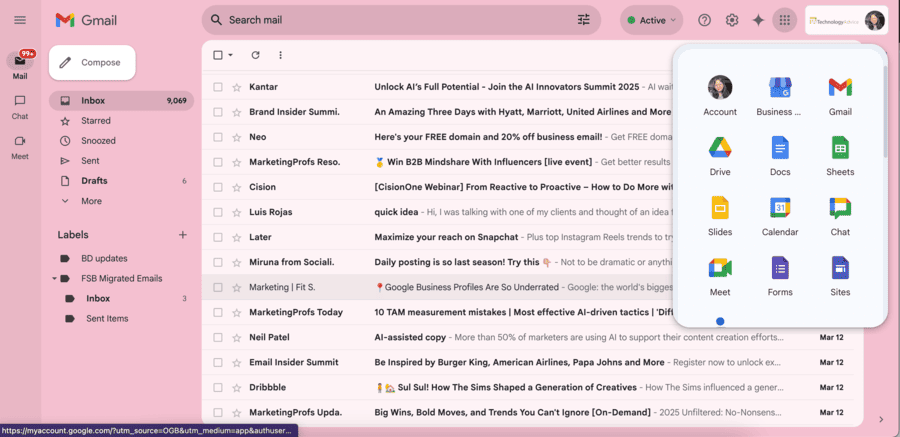
Google Workspace gives you a business email platform and easy real-time collaboration. (Source: Google Workspace)
monday.com: Best for managing projects efficiently

Pros
- Gives an at-a-glance view of all your projects for the month, year, or custom time frame.
- Automation makes projects flow seamlessly by automatically notifying team members of project updates.
- Monday’s project management platform is customizable to your business’s exact needs.
Cons
- There are limits on the number of custom automations you can build.
- Glitches happen on the platform from time to time, and sometimes all you can do is wait them out.
- Building custom boards and automation workflows takes time and effort and isn’t always seamless.
The main benefit of monday.com is its workflow automations that automatically move tasks to different teams’ boards once you update them to a certain status. This is especially helpful if you’re working with a large team (or even multiple teams).
You can also customize monday.com’s automation settings to your team’s needs. For example, at a media publishing company, I worked for used monday.com to organize our content workflows, and once they’re marked “Ready to Upload” in the status column, they’re automatically moved to the website team’s board.
What makes monday.com different from other project management tools like Asana and ClickUp is that it gives you an overview of all your tasks on your board and their statuses, which you can customize to your particular needs.
On the negative side, with monday.com, all your boards are interconnected, sometimes making it difficult to work on your own tasks without accidentally moving something on someone else’s board. In a sense, everything you work on must belong on a board, or it simply doesn’t exist.
monday.com gives each user a “My Work” board for items assigned to or by them. But after using monday.com for nearly a year, I have yet to use this space. In my experience, the more complex your team’s boards, processes, and automation workflows are, the less helpful “My Work” is. Instead, I built a personal dashboard that uses widgets to keep me organized (but even that required significant setup time).
Overall, monday.com’s priority levels for each task, progress bars, and customizable views for each user mean everyone can work how they like. It’ll make a good addition to your tech stack once you have a larger team and need a tool to organize your marketing processes and workflows.
Standout features: A lead management platform, automated lead workflows, lead capture forms, and lead nurturing emails
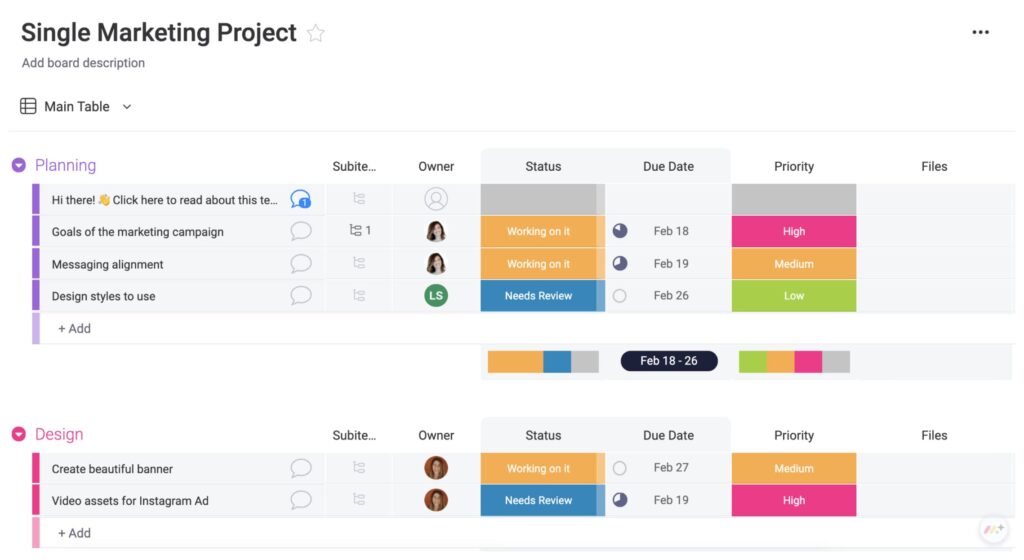
Monday lets you organize projects across teams. (Source: Monday)
Later: Best for social media planning and scheduling
Pros
- Combines social media content calendar planning and post scheduling in one platform
- Easy to set up and use, even for beginners
- Fits small businesses, influencers, creators, and social media managers
Cons
- No free plan, only a 14-day free trial
- Social inbox support is limited compared with broader social media management platforms
- More advanced analytics, brand monitoring, and social listening tools require higher-tier plans
Since our last update: Later has rebranded and expanded its positioning beyond social media scheduling. The company now presents itself as an influencer marketing company while still keeping social media scheduling, publishing, and analytics as core tools for social media managers. Later’s rebrand also emphasizes creator campaigns, influencer marketing, and its Mavely creator marketplace, making the platform a broader fit for brands working with social content, creators, and influencer-led campaigns.
Later marries social media scheduling with content planning, which is why it’s my top pick if you’re only adding one social media scheduler to your marketing technology stack. Its best feature by far is its content calendar that lets you plan social content weeks ahead and see everything at a glance, a lifesaver for any social media manager (and much easier to use than Meta Business Suite).
Aside from scheduling social content, there’s also a unified inbox so you can respond to messages and comments from the platform just as easily. However, this is only available for TikTok and Instagram messages, which is the biggest drawback compared to platforms like Sprout Social and Hootsuite.
However, Later Social continuously adds new features to adapt to social media trends. For instance, it has a link-in-bio mini site builder, an influencer management platform, and a creator community, all of which are relevant.
Standout features: A social media content calendar, automatic scheduled posting across multiple platforms, a message inbox, post analytics, social listening, a link-in-bio site builder, influencer management platform, and creator community
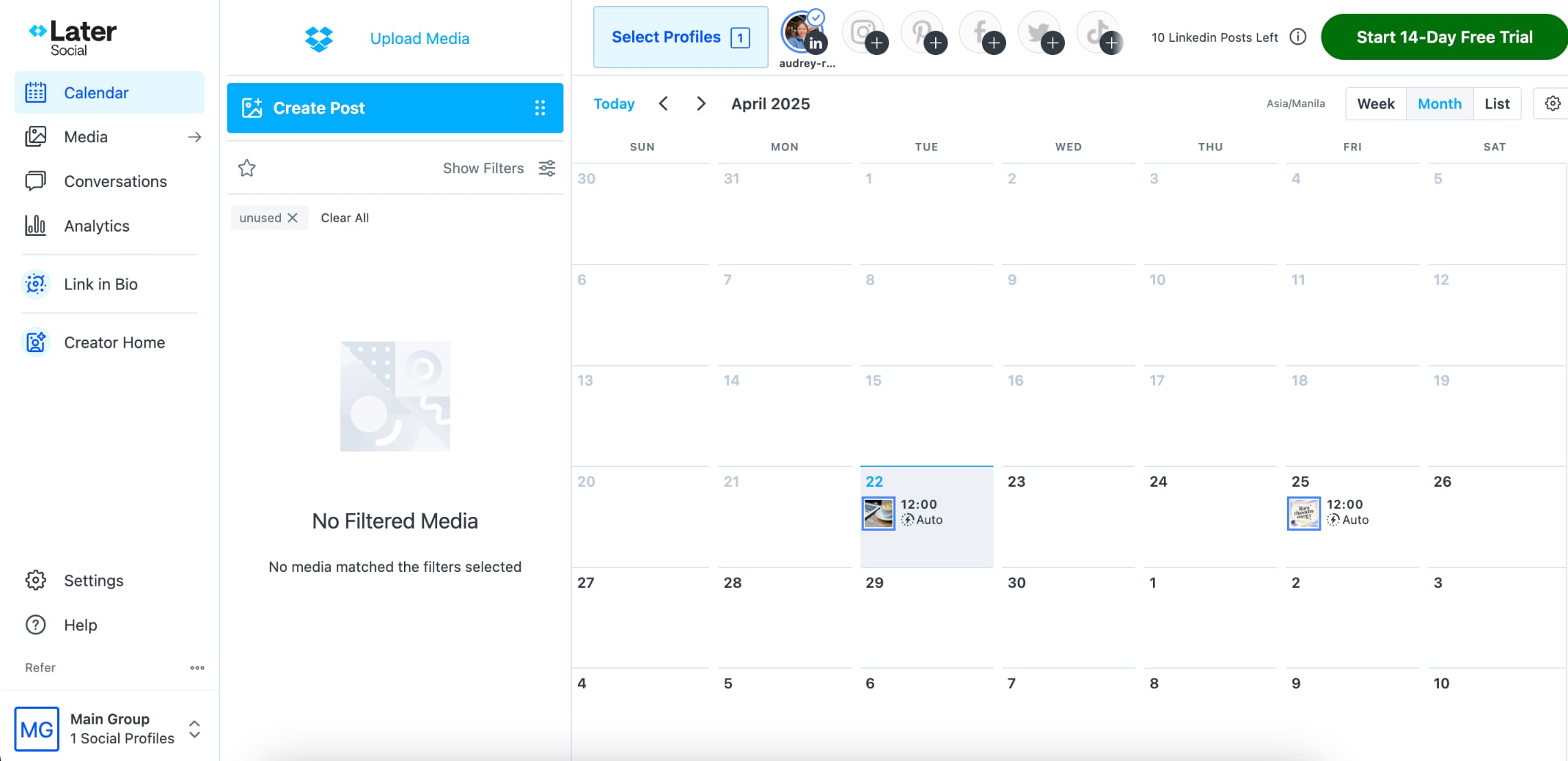
Later Social lets you plan your social media content calendar and schedule posts in advance. (Source: Later Social)
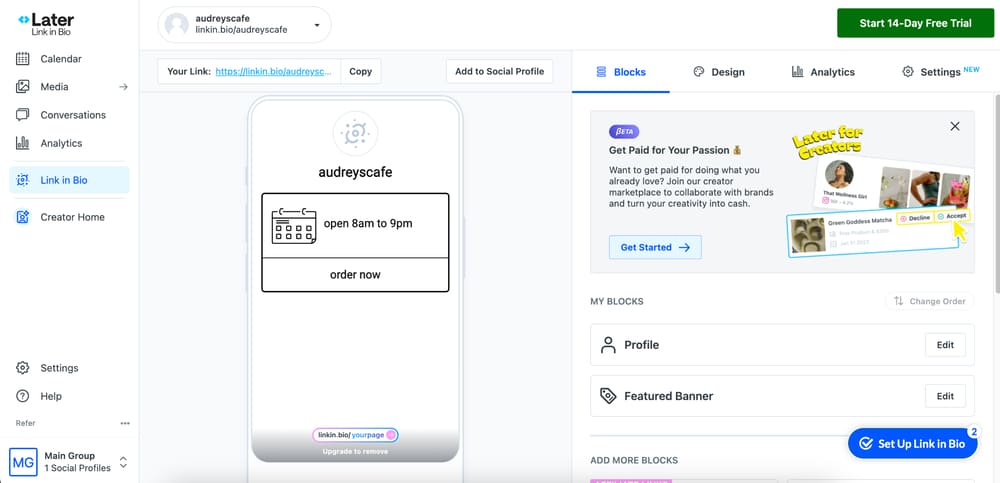
My other favorite feature is the link-in-bio mini site builder. (Source: Later Social)
Mailchimp: Best for engaging, multi-touch email campaigns

Pros
- Mailchimp is easy to set up and navigate, and has all the necessary tools to build professional email campaigns.
- It offers small-business-friendly plans. The free plan includes 500 emails per day, and prices increase as your contact list grows.
- It’s one of the most reliable email platforms I’ve used. It also has a built-in audience platform that shows your recipients’ information and activity.
Cons
- Using Mailchimp’s templates can make your emails look generic and unmemorable.
- While there’s a free plan, you can’t schedule emails on it — scheduling is only available on paid plans.
I’ve tried many email marketing platforms, but my main constant has always been Mailchimp. It’s one of the first platforms I tried when I started email marketing, and it’s still the most reliable one I recommend to most small businesses who want a simple, no-fuss email marketing platform to send mass marketing emails to multiple contacts or segmented lists (instead of one by one like Gmail).
Mailchimp has a free plan that can send up to 500 emails a day to the same number of contacts, which is just enough to start building an engaged email audience. It’s also easy to create email campaigns with the drag-and-drop builder, and you can easily use dozens of templates for professional-looking emails.
Mailchimp also lets you build automated email campaigns, say for cart abandonment or new client welcome emails. What I also like about Mailchimp is that it makes all these tasks easy. Even beginners can build professional, customer-ready email campaigns, see their results, and optimize future messages.
Standout features: An email campaign builder and scheduler, an audience management platform, campaign sign-up forms, email analytics (clicks, opens, and conversions), and a creative assistant for building branded emails
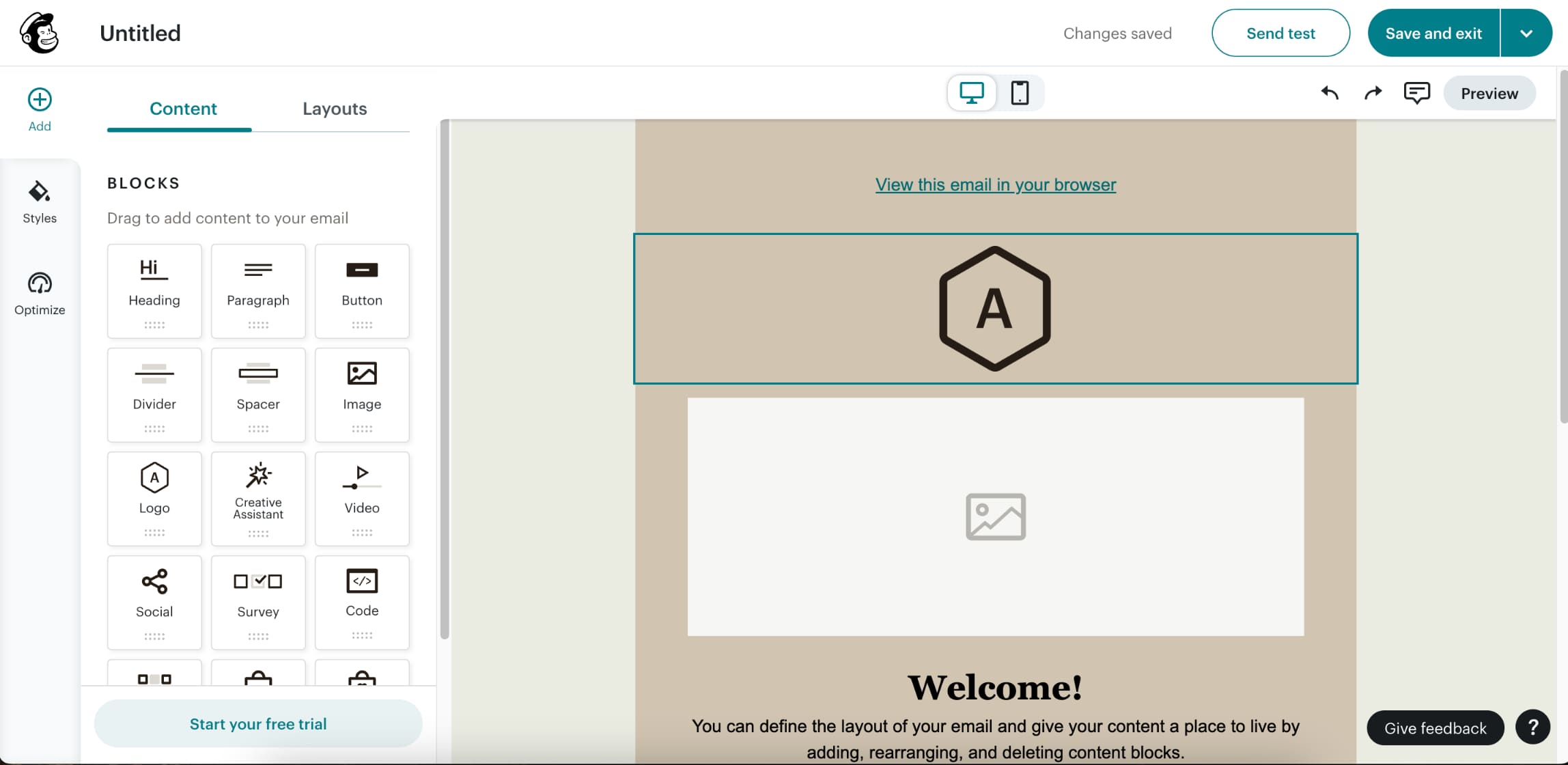
Mailchimp’s drag-and-drop email builder makes it easy to build campaigns. (Source: Mailchimp)
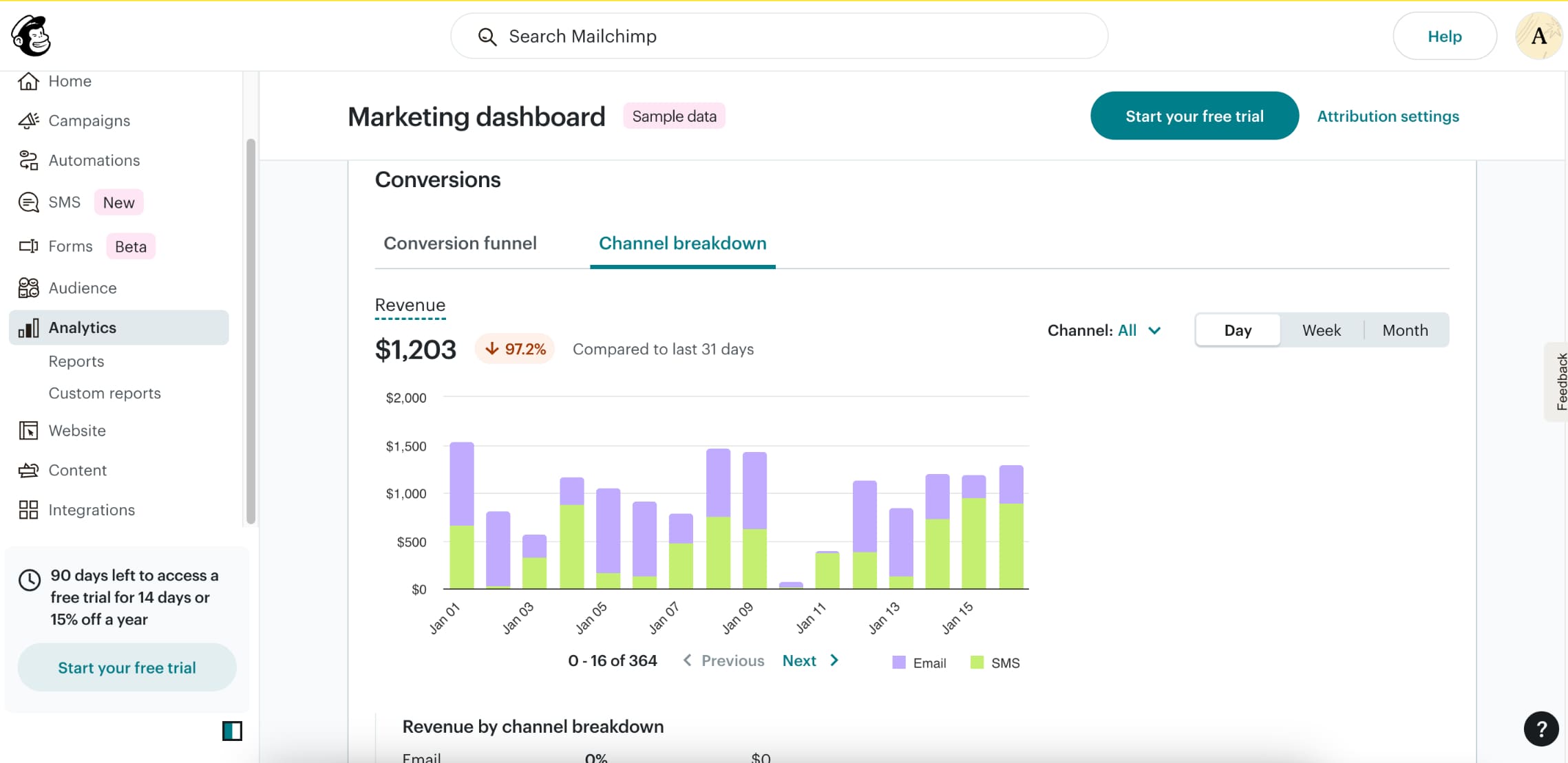
Another thing I like about Mailchimp is that it doesn’t just give open and click rates but also conversions and revenue. (Source: Mailchimp)
HubSpot: Best for capturing and nurturing leads
Pros
- Hubspot offers many tools in one platform, including lead capture forms and a contact management tool, for free.
- Forms you build using HubSpot can be easily shared on your website, online store page, or social media profile.
- HubSpot also has automation workflows for nurturing leads, including sending trigger-based marketing emails.
Cons
- The lead-nurturing workflows are only available on paid plans from $15 per month.
- Having so many tools (and constant updates) sometimes makes HubSpot difficult to navigate.
Every good martech stack has a reliable platform for capturing and nurturing leads, aka people who are interested in your business or have heard about it but haven’t yet become customers.
HubSpot has long been one of the best martech companies in that regard. It works for almost any type of business and has an intuitive interface that shows all your leads along with their information and status.
Plus, HubSpot has lead workflows, which are significant time-savers if you have a small but agile team. These workflows can automatically send lead-nurturing emails and alert your team if a lead performs an action like opening a link or completing a purchase.
It’s especially helpful if you have a large volume of leads and don’t have the time to build and send email campaigns to them all. Plus, HubSpot can send more personalized emails to each prospect based on their past behavior.
HubSpot also has tools for building lead capture forms to place on your website or social media pages, all in one platform. What makes it different from regular landing page builders like Wix is that it automatically sends leads to the built-in HubSpot CRM platform along with their information and behavior. While it may take some exploring to get the hang of it, it’s one of the best AI-powered marketing tools to add to your stack.
Standout features: A lead management platform, automated lead workflows, lead capture forms, and lead nurturing emails
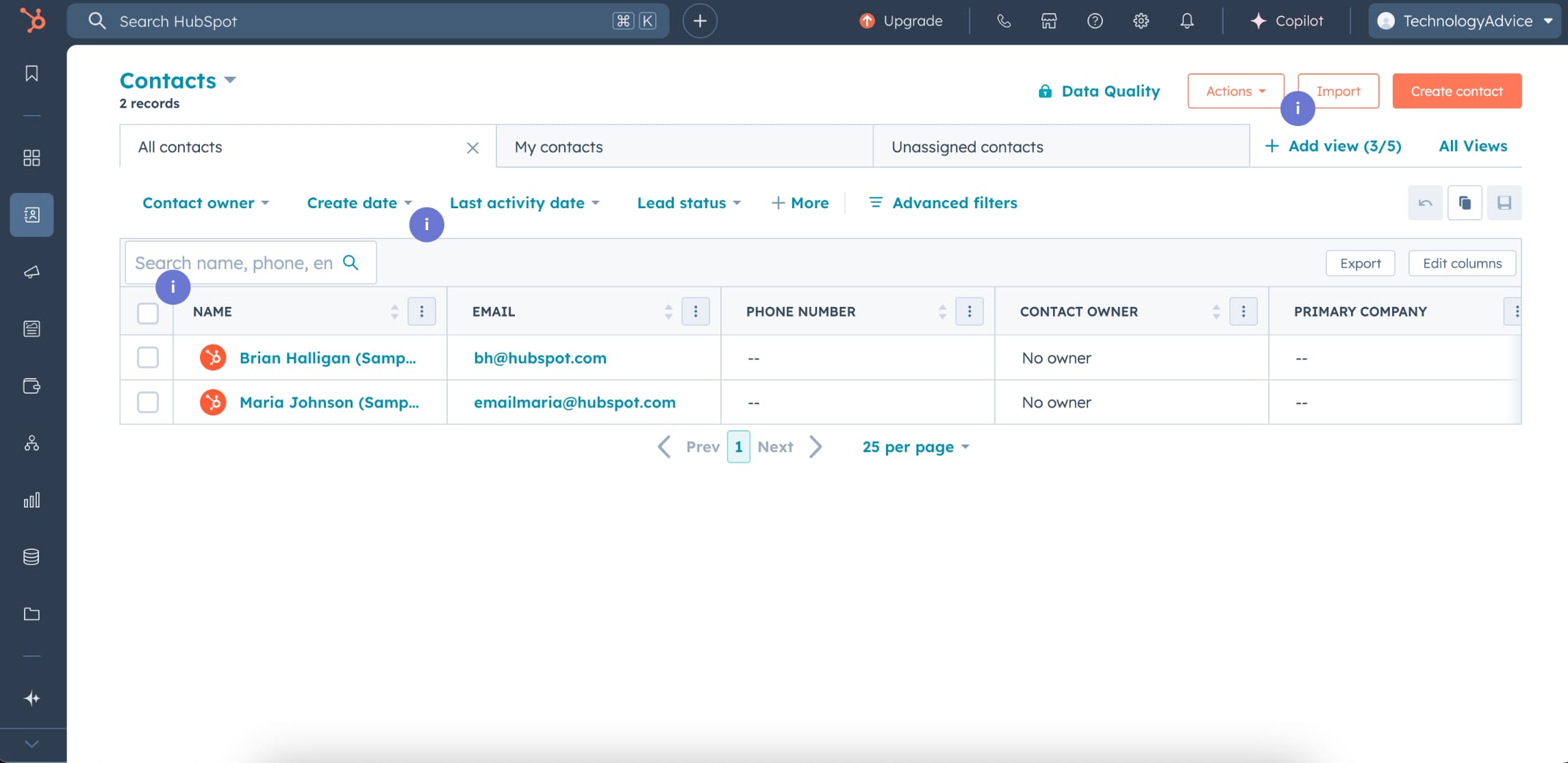
HubSpot’s contact management platform shows all your leads along with their information and activity. (Source: HubSpot)
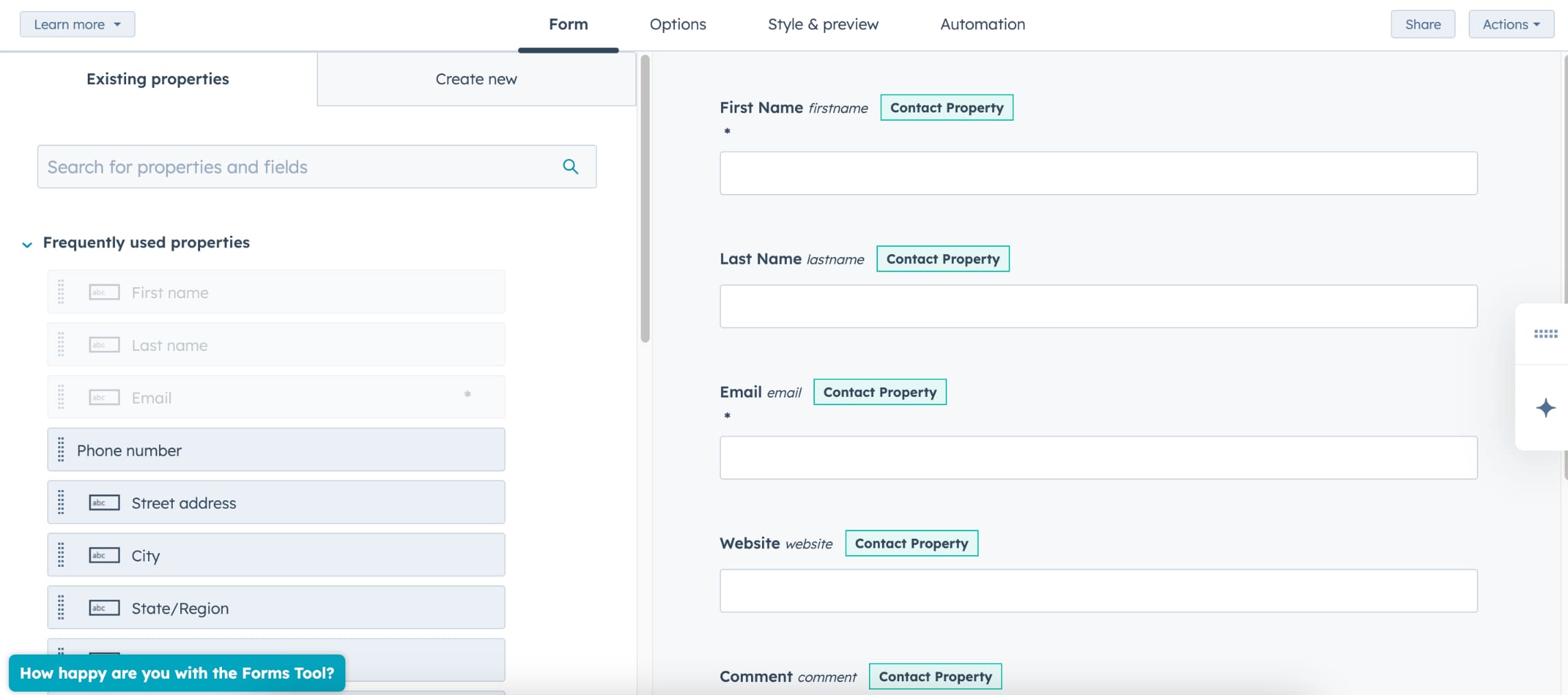
HubSpot also has a form builder for capturing leads. Use them to generate leads from your website, online store, or social media pages. (Source: HubSpot)
Wix: Best for building landing pages

Pros
- You can build as many landing pages as you want for free, from newsletter sign-up to app download pages.
- It’s intuitive and beginner-friendly — no coding necessary.
- It offers plenty of design freedom, so you can make your landing pages as unique, creative, and customized to your brand as you want.
Cons
- Wix, unfortunately, does not build pop-up messages (although it can build non-indexed landing pages).
- You can build unlimited landing pages on the free plan, but they’ll all have a Wix subdomain (yoursite.wix.com).
Wix is my go-to website and landing page builder, whether I’m creating a landing page for a Facebook ad campaign or a creative portfolio. It’s always my first recommendation for small businesses and creators because the platform is easy and intuitive without sacrificing essential features or good design.
It’s also free to make as many landing pages as you want, which is handy if you plan to build many digital marketing campaigns (or already do) but don’t want your landing pages indexed with your main website.
For example, let’s say you use WordPress for your main website. You can use Wix to build landing pages for your Google Ads campaign, sign-up forms, or app download badge, on a domain that won’t be connected to your main website.
It can even build your one-page portfolio if you want to promote your services or previous work. Wix also allows complete design freedom, so each landing page can be as unique and customized as you need.
Standout features: A drag-and-drop and AI website builder, over 50 landing page templates, plenty of design customization
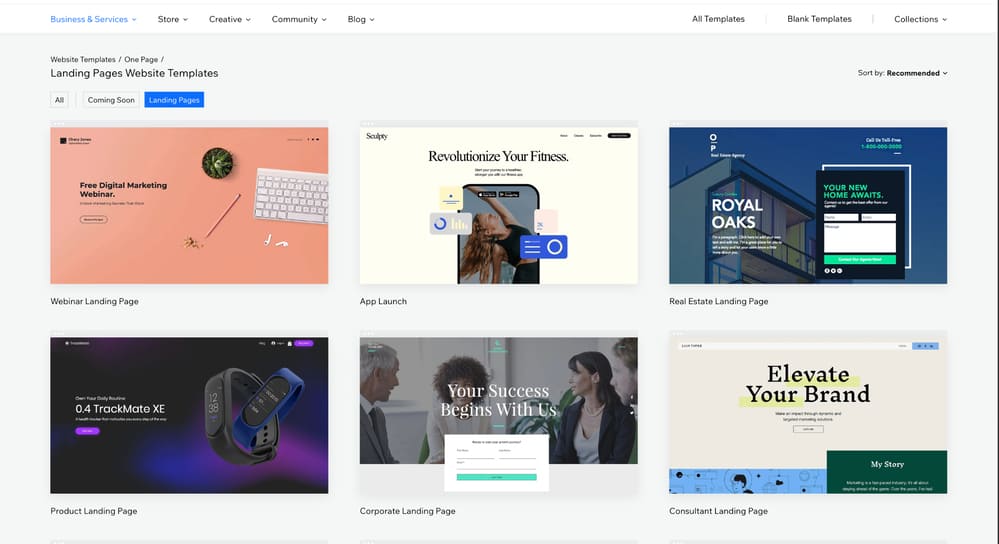
Wix is one of the most intuitive landing page builders, and it has many templates for various objectives and business types. (Source: Wix)
Semrush: Best for content planning and research

Pros
- Combines SEO research, competitor analysis, content planning, site audits, and AI visibility tracking
- Offers a free account with limited access to SEO, AI visibility, keyword, backlink, and site audit tools
- Useful for keyword planning, competitor research, content strategy, and website health audits
Cons
- Paid plans are expensive compared with many small business SEO tools
- Has a learning curve if you are new to SEO, content strategy, or AI visibility tracking
- The free account has tight daily limits, so active SEO teams will likely need a paid plan
Since our last update: Semrush launched Semrush One, a product line that combines traditional SEO tools with AI search visibility tracking. This matters because marketers now need to understand how their brands appear in Google, AI Overviews, ChatGPT, Perplexity, Claude, and other AI-driven search experiences, not just standard search results. Semrush One includes tools for SEO research, keyword tracking, site audits, competitor insights, AI visibility reports, AI brand performance, and AI-ready site audits.
If you want to get your website ranking on Google, the best way is through an SEO content strategy, which is where Semrush can help. It has the most extensive suite of SEO tools, including a keyword researcher, website traffic checker, and even a blog content planner.
You’ll need some basic SEO know-how to get the most out of the platform, but compared to other SEO tools I’ve used, including Ahrefs and SimilarWeb, Semrush has been the most useful as it covers both the planning and analysis parts of SEO.
You can even subscribe to specific Semrush tools based on your content’s needs. For example, Semrush’s Keyword Magic Tool suggests hundreds of keyword combinations from one keyword, while the Traffic Analytics tool compares your website traffic with competitors.
If you’re only adding one SEO tool to your toolbox, this is the one I recommend. Semrush is used by many marketers worldwide (myself included) and is invaluable if you have a website and want it to be found by your target audience. It can help you navigate the best way for your website to be found online.
Standout features: A keyword researcher and keyword recommendations, a website audit tool, website health analysis, and a content marketing planner
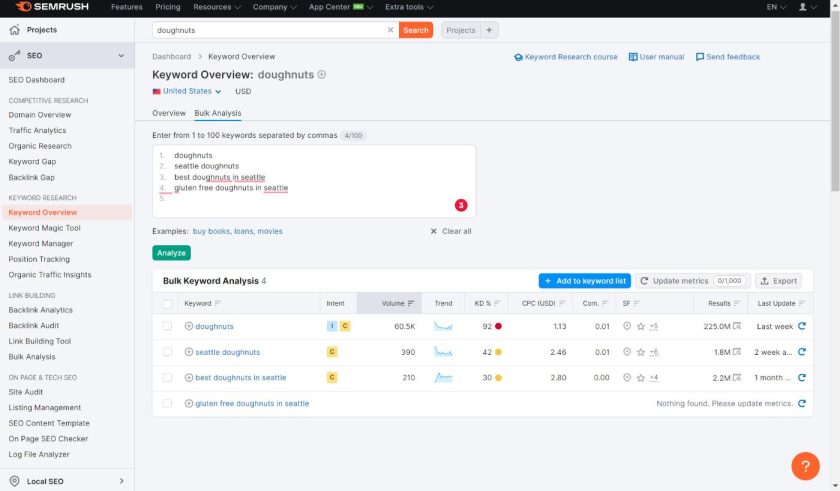
I’ve always found Semrush helpful in planning the best keywords to add to website content and analyzing competitors’ keywords. (Source: Semrush)
WordPress: Best for blog content that builds brand awareness

Pros
- Designed specifically for bloggers, its content management system is the industry standard.
- The free plan lets you publish unlimited blogs (although on a WordPress subdomain). Upgrading to a custom domain costs just $4 a month.
- SEO tools are native to the platform, including keywords, titles, descriptions, and custom slugs.
Cons
- It requires building a website before you can publish blogs, which is not ideal if you already have a website for your business.
- SEO tools and analytics are only available on paid plans.
WordPress is still the industry leader for content websites and lets you publish unlimited blogs, even on the free plan. You can also customize your blog’s look and style to match your brand, or use one of WordPress’s blog templates, all of which have a variety of modern, eye-catching designs.
WordPress’s content management system also makes it easy to optimize your blog’s SEO through keywords, titles, and meta descriptions, which are necessary if you have a content marketing plan. You can also see all your blogs at a glance and how much traffic they get, allow comments and discussion forums, and even accept payments and donations.
WordPress will go hand-in-hand with Semrush if you use blogs to grow your brand credibility. Use Semrush to research your keywords and plan your blogs, then publish them on WordPress.
Standout features: A blog publisher, a content management system, blog keywords, and hundreds of blog templates
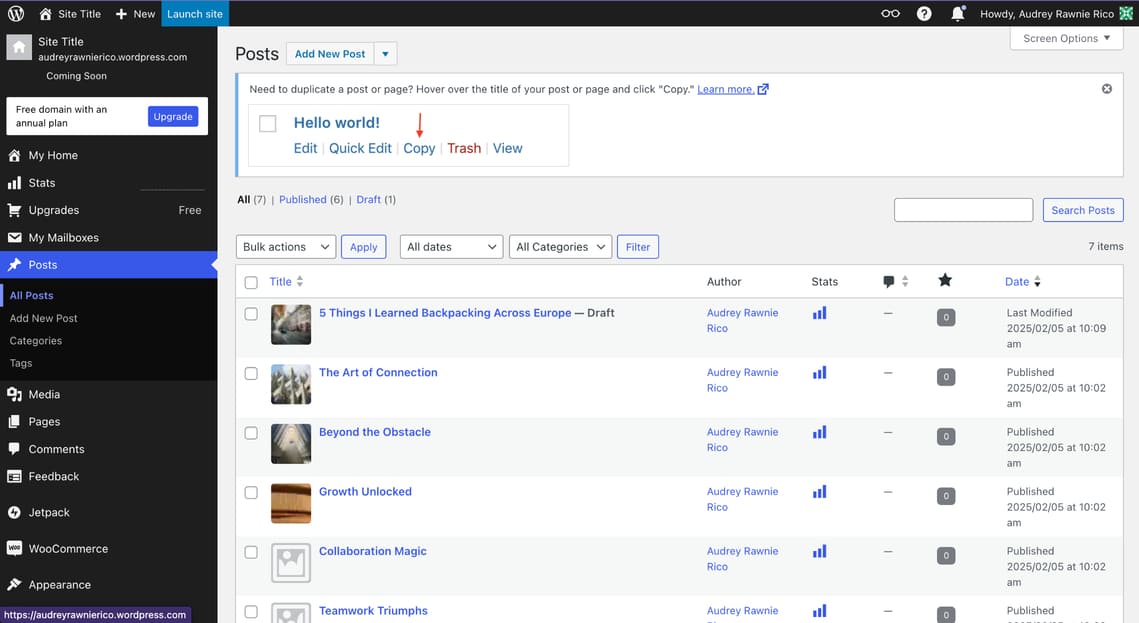
WordPress’s content management system is still the best in the industry and is ideal for publishing many blogs. (Source: WordPress)
Canva: Best for designing content and brand assets

Pros
- It’s an easy and (mostly) free way to design hundreds of marketing materials.
- The brand kit is super helpful for designing branded materials efficiently.
- There are templates for every marketing material imaginable, from presentation decks to infographics to email headers.
Cons
- Canva’s designs can tend to be generic, and its better-designed templates are locked behind paid plans.
- Editing tools can be basic (no image editing or collage-making tools).
- Limited design freedom because you can only use the available tools and templates.
Canva makes design easy and accessible to everyone, even if you don’t have design experience. There are thousands of templates for just about any design or marketing material you’ll need, from business cards to Instagram Stories.
The Brand Kit is invaluable as it stores all your brand assets (logos, colors, fonts, and so on) to make it easier to design branded materials in the future. One notable drawback with Canva is that, because many other people also use it, there’s a chance your designs won’t be entirely unique. I recommend taking the extra time to customize your designs to make them stand out.
Others on my team have reported experiencing a lot of difficulty editing videos for social and even static designs on the mobile app. The video editor isn’t very intuitive (especially when you’re overlaying text), and many of the best design elements are locked behind paid plans. Overall, it’s very easy to move something out of place when selecting small elements, making for a lot of zooming in and out.
Still, Canva’s an invaluable resource in your tech stack. It’s a simple and efficient way to create well-designed content. I just highly recommend using it on your laptop for bigger projects.
Standout features: An online drag-and-drop design platform, design templates for thousands of marketing materials, AI design generators and editors
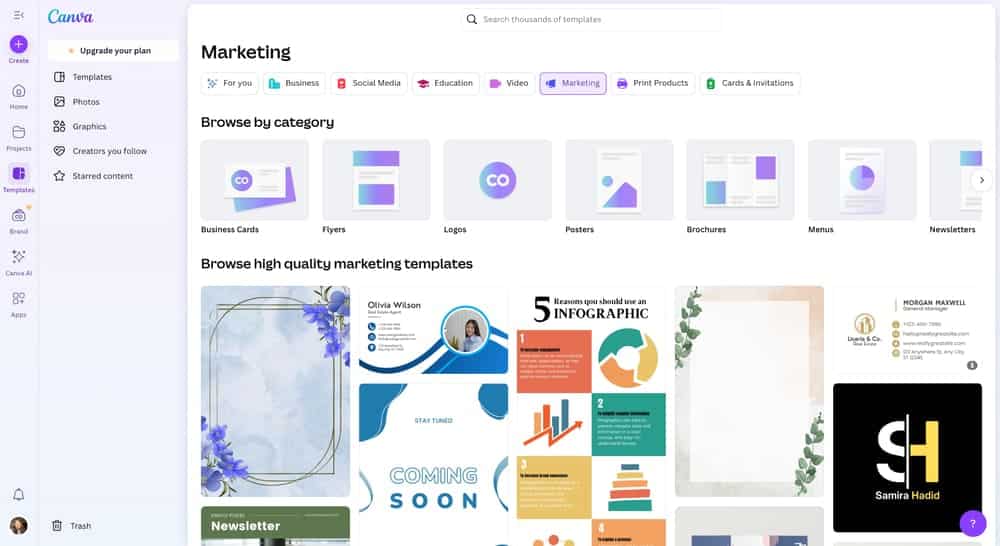
Canva has templates for almost every material you can think of. (Source: Canva)
Methodology: How I evaluated the best marketing technology stack tools
To build this marketing technology stack, I evaluated tools that cover the core marketing jobs most small businesses need: collaboration, project management, social media scheduling, email marketing, lead capture, landing pages, SEO research, content publishing, and design.
I prioritized tools with free or affordable starter plans, beginner-friendly setup, useful integrations, and enough features to support a growing business. I also considered whether each tool solved a distinct marketing need, since a practical martech stack should reduce manual work rather than add more disconnected software.
I scored the tools using the following criteria:
- Value for money: Different platforms have different plans and prices, so I made sure all of them offered good value for your money and let you access essential features on the free or starter plans.
- Marketing usefulness: All the platforms in this guide can help market your business, whether through maximizing your team’s productivity, creating and publishing content, or capturing and managing leads. Many of them are also used by many marketing teams around the world.
- Ease of use: Your team won’t have all the time in the world to learn how to use tech platforms, so I specifically looked for beginner-friendly tools that won’t be a pain to set up.
- My expert opinion: I’ve also personally used or at least tested all the platforms above to prove they can live up to their claims and effectively support small business marketing teams.
How to build a marketing technology stack
To build a marketing technology stack, start with your business goal, then choose only the tools needed to support that goal. A local business focused on visibility may need a website, email marketing tool, social media scheduler, and design platform, while a lead generation business may need a CRM, landing page builder, email platform, and reporting tools.
- Define your main marketing goal. Decide whether you want to generate leads, increase local awareness, grow ecommerce sales, improve customer retention, or publish more content.
- Choose your core marketing channels. Focus on the channels you will actually use, such as email, social media, SEO, paid ads, landing pages, events, or referrals.
- Match each channel to a tool category. For example, email needs an email marketing platform, SEO needs keyword research software, and lead generation needs a CRM or form builder.
- Start with free or low-cost plans. Use free plans and starter tiers until you know which tools your team uses consistently.
- Check integrations before you commit. Your CRM, email platform, website, analytics, and project management tools should work together without manual data entry.
- Assign an owner for each tool. One person should be responsible for setup, permissions, data quality, workflows, and cleanup.
- Review the stack every quarter. Remove tools you do not use, upgrade only when a limit blocks growth, and check whether each platform still supports your current goals.
When you do not need a full martech stack
You may not need a full martech stack if your business only uses one or two marketing channels. For example, a solo consultant may only need Google Workspace, a simple website, and an email marketing tool, while a local shop may only need Canva, a social media scheduler, and a basic email list.
Avoid adding tools just because they are popular. A larger marketing technology stack can create duplicate contacts, messy reporting, unused subscriptions, and extra admin work. Add a new tool only when it solves a clear problem, such as capturing leads, scheduling social posts, sending email campaigns, researching keywords, or managing campaigns across a team.
Frequently asked questions (FAQs)
A marketing technology stack is the set of software tools a business uses to plan, create, publish, automate, and measure marketing campaigns. A small business stack might include tools for email marketing, CRM, landing pages, social media scheduling, SEO, project management, and design.
A small business marketing technology stack can cost $0 if you use free plans, but a paid starter stack often costs between $50 and $250 per month. Costs increase when you add more users, contacts, automation, reporting, storage, or advanced integrations.
The best marketing technology stack for small businesses is one that matches your goals and budget. For many small teams, a strong starting stack includes Google Workspace, monday.com, Later Social, Mailchimp, HubSpot, Wix, Semrush, WordPress, and Canva.
Build a martech stack on a budget by starting with free plans, choosing tools that serve more than one purpose, and adding paid plans only when you hit a real limit. Prioritize the tools tied to revenue or growth first, such as your CRM, website, email marketing platform, and lead capture tools.
A martech stack includes the tools used to run marketing campaigns, such as email, CRM, social media, landing pages, content, and design software. A marketing data stack focuses on collecting, storing, cleaning, analyzing, and reporting marketing data from different systems.
A startup martech stack should usually include a CRM, landing page builder, email marketing platform, analytics tool, project management software, and design platform. Startups focused on content or inbound leads should also add SEO research and blog publishing tools.
A local business martech stack should include a website or landing page builder, business email, email marketing software, social media scheduling, design software, and tools for local SEO or review management. If the business collects leads, it should also use a CRM.
Bottom line
A marketing technology stack does not need to be expensive or complicated. Start with the tools that support your most important marketing goal, such as lead generation, local visibility, ecommerce sales, or content growth. Then add software only when it solves a clear problem or saves your team time.
For most small businesses, the best starting point is a practical stack that covers collaboration, project management, email marketing, lead capture, landing pages, social media, SEO, content, and design without going over budget.
Source link