DNA links a soldier from the Revolutionary War to his living relatives : NPR
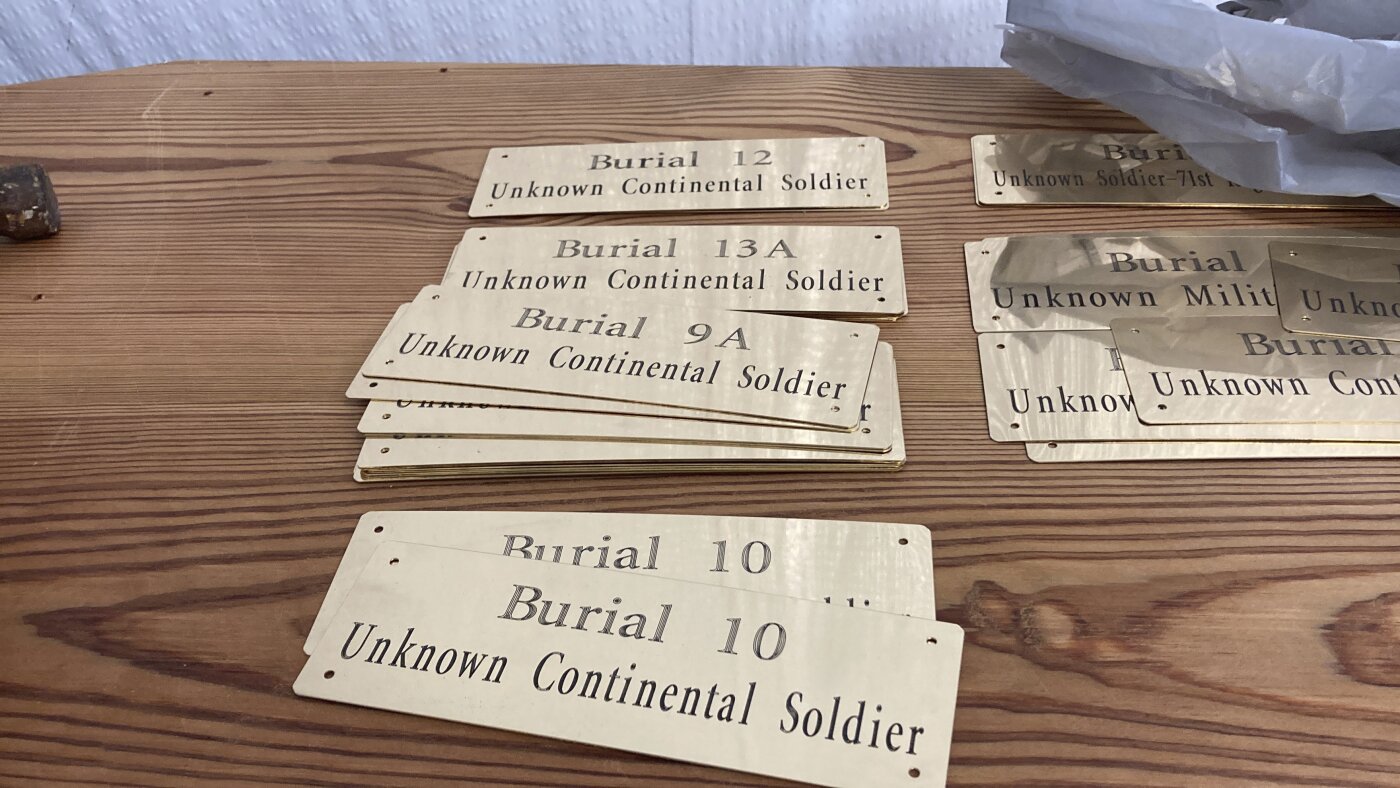

Plaques to help identify 14 unknown soldiers who were found at the site of the Battle of Camden and are being reburied are seen on Thursday, March 30, 2023, in Columbia, South Carolina. DNA analysis has recently identified one of them.
Jeffrey Collins/AP
hide caption
toggle caption
Jeffrey Collins/AP
After enlisting as a teenager in the 7th Maryland regiment of the Continental Army in January 1777, Pvt. John Pumphrey marched hundreds of miles through early American history. Records show he took part in the battles of Brandywine and Germantown in Pennsylvania and the battle of Monmouth in New Jersey. He spent two brutal winters encamped at Valley Forge and Morristown before heading into the deep South to face the British once again.
The Battle of Camden, in August 1780, would be his last. Pumphrey was felled there by a British musket ball, his body left to lie in a shallow grave in South Carolina. Then, in 2022, archaeologists from the University of South Carolina uncovered his skeletal remains and submitted them for DNA analysis in hopes of discovering his identity.

When the results came back from a genome sequencing laboratory, they were handed off to FHD Forensics, a company that matches DNA with historical genealogy records to identify unknown human remains.
Among the many matches was 71-year-old Nancy White. When she was contacted about her distant relation, the news came as a shock, she says.
“This is absolutely a miraculous discovery for us,” says White, who lives on the Eastern Shore of Maryland. “We were told that the soldier would be our fourth great uncle.”
FHD President Allison Peacock says three different types of DNA analyses were used to cross-check results for Pumphrey, who she says likely died too young to have any direct descendants. She says her team were “blown away by the quality of [DNA] matches” they got — about 20,000 for modern relatives. White, who attended a news conference last week in Maryland announcing the find, was just one of hundreds of people who responded to emails she sent asking people to share their family trees and track down other information to help confirm results.
“It was definitely a collaboration,” Peacock says. “We even had family members that went to the archives and pulled records or pulled tax records for us.”
An unlikely soldier
White and her sisters had been investigating their family’s genealogy for years and had opted into a DNA database that allowed FHD to track them down. They were aware of the Pumphrey line in their ancestry, but also knew that branch of the family was Quaker, a Christian group historically known for pacifism. So when their research showed that a Pumphrey had fought in the Revolutionary War, they dismissed the idea that they might be related. “We … knew they were predominantly Quakers, and Quakers didn’t fight,” White says.
Pumphrey’s circumstances may have led him away from his pacifist roots, White says. He lost both parents as a child and enlisted as a young teen. “He and his siblings were orphans,” she says. “You know, you have a different feeling when you lose your parents. It’s just not the same.”
Pumphrey apparently saw the army as his home. He even re-enlisted — a relatively uncommon occurrence in the Continental Army, which was chronically short of manpower because farmer-soldiers often went home to tend crops, White says.
Peacock says to her knowledge, Pumphrey is the oldest John Doe ever identified with genetic genealogy. “We really assumed that with the genetic distance between the living people and the person that died, there’s so many extra generations in there,” she says. “We weren’t sure there was going to be enough DNA relatedness left to measure.”
Unearthing the battlefield
A total of 14 sets of remains were uncovered by James Legg, a USC public archaeologist, who led the excavation along with colleague Steve Smith. The site of the battlefield was well known, and Legg says the team referenced old reports of possible remains from relic hunters.
But it was the COVID-19 pandemic that prompted him to dig deeper — although as it turned out, the average depth of the graves was only about 14 inches. “I had nothing else to do, so I started doing a lot more metal detecting” on the battlefield along with Smith, he says. “We would get a reading, and it would be a musket ball or a button that ended up being a shallow burial.”

Forensic anthropologists, archeologists and volunteers prepare homemade coffins for the remains of unidentified Revolutionary War soldiers killed in the Battle of Camden in 1780 for reburial on Thursday, March 30, 2023, in Columbia, South Carolina. The remains were removed from the battlefield, studied and analyzed and will be buried in a ceremony.
Jeffrey Collins/AP
hide caption
toggle caption
Jeffrey Collins/AP
Legg says two sets of remains were actually sticking out of the ground. “That’s how shallow they were.”
The reason the graves were so close to the surface is because they were likely dug by Continentals taken by the British as prisoners of war, according to Rick Wise, the executive director of the South Carolina Battleground Preservation Trust, a nonprofit that helps protect, preserve and interpret the state’s historic military sites and battlegrounds. “There weren’t shovels,” he says. “They’re literally digging graves with their fingers and hands and maybe loosening the earth with a stick or something.”
Peacock is working on tracking down relatives for a second set of Camden remains – a soldier that she herself is related to. That also came as a surprise. That she might be related to one of the soldiers, was “the furthest thing from my mind,” she says.
“We took everybody on the team’s kits and compared them to both soldiers,” she says. “One of our employees is related to both soldiers.”
Wise says he believes Pumphrey survived a number of major engagements in the Revolution before the fateful Battle of Camden: one of the biggest American military defeats of the war.
The Continental Army went into the battle with a two-to-one advantage in numbers, but when most of the American militia crumbled in the face of a British bayonet charge, Pumphrey’s unit was outnumbered, Wise says. “The men on the left side of the line, I think, got away,” he says.
But the men on the right side of the line, including Pumphrey, did not.
“I can envision these men back to back, depending on each other,” Wise says. “The oldest man in that grave was somewhere in his 30s or 40s, probably their noncommissioned officer … they died for each other.”
Source link