The smart way to plan a city day between check-out and departure | News
Travelers often have to deal with the time after checking out of their hotel and before a flight or train departs. This period, usually from late morning to evening, can add value through city exploration or become a hassle. With good planning you can make it happen, paying attention to transfer times and luggage. Steps like arranging luggage storage for families helping to make everything run smoothly, especially for those traveling with children or having extra luggage.
Why the hours between hotel and transport determine the entire trip
These hours apply to the entire trip and connect the hotel stay with the departure. Poor operation leads to fatigue or missed connections, but good adjustment increases the experience. In places like Paris or New York, coordinating activities with transportation prevents problems. The weather or crowds can slow you down; rain can complicate an outdoor plan. These times show how flexible a traveler is, and handling baggage early keeps options open.
Build the day around fixed points, not around wish lists
Base the schedule on fixed times such as departures, and not on loose plans that skip restrictions. This reduces risks and makes better use of time. It also helps you see how much time you actually have, rather than overestimating what can fit into the day. Once the key timings are clear, the rest of the plan can be adjusted more easily and without stress.
Start with departure time and a realistic transfer buffer
Note the departure time and work backwards with buffers. For domestic flights, you should arrive two hours earlier, as advised at airports such as JFK or LHR. International flights take three hours, by airline like Delta. Trains take 30 minutes for services like Amtrak, but 60 minutes for high-speed services like TGV. Add 30 to 60 minutes for traffic in cities like London or Paris and check apps for updates.
Choose one compact area instead of crossing the city
Choose an area nearby to avoid long journeys. In Rome, stay in the historic center, near the Colosseum if you leave from Termini station, not in the suburbs. This saves energy for exploring streets and makes good use of public transport, avoiding delays.
Match activities to energy, weather and walking distance
Adapt activities to your energy and circumstances. If you are tired, choose cafes; in good weather, walks. Keep walks under 2 kilometers to avoid fatigue. In Tokyo, visit a nearby shrine and market when it rains, and skip larger sites.
Lighten the route without losing flexibility
Add extras to move more easily and keep what you need. Traveling lighter makes it easier to adjust plans without stress or delays. With fewer things to manage, you can switch more freely between activities or change routes if something doesn’t go as expected.
Determine what should stay with you and what can be left behind
Check the items for the day: store medications or snacks, store bulk. At airports such as Heathrow or CDG, 24/7 lockers cost €10-20 per day for items up to 90x50x40cm, with a limit of three to five days. Train stations have coin lockers for €5-12 or staffed for €25 and are open from 6am to midnight. Avoid storing valuables because of the limited theft coverage.
Use bag-free time for museums, markets, cafes and long walks
Without bags, visit places where they are restricted. The Louvre limits bags to 40x40x20 cm, with free small lockers and €2-5 for larger ones, plus security. Markets such as London’s Borough prohibit large luggage, so take advantage of station storage. This allows for cafe time or walks.
Keep tickets, chargers and travel documents easily within reach
Place important items in a convenient place to avoid delays. This saves time at security checks and when entering stations or museums. Rules prohibit sharp objects or liquids over 100 ml. Galleries such as the Tate have checks that delay entry if they are not ready.
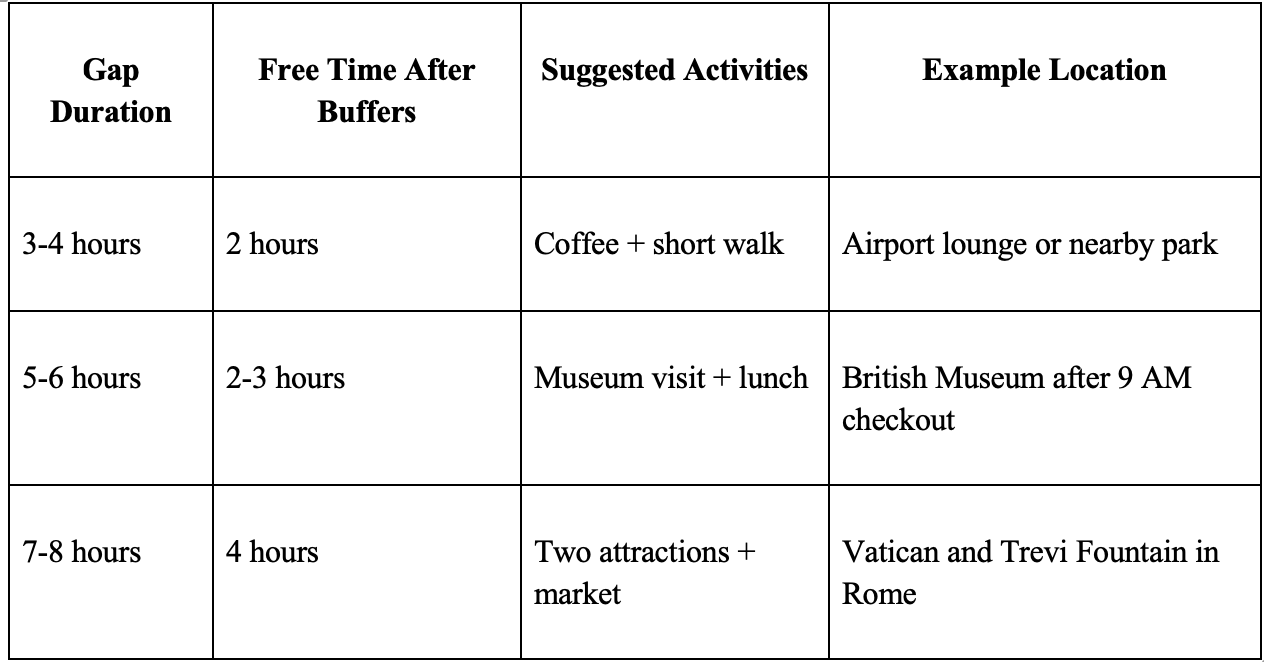
Practical timing templates for common travel gaps
These templates include buffers: 45 minutes for transfers and 30 minutes for check-ins at shorter intervals, with more time for longer intervals. They help you avoid overcrowding in the schedule and leaving no room for delays. Use them as a flexible guide rather than a fixed plan, adapting them based on the city, distance and time of day.
Transportation choices that reduce friction on a short city day
Choose transportation that fits bags. Express trains run with 95 percent reliability, with rack space, from 5 a.m. to 1 a.m. and with little disruption. Subways, which are sometimes open 24 hours a day, handle bags poorly because of the stairs and run high risks of delays. Buses take luggage, but have to deal with traffic, limited opening hours and a lot of disruption. Taxis manage luggage well, are always available, average traffic risk. Ride-hailing has high reliability and bag support, but spikes can occur.
Common scheduling mistakes that turn free hours into a stressful sprint
-Overlook timed entries: places like the Louvre need to be booked weeks in advance; Missing them means no entry and fees.
– Ignore last entry times: Venues close with last entry 1-1.5 hours earlier, such as the Met at 5:30 PM.
– Assuming re-entry: places like the Eiffel Tower don’t allow this without passes, breaking plans.
– Underestimating security queues: peaks last 20-40 minutes, worse with bags in the Colosseum, where large bags are prohibited.