AI adoption creates travel industry’s most valuable customers, according to new research from Phocuswright | News
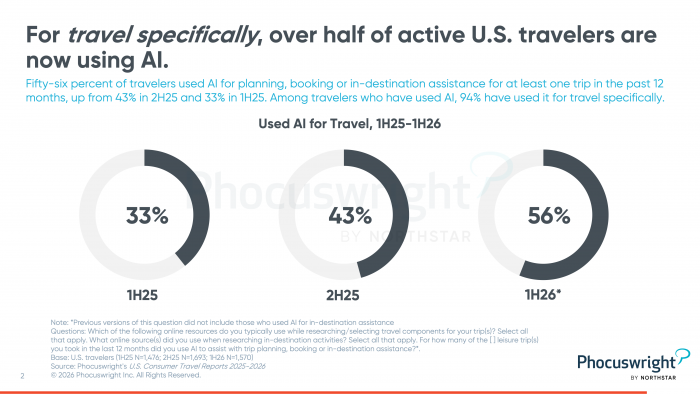
Travelers using artificial intelligence for trip planning and destination support are emerging as the industry’s most valuable customer segment, according to new research from Phocuswright. The findings show that travelers who adopt AI take more trips, spend significantly more per year, and interact more deeply with digital travel tools than travelers who have not adopted AI.
Phocuswright’s new report, The AI Surge: Travel’s Fastest Behavioral Shift in a Decade, finds that AI travelers have a median household income of $129,200, compared to $104,000 for non-users, and take 3.8 vacation trips per year, compared to 2.9 among non-users. They also spend $4,500 annually on vacation travel, far more than the $3,000 spent by those who don’t use AI.
“AI in travel has crossed a critical threshold and gone from experimentation to expectation,” said Mike Coletta, senior manager of research and innovation at Phocuswright. “What’s striking is not just the scale, but the speed. Within a few months, usage has skyrocketed across every generation, every touchpoint and every stage of the journey. Yet this isn’t a story of disruption replacing the old guard. It’s a story of augmentation, where AI is rapidly changing the way travelers discover, plan and book, while traditional channels still hold meaningful ground. For industry leaders, the implication is clear. This is a crucial time to understand how AI fits into the traveler decision-making journey, as the companies that will define the next era of travel right now.”
The report also shows that AI travelers are generally heavier users of online travel tools, using an average of four digital tools when researching and booking travel, compared to 2.2 among non-users. They are also younger on average, 41 versus 52, and are more likely to quickly adopt new travel technology.
“AI is already changing where and how travel brands compete, and the impact is measurable,” said Eugene Ko, director of marketing and communications. “We see it emerging in the way travelers discover brands, where they engage and how decisions are ultimately made. In a short time, it has reshaped the front door of travel and raised expectations for every digital touchpoint. At Phocuswright Europe we are exploring what this means for companies competing for attention, loyalty and conversion in an AI-influenced journey.”
AI travelers are also more comfortable sharing data to enable personalization, more willing to book via AI in the future, and more likely to pay for AI tools. Nearly 40 percent subscribe to a monthly AI service, compared to 20 percent of U.S. adults overall.
The publication of this research comes ahead of the Phocuswright Europe conference in June, where leaders from the travel, technology and investment communities will explore how AI is reshaping traveler expectations, supplier strategies and the competitive landscape.
“The impact of AI is no longer purely behavioral, but economic in nature,” says Coletta. “At Phocuswright Europe we will explore how this high-value segment is redefining what travelers expect from digital experiences and how the industry can respond.”