Page to Screen Changes, Piggy’s Name
SPOILER ALERT: This post contains spoilers from “Lord of the Flies,” the 2026 adaptation now streaming on Netflix.
The kids are not all right. But they haven’t been, not really, since 1954 when William Golding’s landmark novel “Lord of the Flies” was first published.
The unfortunately timeless tale of the potential for savagery and survival within a group of young boys stranded on an deserted island has long shocked audiences for frankly depicting the cruelty of children — reflecting examples set by adults in their lives –– during moments of desperation. It has been adapted twice for English-language audiences: an acclaimed 1963 film directed by Peter Brook and an inferior Americanized 1990 version that was required high-school viewing for millennials.
But Golding’s tale gets its first episodic treatment with writer/creator Jack Thorne’s new four-part series for the BBC, now streaming stateside on Netflix. Thorne won an Emmy last year for co-writing “Adolescence” with Stephan Graham, perhaps the most comparable story of modern child-on-child violence to the post-WWII “Lord of the Flies.” But even considering “Adolescence”’s chilling case of a volatile teenage boy accused of murdering a girl, his classmate,“Lord of the Flies” still remains the searing tale of innocence lost.
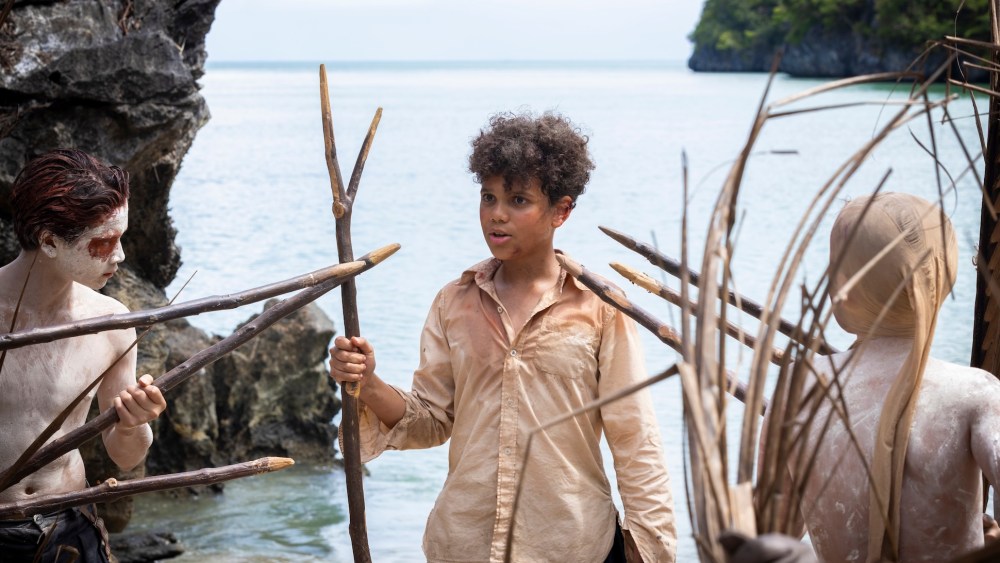
The basics of Golding’s cautionary tale about boys who embrace or resist their worst impulses when left to build their own society remain largely untouched in Thorne’s version. There’s the confident and cool Ralph (Winston Sawyers), who emerges as an anointed (which is to say, flawed) leader almost immediately after the boys survive the plane crash. Piggy (David McKenna) is his bespectacled right-hand man, a smart and practical thinker — and a bit of a stick in the mud, according to the other boys. Their quieter ally is Simon (Ike Talbut), a sensitive and introspective guy who finds a rhythm in the island’s remoteness. But they all live in reaction to Jack (Lox Pratt), an ego-driven wannabe leader who glides down the slippery slope of barbarism as a means of avoiding his own deep-rooted issues of abandonment.
Courtesy of J Redza/Eleven/Sony Pictures Television
However, in taking on the classic story, Thorne does deviate in ways that will have “Lord of the Flies” purists talking. Among his most crucial changes is the decision to, for the first time in more than seven decades, give Piggy a real name –– Nicky. In fact, when Thorne talks about the series, he says he prefers to call him Nicky, despite Golding’s commitment to shackling him with that cruel moniker bestowed by his classmates.
“I gave him a name for himself,” Thorne tells Variety. “I felt like he needed that identity. But more importantly for Ralph, because his journey through the island is Piggy to Nicky. This is someone who learns to judge people, not by how other people see them, but by how he should.”
More than other adaptations, and even Golding’s original, Thorne foregrounds Piggy in significant ways, including starting the show in his POV after the crash and naming the first episode after him. When the events on the island reach a fever pitch in Episode 4, and Roger (Thomas Connor) drops a boulder on Piggy’s head, Thorne doesn’t kill him instantly like every other telling but rather keeps him alive long enough to go on the run from the hunters with Ralph through the forest. At a certain point, Ralph is dragging Piggy along, wringing every second he can out of his friend’s final moments before he ultimately buries his body.
Below, Thorne tells Variety about the big swings he took in both Piggy and Simon’s death scenes; how his own son inspired the tender nature of Jack and Simon’s friendship; and what moment –– a significant change, nevertheless –– he considers among his favorite things he’s ever written.
Was working on “Adolescence” what inspired you to adapt what’s perhaps the most iconic and often-told story of childhood violence?
Bizarrely, we filmed “Lord of the Flies” and “Adolescence” in the same summer. In fact, at exactly the same time. I was flying between Malaysia and Pontefract, so it was quite a mad, mad few months. It’s just that “Lord of the Flies” obviously took a lot longer in the edit. I was actually writing “Lord of the Flies” before I was writing “Adolescence.”
The reason why I worked on this, though, is because it’s the book that did damage to me as a kid. There’s sort of two seminal texts for me as a child. One was “E.T.” My son is called Eliott and I have “Be Good” tattooed on my wrist. The other was “Lord of the Flies,” which I didn’t name a child after and don’t want a tattoo of anywhere near me. But it did get inside my head.

Courtesy of Lisa Tomasetti/Eleven/Sony Pictures Television
Were you completely terrified for our youngest generations after that summer shooting these two shows together?
Yes, I absolutely was! But the mad thing is that you’re doing these shows about the damage that kids can do, and yet you are working with the most tremendous group of kids you can possibly imagine. David and Lox and Ike and Winston, these kids just restore my faith in the future. The joyful way that they and this whole cast behaved. I mean, we had 40 kids on that island, which isn’t an easy amount of kids to have, but they were wonderful together. David was just nominated for The Gotham Awards! He’s just been blessed with this insane buoyant spirit. He’s had a really, really hard life. He’s had kidney transplants, he had all sorts happen to him, and yet he’s just filled with this joy. Our first question in the casting call was, if you could be stuck on a deserted island with anyone, who would it be? David’s response was the entire company of “Les Misérables.” If you don’t immediately cast that kid, what’s wrong with you?
Generally speaking, things aren’t great in the world right now. Is that why you felt it was the time to pick up this story that seems to get revived once a generation and filtered through the current state of the world?
I mean, it’s one of my favorite books, and I’ve always thought that it would work beautifully on TV. I did try 15 years ago to make it, and it failed. But I do think that now is a very, very apt time for it. We’re obviously not in as extreme a situation as William witnessed, but what we are asking our young people to do right now, the way that we’re asking them to navigate themselves as shadows of us, as shadows of the generation that’s supposed to guide them, is quite extraordinary. I do fear for them, and I do think that’s what Golding was doing. He was asking, “How can we hope for the future when the present is so troubling?”
This version reveals Piggy has a real name –– Nicholas or Nicky. Why was it important to give him a name?
I gave him a name for himself. I felt like he needed that identity. But more importantly for Ralph, because his journey through the island is Piggy to Nicky. This is someone who learns to judge people, not by how other people see them, but by how he should. I don’t think Ralph is a perfect kid. Sometimes, he is given hero status right from the start, but the first thing Ralph does on the island is betray Piggy or Nicky, as I prefer to call him. The first thing he does is tell everyone the Piggy nickname, and the reason why he does that is because he wants Jack to like him. That’s the curse that takes you through the whole of “Lord of the Flies.” The desire to be liked, the desire to be popular. Seeing Ralph understand what Piggy meant to him and what Nicky meant to him is really important to his unlocking as a human before he is then saved.

Courtesy of J Redza/Eleven/Sony Pictures Television
Jack and Simon’s relationship has always been somewhat of a mystery, even to each other. The moment they share in Episode 2 by the river, when Simon paints Jack’s face with mud, is maybe the most beautiful in the whole series. How should we read their relationship in this version?
I don’t think either of them know their sexuality, and I don’t think that’s the story. I think it’s about the tenderness between them. The thing that I observe in my 10-year-old is that he is still very anxious to have physical contact with us. There are moments when you’re like, “I’m just gonna take my hand away here, Elliot, because I don’t know that it will help you walk into the school with us holding hands.” But amongst his peer group, they are rough and tumble, and they still touch a lot. Definitely more than you do when you hit the teenage years, where you’re sort of allergic to each other, and allergic to physical touch. But tender touch is starting to be eliminated from my son right now at this age. Because Jack and Simon have been alone together for long periods from the age of 7, that touch was part of their relationship. Touch was part of who they are, and so they know what each other feels like. It’s not just that Simon touched him, it’s the way that Jack reacts to the touch, which is one of need.
At the end of Episode 3, we see Simon’s death. It’s such a pivotal moment in any telling of this story, but you keep it kind of vague in the chaos of the hunters’ dance. It’s not even immediately clear what has happened without already knowing this story. Was that in your script?
It was in my script. There was one change from the book that I made at that moment, and one thing that I leaned into. The change I made is that I didn’t think it was important that Simon saw the parachutist, which is in the book, but it felt like that was too much. The Lord of the Flies has already spoken to him. He understands the truth, and he wants to. The Lord of the Flies is obviously himself, and it’s his own voice that’s being reflected back to him. So he doesn’t need to see a fact in order to be able to go back to the others and take that understanding with him.
Also, when I was 11 and I read the book, I felt like Simon, and then Simon was suddenly dead. I didn’t understand what had happened until Golding talked about his body drifting out to sea. I thought that it was so important to capture that confusion. You lose any clarity in that moment, but also as soon as it’s happened, as soon as you see the body, you can connect the dots. You don’t need to lay it all out for people. The confusion of that moment is what makes it so horrifying and compelling. That’s how he wrote it, and that’s how I wanted to play it.
Soon after Simon’s death, Piggy is hit with that fateful boulder by Roger. But unlike Simon, who is just suddenly gone, you extend Piggy’s death, and Ralph takes his increasingly limp body through the forest. Why did you prolong that inevitability?
Technically, this was Ralph’s episode. I wanted to end Episode 3 with Simon’s death, and I had to create a compelling path for Ralph through the episode that wasn’t just about being on his own on the run. So just giving him a companion was important. But the emotional reason was that, as I said, this is Ralph’s journey from Piggy to Nicky, and I wanted Ralph to have the opportunity to understand how much he cared for this kid. Always in shows, my favorite bits are the ones without words. Ralph burying Nicky is one of my favorite moments of anything I’ve ever done because I just think it’s so understated and yet so moving because of Winston and how he delivers in that moment. Just the pain on his face as he’s trying to do right by a kid who, in Episode 1, said, “We need to bury the pilot” and they didn’t. There was no way that Ralph was leaving him on the island without burying him properly. It’s him embracing what Nicky meant to him.
“Lord of the Flies” always ends the same way –– Ralph runs to the beach with the hunters in pursuit, and he bumps into an officer who has seen the forest ablaze. The adult always expresses disappointment for how civility has disintegrated, but what did you want to leave a television audience with at the end of yours?
I love a couch show. The show that I always want to write is the show that I grew up with, which is watching telly with my mum, finishing a show and then talking to her about it. So I wanted to end with questions rather than answers. But there’s two things that really interest me in how Golding wrote that moment, and what I did was more or less word for word what he wrote, which is that civility isn’t kind. When you’re looking for answers as to why the boys turned out the way they did, the answer is as much in the officer as it is in the boys.
The second thing –– and it is all down to the brilliance of our actors and our director Mark Munden –– is that the truth of the moment is reflected on every single one of those kids’ faces. Every single one of those kids makes a different choice. I didn’t write it in, but I love that Roger immediately puts down the spear, basically saying, “I’m going to be a human being now.” That’s the scariest guy on the island. But their individual trauma is so apparent, particularly for Jack and Ralph. There are no lessons to be learned about “Lord of the Flies” that are about how a group of people behave. The only lesson to be learned from “Lord of the Flies” is about how individuals behave. What happens on this island is not an inevitability, and Golding isn’t writing about inevitability. He’s writing about personality, and he’s writing about who these kids each are. He’s writing about how kids were cultured and socialized in 1940s and 1950s Britain, and the truth is, the brutality of my country is reflected in the brutality that they then enact on the island. In that last moment, the kids are allowed to make their own choices as to how they approach the next stage of their lives, and I love that.
Hopefully, your next project isn’t about the sad state of childhood, even though you have found quite the niche for yourself.
My son is going to thankfully escape all those slightly-too-tight hugs at the end of every working day that he had to endure during this writing period. I’m writing about other things now and, thankfully, they aren’t quite as traumatic.
This interview has been edited and condensed.