Eva Longoria, EP’s ‘House of the Spirits’ on the adaptation of Allende’s novel
It involved both magic and realism for Chilean creatives Francisca Alegría and Fernanda Urrejola, who brought Isabel Allende’s beloved novel “The House of the Spirits” to the screen as a limited series for Amazon Prime Video.
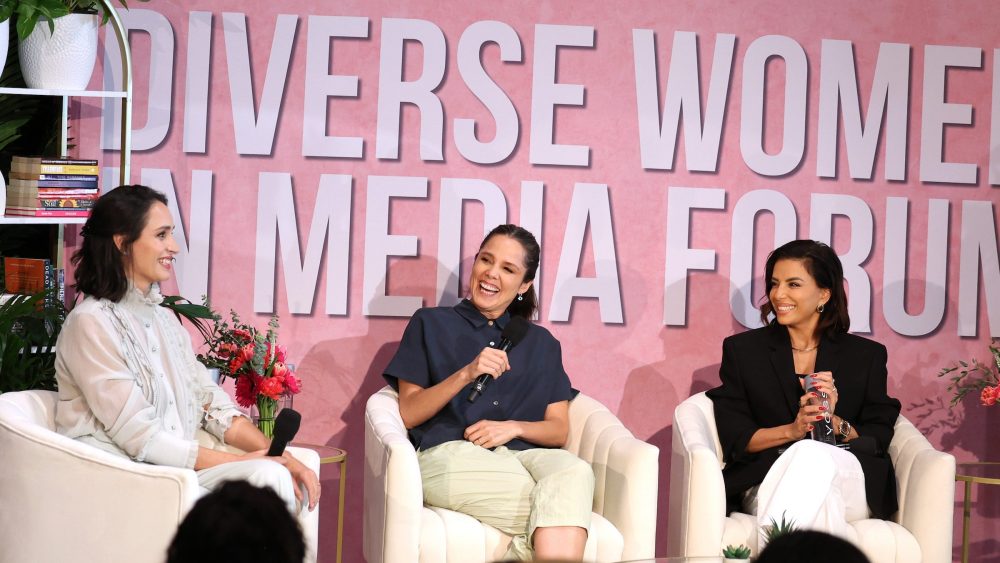
Alegría and Urrejola and “House of the Spirits” executive producer Eva Longoria laid out the backstory of the eight-episode series during their May 1 keynote address at the National Association of Latino Independent Producers’ Diverse Women in Media Forum. Variety gave “House of the Spirits” a favorable review, calling the Spanish-language adaptation “sensational and long overdue.” “House of the Spirits” bowed on April 29.
Although Alegría and Urrejola did not have a long track record of managing extensive period productions, the confidence that FilmNation and Longoria’s Hyphenate Media showed in their vision for the Spanish-language adaptation and the support system they provided made all the difference.
“It’s very important when you have producers who believe in you and protect you and shelter you so you can focus on doing the best work,” Alegría said.
Alegría and Urrejola, who are partners in life and production, co-wrote the series and serve as showrunners and executive producers. Alegría directed half of the show’s eight episodes; Urrejola plays the main character of Blanca. Longoria was recruited by FilmNation as an executive producer because she had been vocal in the development community about her interest in adapting Allende’s works. The Chilean novelist and human rights lawyer has been prolific since she rose to international fame with her 1982 debut “House of the Spirits,” a sprawling tale of a family and political dynasty told in the magical realist literary form popular in Latin America in the 20th century.
“I’m obsessed with Isabel Allende, and especially ‘House of Spirits’. It’s just her as a human being and as a woman and as a Latina that I look up to. You know, she started her writing career at the age of 40! said Longoria. “And so when FilmNation came along and they said, ‘Hey, we’d like you to sit with these two ladies, and they had a Bible, they had a look book, they had a vision, a vision board presentation where every frame looked like a painting, you knew just that this book was in the right hands.”
Longoria was blunt about her role in helping Alegría and Urrejola.
“I was appointed to use my voice and my political capital in this city, to make sure that the city ended up in the right place, that it got the support and budget that it needed,” she said.
Urrejola, a well-known Chilean actor, told the crowd at the W Hollywood hotel that the working environment of the project, which was shot in Santiago and other parts of Chile, reflected the dynamism of the novel.
“The great thing about this novel is that the female characters are so powerful because they are women. They don’t try to look like men to be so powerful,” Urrejola said. “That is the power of women. We create a community. In that sense, we really create culture, and we don’t have to forget that. And we are so lucky to have our female producers with us, who help us bring forward our vision. But again, the novel talks about that and our point of view. The starting point was the healing process of generational trauma. It is the granddaughter who is able to express what the previous generations could not.”
Alegría complimented the pair’s experienced production partners for guiding them through the most unfamiliar process of preparing for the final cut and preparing for the marketing, press and distribution calls with Amazon and FilmNation. This was uncharted territory for the showrunners.
“As independent filmmakers, working with such a big platform means you have to know how to navigate. Some things you have to defend, and other things you have to take the platform’s point of view,” Alegría said.
Longoria highlighted this as an important point for the rising star producers in the room.
“You have to choose the hill you’re going to die on. I see so many young writers that I’m trying to develop with, and they’re just doing their best to do the wrong thing. Studios are not your enemies. Producers are not your enemies. You all want to make something, and you have to defend your vision, and know what to defend, and know what to let go. And that’s a talent in itself,” Longoria said. “The platforms have information that you don’t have. So use the information that producers have.”
The session, moderated by Cynthia Littleton, Variety co-editor-in-chief, concluded with a discussion of Chile’s growing film and TV production infrastructure. (Longoria called it ‘Chili wood’.)
Bringing a national treasure like “House of the Spirits” to life in Chile was a dream come true for the couple, Urrejola said.
“I am fortunate to have worked in different parts of Latin America, and I can say that Chile has so much talent,” she said. “And the landscapes – you can find everything you want in Chile. You can see white, standard, beautiful beaches – very cold by the way. And then it will look like the Caribbean. And then you can go to Patagonia, which is a very different, unique landscape, and the desert that we have. We are still fighting for the [production tax] discount so we can make it even better, but we have co-production funds and it keeps getting better. It was great to work in Chile and to have that great team with us.”
(Photo: Fernanda Urrejola, Francisca Alegría and Eva Longoria at NALIP’s Diverse Women in Media Forum, held May 1 at the W Hollywood.)