NASA Artemis II mission success fuels Arizona State University role in Artemis III Moon landing
TEMPE – Even as the world celebrated the success of the Artemis II mission, researchers in Arizona were already looking ahead to Artemis III.
NASA’s next mission – Artemis III – aims to help land astronauts on the lunar surface for the first time since the Apollo era. The long-term goal is to establish a sustained presence on the Moon.
NASA will disclose more information on the Artemis III mission design and crew closer to the 2027 launch.
“Artemis III mission, now in 2027, will be designed to test out systems and operational capabilities in low Earth orbit to prepare for an Artemis IV landing in 2028, according to a statement by NASA.
It is part of NASA’s goal of returning astronauts to the moon and achieving an “enduring” presence there.
“It is really our first steps back to landing on the Moon again, to setting up a base on the moon and to having a permanent human presence on another world,” said Laurie Leshin, former NASA Jet Propulsion Laboratory director who is now a professor at Arizona State University.

(Tyler Mitchell/ Cronkite News)
Artemis II marked the first crewed trip around the Moon in more than 50 years, traveling 252,756 miles from Earth, surpassing the record for human spaceflight’s farthest distance of 248,655 miles previously set by the Apollo 13 mission in 1970, according to NASA.
Part of that historic effort was tied to work happening right here in Arizona. From training astronauts to supporting mission control and developing new technology, ASU is playing a growing role in the future of space exploration.
Kelsey Young, an ASU graduate, served as a lead scientist in mission control, becoming part of a new generation helping guide deep-space missions from Earth. She was the Science Flight Operations Lead, according to NASA.
Young’s research focuses on the integration of science into human exploration. She also focuses on science operations with NASA’s Artemis campaign as the science flight operations lead and in several other capacities, according to NASA.
Young also conducts fieldwork in both impact cratered and volcanic terrains, like Arizona’s desert landscape. Parts of Arizona provide conditions similar to a lunar surface, offering astronauts a hands-on experience navigating unfamiliar environments.

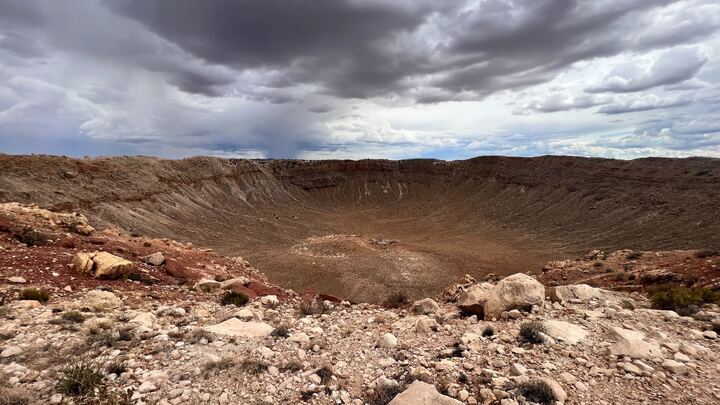
Sites like Meteor Crater in northern Arizona and Cinder Lake, created by a massive meteor impact tens of thousands of years ago, give astronauts and researchers a rare opportunity to train in landscapes that mirror the Moon’s rocky surface, according to the company that runs the site.
“We’ve been training astronauts here on some of our more Moon-like landscapes since back in the Apollo days,” Leshin said.
The university has contributed to more than 25 missions across the solar system, with instruments currently operating around Earth, Mars, the Moon and asteroids. It is also one of only a handful of universities in the country capable of building interplanetary spacecraft, according to a 2020 ASU News article.
Leshin says Artemis II astronauts also worked with ASU faculty to better understand geology.
The Artemis II mission lasted 10 days, starting April 1. The crew successfully splashed down in the Pacific Ocean after completing the mission, marking a major milestone in the NASA program.
For researchers like Leshin, missions like Artemis II are just the beginning.
ASU researchers are also contributing to the technology that makes future missions possible.
“We have students working on superconducting detectors that help receive optical signals from missions like Artemis,” said ASU professor Philip Mauskopf. “That kind of work is critical for communication and data collection in deep space.”
For Arizona researchers and students, that means their work will continue to shape what comes next, from the desert landscapes where astronauts train to the labs developing the tools that guide them.
“We are literally becoming a multi-planet species with Artemis II,” Leshin said. “We are paving the way for that.”
Related

Source link