Cultural tourism in Italy: cultural leaders, sentiments, geographical shifts | News
Italy still has the highest number of UNESCO World Heritage Sites in the world – 61 in total – and Italian cuisine will be added to the list of Intangible Heritage in 2025. Italy’s reputation as a leading global cultural destination is firmly established.
The deeper story lies in how travelers interact with that heritage: which cities enhance their appeal, how demand redistributes geographically and whether growing visitor numbers affect the quality of the experience.
Based on digital traces and preferences collected between January 1 and December 31, 2025, Data Appeal and Mabrian, both part of Almawave – Almaviva Group, outline the following trends.
He travels to the art cities of Italy
Cultural tourism still has a strong social dimension. Couples account for 43% of travelers to art cities, followed by families at 28%. Solo travelers represent 16% and recorded an increase of +3% year-on-year, indicating a gradual move towards more independent and personalized cultural travel. This trend also fits in with Italy’s reputation as a destination where solo travelers can explore cultural cities with relative ease and confidence. Groups make up 12% of visitors.
From a source market perspective, Italy itself remains the leading source market in terms of assessment volume. France remains largely stable year on year, while Germany drops from 7% to 5.5%, indicating subtle behavioral adjustments within Europe in addition to an overall stable international mix, possibly linked to the renewed growth of domestic travel in Germany since 2024.
Heritage attracts visitors, experience creates satisfaction
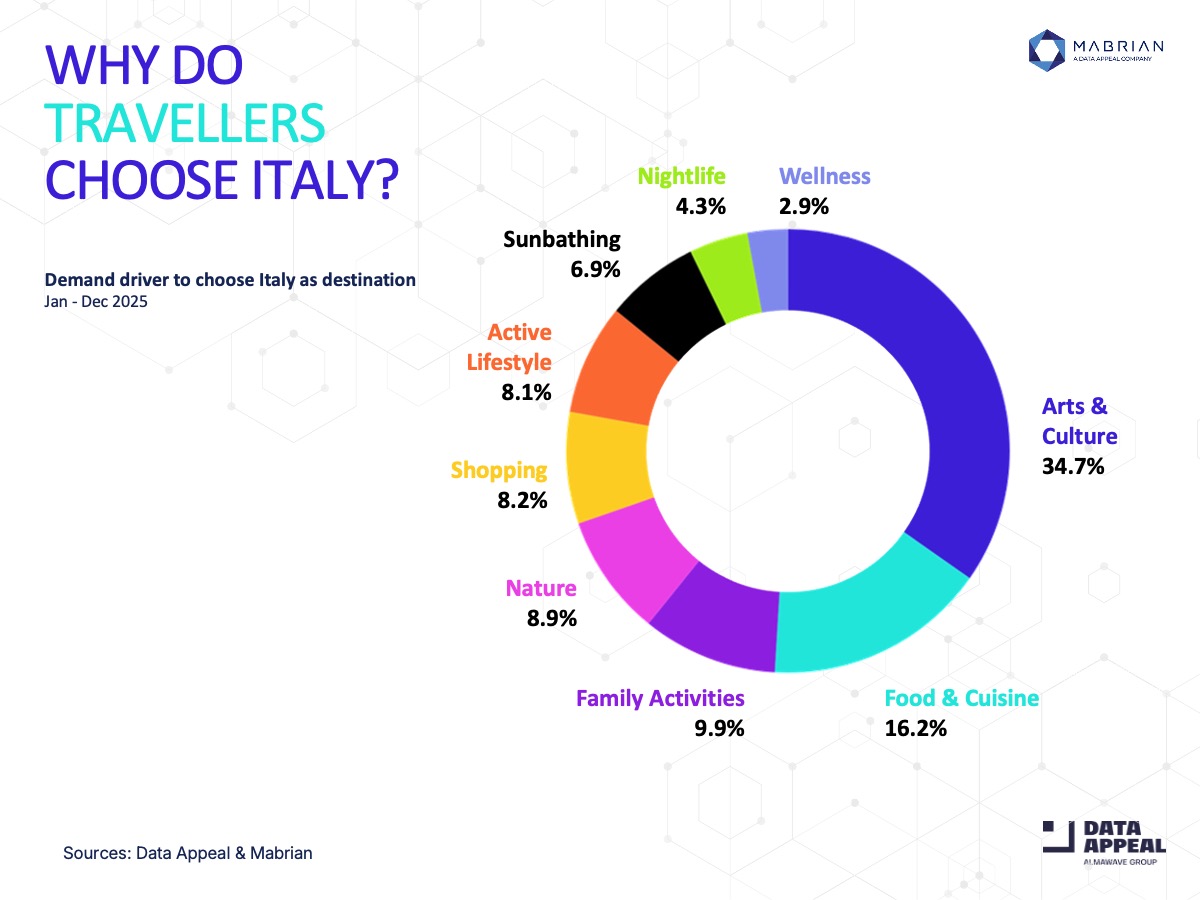
While cultural sights remain the main attraction, overall satisfaction is increasingly influenced by the broader travel experience. Culture remains the most important travel motivation: in 2025, ‘Art and Culture’ was responsible for 34.7% of travel motivations.
Culinary experiences achieve a sentiment score of 86.5/100, an increase of +1.1 percentage points year over year. The hospitality indicators are also improving: accommodation scores 81.9/100 and short-term rental 84/100, both showing an increase year-on-year.
These results confirm that Italy’s competitive advantage is supported not only by its heritage, but also by its gastronomy, hospitality standards and overall atmosphere.
Rome leads in size, but its growth extends beyond its icons
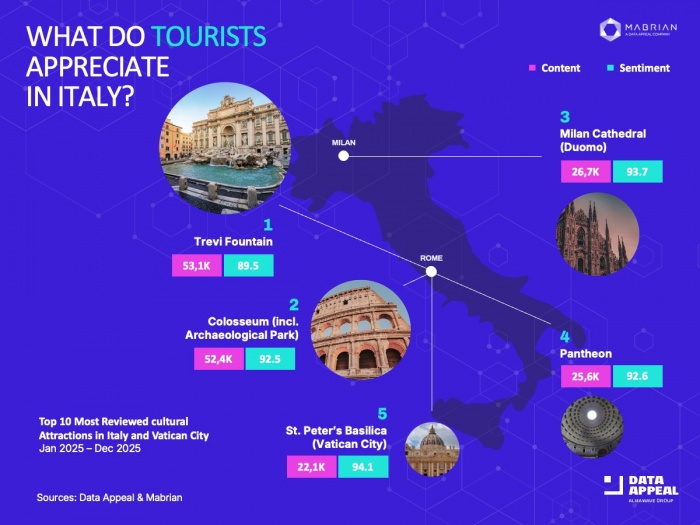
In 2025, the Trevi Fountain ranks first in review volume (53.1K), records the strongest year-on-year growth among major attractions (+67%) and maintains a strong sentiment score of 89.5/100. The Colosseum follows closely behind with 52.4k reviews, combining exceptional visibility with a sentiment score of 92.5/100.
Milan’s Duomo is in third place (26.7,000 reviews) and stands out for a particularly strong rating (93.7/100). The Pantheon and St. Peter’s Basilica complete the top five, with St. Peter’s Basilica scoring 94.1/100. Reinforcing high visitor numbers does not necessarily reduce visitor satisfaction.
Florence and Rome dominate the visibility of museums. Among the most highly rated institutions are the Museo Leonardo da Vinci Interattivo in Florence, the Vatican Museums and the Archaeological Park of Pompeii. Sentiment at leading museums remains exceptionally high, with peaks above 95/100.
Juliet’s House in Verona records the highest year-on-year increase in review volume of both public and private museums (+19.1%), underscoring the continued interest in narrative and symbolically resonant sites.
Towards a more balanced cultural geography
While Rome continues to dominate in terms of volume, sentiment data shows growing appreciation across a broader geographic spectrum. In central Italy, Siena and Assisi are distinguished by particularly high visitor sentiment. In the South, Caserta (85.5/100) and Bari (85/100) achieve the strongest sentiment among the major southern art cities. The Reggia di Caserta is among the most reviewed museums in the entire country, while the Museo Cappella Sansevero in Naples is the third fastest growing museum in terms of review volume (+10.89% year-over-year).
This pattern is consistent with broader travel trends identified by Mabrian for the European Travel Commission, with long-haul travelers increasingly exploring destinations beyond Europe’s traditional hubs, supporting more geographically dispersed tourism demand.
“These trends indicate a structural shift in cultural demand: it is no longer exclusively concentrated in Italy’s traditional art capitals. Southern and secondary cities are steadily strengthening their reputation online, proving that authentic, local experiences are becoming as important as iconic landmarks,” says Federica Amati, Sales Engineer at Data Appeal.
Interactivity is gaining momentum, but operational factors matter
Semantic analysis of reviews points to an increasing demand for immersive and participatory experiences. Museums that integrate interactive elements tend to generate stronger engagement and greater visibility.
At the same time, recurring points of friction remain consistent. Costs, cleanliness and waiting times are the most frequently mentioned points of interest.
Overall, the findings suggest that investments in interactive design, timed entry systems and improved visitor flow management can both increase engagement and reduce operational pressure, enhancing the visitor experience without sacrificing scale.