ASU men’s basketball prepares for next steps in crucial offseason
TEMPE – Sitting on a pedestal near athletic director Graham Rossini’s office, championship trophies glisten in the sunlight beaming through a window on the top floor of Arizona State’s Carson Student-Athlete Center.
Sports like football and volleyball own hardware on the stand that immortalizes some of their most memorable recent seasons. Downstairs on the first floor of this athletic department building that sits adjacent to Mountain America Stadium, programs like baseball and wrestling showcase memorabilia from past national championships, highlighting their illustrious history.
For one program, hardware and history are harder to find.
Lately, losing has come more frequently than winning for men’s basketball.
After bowing out of the Big 12 Men’s Basketball Tournament with a 91-42 loss to Iowa State on Wednesday, the Sun Devils will miss the NCAA Tournament for the third consecutive season and the fifth time in six years.
Following the loss, the school announced its decision to move on from coach Bobby Hurley, electing not to extend the 11th-year coach into next season.
The move to the Big 12 hasn’t been kind to Arizona State, which has compiled an 11-27 record in its first two seasons of conference play. Competing among the middle to upper echelons of the league, which boasts multiple top-ranked teams, will require the school to establish a new standard for its product on the floor, its financial backing and its facilities.
The administration is working to address some of these issues, mainly upgrades to its facilities, in an effort to bring the program into relevance.
“It raises the stakes,” Rossini told Cronkite News. “It raises the importance of it at ASU. It raises the opportunity for us to connect in the community, to generate resources, to really have that be a showpiece for our department.”
The program’s difficulties predate ASU’s move to the Big 12. Arizona State has advanced past the first weekend of the NCAA Tournament just one time in the past 50 years, although the postseason victories of that lone appearance in the 1994-95 season have since been vacated due to NCAA violations.
The most recent stretch of success came near the middle of Hurley’s tenure, when ASU was on pace to make the tournament for a third-straight year before the pandemic cancelled the postseason.
Outside of the aforementioned three-year period, whether due to untimely injuries, subpar coaching and play, or lackluster resources, the program hasn’t been able to string together consistent success in recent years.
So, how does the school enable a resurgence in men’s basketball?
It starts with showing greater commitment to investing in the program. Although at times the school has shown interest in taking men’s basketball to an elite level, it hasn’t always demonstrated a consistent level of devotion.
ASU Hall of Famer Roger Detter experienced it firsthand.
Detter helped the Sun Devils win back-to-back national championships in baseball under coach Bobby Winkles in the late 60s, but also played for the basketball program for coach Ned Wulk, the program’s winningest coach. Detter has been a long-time season ticket holder.
At a reception after Hurley’s hiring, Detter remembers former athletic director Ray Anderson assuring everyone that the school would arm the new head coach with the resources needed to compete at the highest levels of college basketball.
“We will provide the necessary resources to compete within our state, our conference, and across the nation,” Anderson said in 2015.
After the reception, Detter approached Anderson and asked him what those resources would be.
His response? Upgrades to the arena.
For more than a decade, that promise went unfulfilled. Now, nearly 11 years and one change at athletic director later, it will be.
While questions remain about who will be its next head coach and about the program’s resources, Arizona State believes it has solved one piece of the puzzle: a much-needed refresh for its arena.
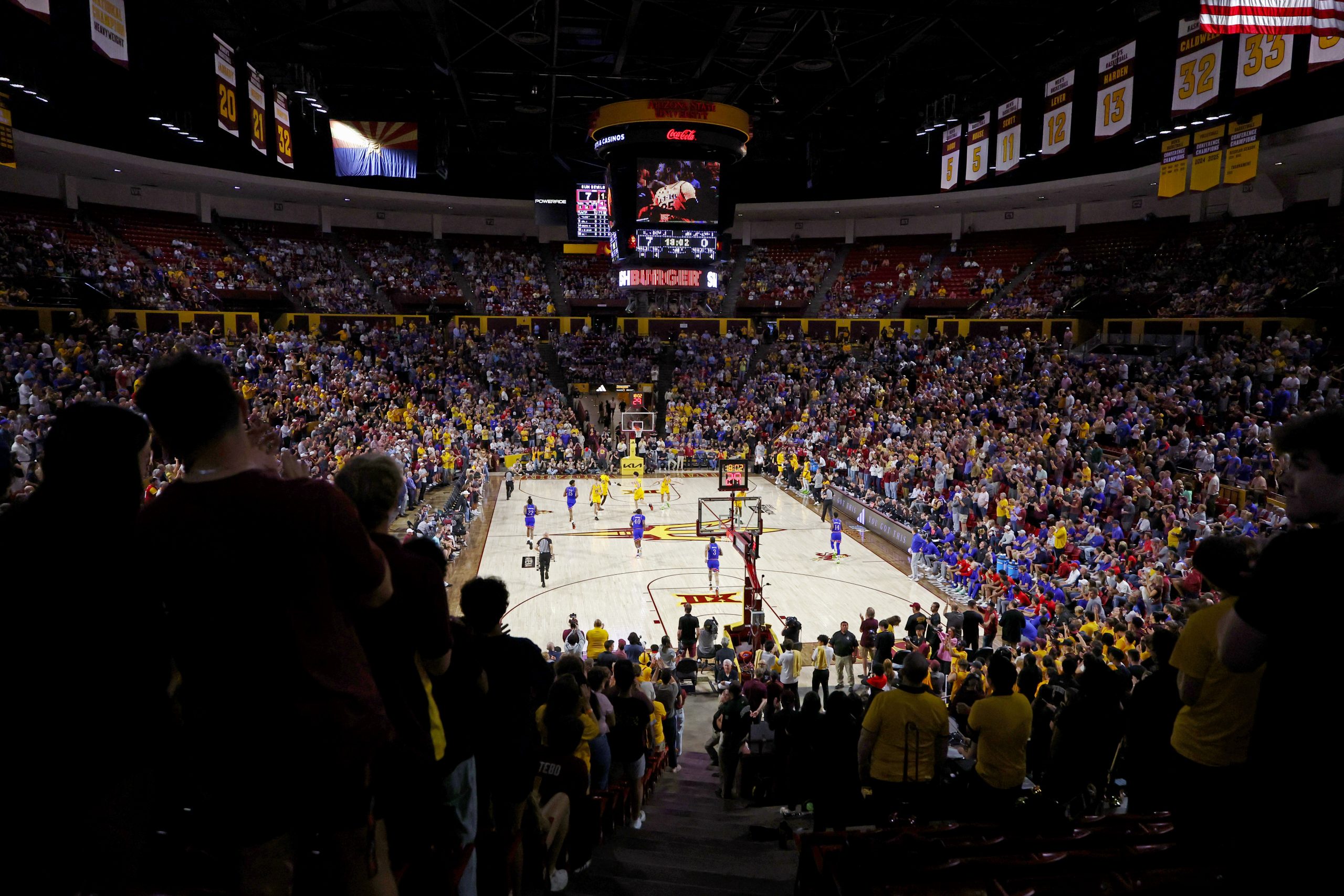
The home of the Sun Devils, Desert Financial Arena, has its issues. From the outside, its round figure, beige body, and disk-like top give it the look of an outdated spaceship. Inside, its steep set of seats extends up more than 30 rows, wrapping around the circumference of the arena to create a venue that holds more than 14,000 patrons.
A few noteworthy names headline jerseys dangling from the rafters above: all-time greats like James Harden, Eddie House and Fat Lever. Yet, the rest of the building’s signage fails to effectively highlight the men’s basketball program’s history.
On the lower bowl, the current lack of handrails presents a safety issue for the elderly, leading some patrons to fall on their trek to their seats.

“My wife and I personally know a number of people, they’re in kind of our (older) age group who, over the last five years, stopped renewing their season tickets because it was no longer possible without handrails and accessibility to make it,” Detter said. “They wanted to continue to support ASU basketball, but it just wasn’t something that they could do.
“In fact, a few of them who had tickets in the lower bowl actually moved up right above the upper concourse for a couple of years, thinking that might help them.”
Meanwhile, on the concourse, flickering, or in some cases burned out lights struggle to illuminate dimly lit walkways, while analog clocks that jut out from walls compiled of wooden beams and stone slabs, complete the out-of-date look.
Since the arena’s opening in the mid-1970s, it hasn’t undergone a major overhaul – until now.
Last October, the school announced plans for a multiyear, $100 million renovation to Desert Financial Arena.
“I think those who have invested, like myself, are looking forward to these renovations,” Rich Dubek, a long-time men’s basketball season ticket holder said. “This is like stepping back into 1975 in the time-way-back machine, and it’s not in a cool way. It’s in an old, uncomfortable way.”

The renovations will begin in May, starting with a new court and refurbished seats in the lower bowl.
The next year, an update to the concourse is in order, renovating restrooms and highlighting historic moments around the stadium with signage and digital technology. The school also plans to add a new sound system and loge boxes along the lower bowl, accommodating up to 120 guests.
The final set of renovations involves a few long-awaited additions to DFA, including a new video board and enhanced locker rooms.
Despite some calls for a complete teardown of the arena, relocation was never on the table for Rossini and the athletic department, although it was discussed under Anderson
“I don’t think that would be feasible right now,” Rossini said. “A brand new, similar-sized arena could range from 500 million to over a billion dollars in the current marketplace. And so we want to be realistic that a nine-figure investment is significant, but we have a better likelihood of affecting the building in the way that we need to, without overspending to do a brand new arena.”
The desire to create a true home-court environment stood as one of the athletic department’s primary motivators for the project, especially considering Arizona State’s struggles to protect its home court.
“We have not played well here in years,” Hurley said after the Sun Devils’ 75-63 home loss to West Virginia in January. “We had this place cooking before COVID. Now it’s just a sterile environment. We don’t win here. We don’t give our fans any reason to show up with enthusiasm to think that we’re going to win a basketball game.”
Despite a recent surge at home over the past month, including wins over No. 14 Kansas and then-No. 10 Texas Tech, the Sun Devils have been exceptionally bad since the COVID-19 season in 2020-21.
Starting from that season, Arizona State is 44-30 at home. Its 59.5% winning percentage at Desert Financial Arena ranks tied for eighth-worst among all Power 5 programs, according to BetIQ.
It marks a stark turnaround from the three years before the pandemic. The Sun Devils tallied a 39-10 record (79.6%) at home, contributing to a three-year stretch in which they made the NCAA tournament twice, and were on track to make it a third time before the pandemic cancelled the 2020 tournament.
“It was really exciting. Bobby Hurley was a brand name that everybody knew,” Dubek said of the three-year run. “We were getting a lot of TV exposure because of that personality and that name (Hurley), and he was able to recruit some really exciting players.
“They had a very archaic environment that was loud, rowdy, raw, and it was fun. It proved that if you put a good product on the court here, regardless of the age of our arena, people will show up and they will support the program.”
A matching trend for the dip in win percentage at home? Dropping attendance.
When Hurley arrived in Tempe over a decade ago, attendance hovered just below 6,000 fans. Slowly, he built a home-court advantage, averaging over 10,200 fans in the three years before the pandemic hit, per Sun Devil Athletics.
But after the break, the average attendance dipped by 2,000 fans to 8,250 over the past few seasons.
ASU drew sizable crowds for many of its games against ranked opponents this season, but often found more visiting fans in the stands than its own in ranked matchups. Against teams like Kansas and Arizona, a sea of opposing fans painted large portions of DFA blue, washing out the maroon-and-gold crowd.
“We want to build the type of environment that fans want to come, win or lose,” Rossini said. “And certainly winning can accelerate that.
“But we want to build the kind of game day that you just look forward to coming to no matter who’s playing, no matter who the opponent is.”
Achieving this goal will require more than simply renovating the arena.
Bill Kulesh has owned season tickets to ASU men’s basketball games since the 1970s. He also recently became a season-ticket holder for the Sun Devils’ men’s hockey team; a program that he thinks the hoops team can learn from to improve its fan experience.
“They really do an unbelievable in-game job of presentation,” Kulesh said about the ASU hockey team. “There’s a ton of energy in the building. … We (have) got to figure out a way to get that energy into basketball.”
Rossini hopes that the benefits the revamped arena provides will have a trickle-down effect on other aspects of the program.
In the past, Desert Financial Arena’s deficiencies could have driven away recruits, as other top schools offered more modern facilities. With a renovated arena, the hope is that the space can be used as a recruiting tool rather than viewed as a recruiting deterrent.

In the best-case scenario, a revamped home environment could even be the difference in garnering a few more victories in ASU’s win column.
“It’s going to be a great place to watch high-action, competitive sports that we have here at ASU,” Rossini said. “And maybe that helps us avoid the ebbs and flows on the performance side because we’re generating resources, we’re generating that home-court advantage that allows our teams to have success more times than not.”
But relying on the renovations alone to fuel a resurgence of resources and talent necessary to compete in the Big 12 may be a lofty assumption.
Although ASU is a full participant in revenue sharing with its collegiate athletes, capped at $20.5 million for each school, its Name, Image and Likeness collective group, the Sun Angel Collective, along with its cohort of donors, has room for growth to rival some other programs in the conference which have procured multi-million deals for their star talent like BYU (AJ Dybantsa and Rob Wright III), Texas Tech (Christian Anderson and JT Toppin) and Arizona (Koa Peat).
With football serving as the kingpin for the school’s athletic operation, and other sports such as baseball, hockey, women’s basketball and volleyball all siphoning away remaining funds, men’s basketball hasn’t been able to keep up.
“I understand the reality of it,” men’s basketball season ticket holder Aaron Novak said. “There’s only so much money to go around. … Obviously, football drives the train, and I’m a massive football fan, so I get it.”
While the future of NIL remains subject to change, Arizona State is still searching for ways to close the gap. Looping in former alumni could help, as NBA players like Sun Devil graduate James Harden have the ability to provide a significant boost to the school’s resources.
“Guys like James Harden, Lu Dort, Jeff Pendergraph and others are very visible around the program,” Rossini said. “It’s great that you’ve got guys that have had success to the next level, also at a point in their career where they want to be more visible, and they want to have relationships with the coaches and players. To me, those are signs of a healthy program and something that we want to continue to enhance going forward.”
Nonetheless, in one of the largest markets in the country, ASU’s focus remains on working with businesses in the Phoenix metropolitan area to gather NIL funding for its athletes.
“We’ve got a great opportunity here in the Valley,” Rossini said. “The fifth-largest city in America, companies, big and small, that are looking for a connection back to the university. I really think that puts ASU in an advantageous position relative to the competition.”
Generating resources will continue to be an important aspect of the program’s success, regardless of who’s coaching next season.
“It’s unfair for us to say, ‘Hey, coach, just go win, and when you win, the resources come, the fandom will come (and) the investment will come,’” Rossini said. “That’s the shared responsibility.
“We want to hire and retain elite coaches throughout all levels of the department that can get the most out of their rosters and get the most out of their teams, but we want to be a very willing teammate in that effort of driving the resources that our coaches identify as important for them to have success.”
Still, one lingering question hovers over the program: Who will be the coach next season and beyond? Who will lead Sun Devil men’s basketball into this hoped-for promised land?
On Wednesday, the Sun Devils announced their decision not to extend Hurley’s contract into next season and beyond, thus ending his 11-year run in Tempe.
In just over a decade, he accumulated a 185-167 record, finishing with the second-most wins in program history. Although his latter years were rocky, he generated palpable buzz around the program at times during his coaching stint at Arizona State, reaching as high as No. 2 in the AP poll and stacking multiple upset wins over top-10 teams, including in back-to-back years against top-2 ranked Kansas squads in 2017 and 2018.
Nonetheless, after three straight seasons without an NCAA Tournament appearance, he’s out as the head coach at ASU.

So what, or who is next?
While the pool of coaching candidates isn’t extensive, Arizona State will have a few options to choose from, likely from the mid-major level. ASU could also try its luck with a Power 5 program’s assistant.
Either way, Rossini and his athletic department believe that they have the men’s basketball program headed in the right direction. The school hopes that whoever may take over will be riding a wave of positive momentum with the recent steps taken by the athletic department.
“I know there’s a lot of momentum behind what we’re prepared to do in the department with the sport, with the building (and) with the team,” Rossini said. “There’s no reason to believe we can’t be as successful in men’s basketball as we are in a lot of other sports in our department right now.”
Related

Source link