NCAA hockey evolving as CHL eligibility, transfer portal and NIL reshape recruiting
PHOENIX — For decades, American college hockey and Canadian major junior hockey lived in separate worlds.
Players either pursued the NCAA route or skated through the Canadian Hockey League (CHL), two development paths that rarely crossed because they could not due to eligibility rules. Late in 2024, the NCAA removed that barrier, opening the door to a dramatically larger talent pool and reshaping the sport’s recruiting landscape.
“I do think that is the single biggest development in college hockey probably in my lifetime, and I’m 41,” said Chris Peters, an NHL Draft and prospect analyst for FloHockey. “The biggest and most seismic adjustment is the addition of CHL players.”
But it’s not the only shift reshaping the sport. The arrival of CHL players, combined with the rise of NIL opportunities and the growing influence of the transfer portal, is rapidly transforming how programs build rosters and how players chart their development paths.
The full impact of that change didn’t become clear until this season when high-profile prospects began making the jump. When Gavin McKenna, a forward widely projected as the No. 1 pick in the 2026 NHL Draft, committed to Penn State, and Keaton Verhoeff, a defenseman also projected as a top selection, landed at North Dakota, the ripple effects of the new eligibility rules were felt across college hockey.
“I think that there’s still a lot of talent in college hockey. There was before this, but you’ve now increased it by a significant degree,” Peters said. “I think that we’re still years away from really fully understanding the impact of the new CHL rules.”
College hockey’s new landscape isn’t just affecting the sport’s biggest prospects. Peters said the rule change has also created new opportunities for players who previously had limited options after their junior careers ended.
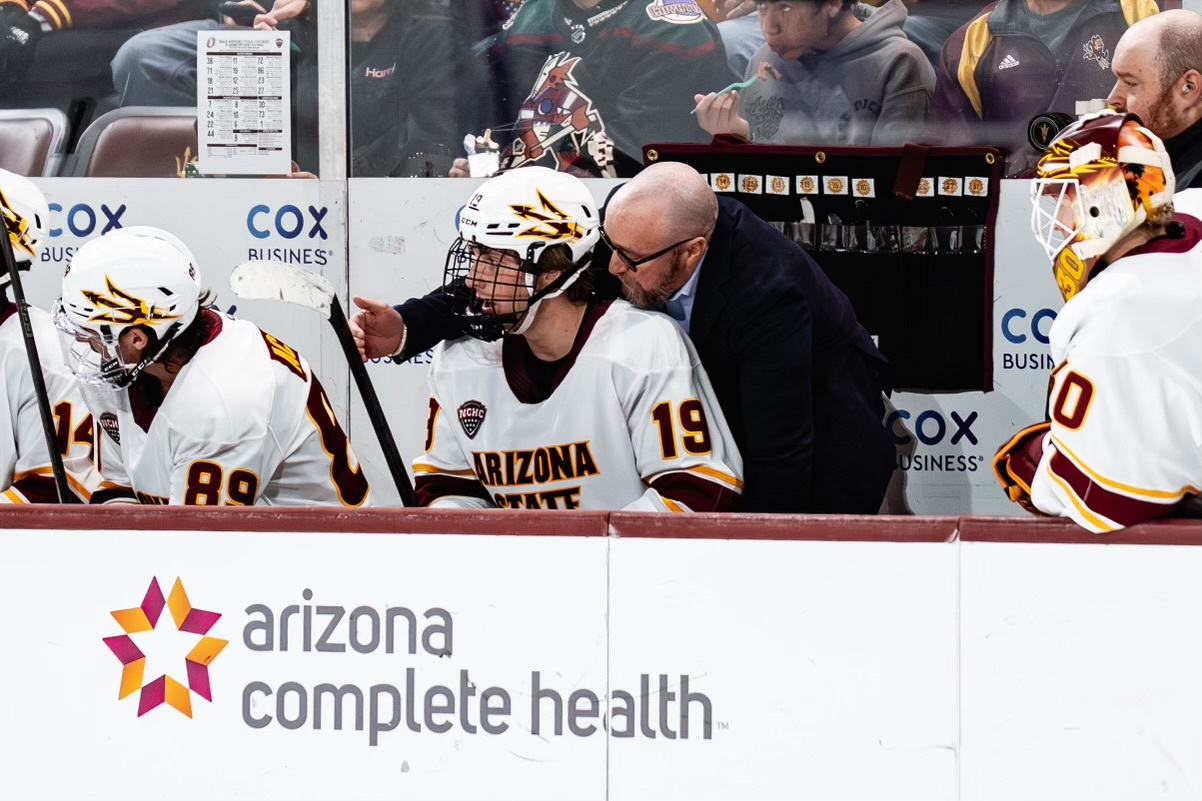
Arizona State forward Ty Nash is one example. After five seasons in the CHL’s Western Hockey League, split between Lethbridge, Winnipeg and Edmonton, the Arizona native was able to continue playing at the NCAA level, an opportunity that didn’t exist for many players in the past.
“For years, if you were an undrafted player in the CHL, your options were pretty limited,” Peters said. “Now they have the option to go the NCAA route where there is going to be more opportunity for exposure, development and other things that allow them to potentially earn a better pro contract.”
However, for college coaches, the overall effect has been this: the recruiting board just got a lot bigger.
For decades, the CHL — which includes the Western Hockey League, Ontario Hockey League and Quebec Maritimes Junior Hockey League — represented a one-way door. Once a player selected that route, NCAA eligibility was gone.
That meant college programs were drawing from a smaller pool of players: junior leagues like the United States Hockey League, the North American Hockey League and various international circuits.
With the change, coaches such as ASU’s Greg Powers have been forced to adapt to the new era of college hockey.
“You’re forced to push the envelope and evolve and think harder or, with the landscape, you’re going to get passed by — you’re going to die,” Powers said by phone. “I think a lot of us underestimated the amount of kids that still have CHL eligibility that were getting recruited daily to go back to the CHL that came to college. ‘Hey, we saw you didn’t play. We saw you only played eight minutes. If you come back here, you’re gonna get 20.’”
Even with those challenges, Powers believes the expanded player pool will ultimately raise the level of college hockey.
“There’s just more players now,” Powers said. “You’re evaluating guys that maybe you never would have looked at before because they were in the CHL. Now they’re options, and that changes the entire recruiting board.”
Even with those new opportunities, Powers said the transition period has required programs to adapt quickly.
“There’s so many factors that come into it now that are brand new for everybody,” Powers said. “Some programs did really well with it. Some programs did not.
“Everybody knows who the top 10, top 20 overall NHL draft prospects are, and those kids cost a lot of money. The programs that have a lot of either revenue share from their institution or NIL were the ones that were able to go get those kids and sign them up.”
That financial reality has created another layer in the recruiting process. Programs with strong NIL backing or institutional support often have an advantage when pursuing top prospects.
But even with that reality, Powers believes the floor has also significantly increased, only helping the growth of the sport.
“The floor is much higher now,” Powers said. “There’s so many players, there’s not enough stalls to fill the demand of how many good players are out there because there’s only 64 teams.”
At the University of Denver, one of college hockey’s premier programs with three national titles in the past eight seasons, coach David Carle said the rule change has significantly expanded the recruiting landscape his staff must evaluate.
“I think players have more options today than ever before,” Carle said in an interview at DU’s Magness Arena. “There’s a lot more players available in the marketplace to be able to recruit, which has increased the quality of college hockey.”
For Denver, which has built its success on developing players over multiple seasons, the philosophy behind recruiting has not necessarily changed. Carle said the program still prioritizes identifying players early and helping them grow within the system rather than relying heavily on quick roster turnover.
Over the years, the Pioneers have developed players such as Zeev Buium, a first-round NHL Draft pick and one of college hockey’s top offensive defensemen, along with Jack Devine and Aidan Thompson, two of the program’s recent standout forwards, all of whom spent their entire college careers with Denver.
“We prefer to build relationships, recruit kids and bring them in as freshmen,” Carle said. “We’re still looking for the right kids from the right families who fit our program culturally in what we’re looking to do.
“(We) brought in 10 freshmen this year and could have brought in a lot of transfers trying to be older. What I like to (do is) bring in guys and get them in our program, work with them.”
Still, the addition of players from the CHL has added another layer to the decision-making process for coaching staffs. Experienced major junior players often arrive older and closer to contributing immediately, while traditional prospects may require more time to develop.
Across the country at the University of Maine, coach Ben Barr said the eligibility shift is only one piece of a rapidly changing college athletics landscape.
“I think it’s just very volatile,” Barr said. “We don’t even know what our rules are in the NCAA from day to day because everything’s in the courts.
“You couldn’t transfer, you couldn’t take any benefits from anybody — whether that was a bologna sandwich or a million dollars. Now you can basically do anything.”
That uncertainty has sparked broader questions about what the future of college hockey might look like if the current trends continue.
“If there’s no guardrails put in,” Barr said, “I truly believe that it’ll just become the American League.”
There are a handful of players in college hockey right now with past professional hockey experience such as the American Hockey League and East Coast Hockey League. At Maine, Barr pointed to defenseman Artyom Duda, a Coyotes and Utah Mammoth prospect who arrived in Orono in 2023 after spending time playing overseas in Russia.
Because of past professional experience in Russia, Duda’s eligibility became a complicated case when he attempted to join Maine’s program. Under long-standing NCAA amateurism rules, players who competed in professional leagues often lost their ability to play college hockey.
In the end, the NCAA ruled Duda ineligible and he never appeared in a game for the Black Bears.
“It turned into a six-to-eight months process that ultimately failed, where today, honestly, I think it would have been a one-week process, and it would have been no problem,” Barr said. “He’d have been playing for us.”
With the uncertainty surrounding NIL, the transfer portal and the expanding recruiting pool, many coaches believe college hockey is entering a new phase of growth.
For decades, the NCAA offered a clear development path for players outside the CHL system. Now, with those two worlds blending together, the talent level across the sport could rise dramatically in the coming years.
“It is rapidly becoming one of the highest levels of hockey in the world,” Powers said. “It was already really, really good, but it’s just getting even better. So who knows, five years from now, it may be the second-highest level in the world.”
Related

Source link