Ken Burns explores the birth of America
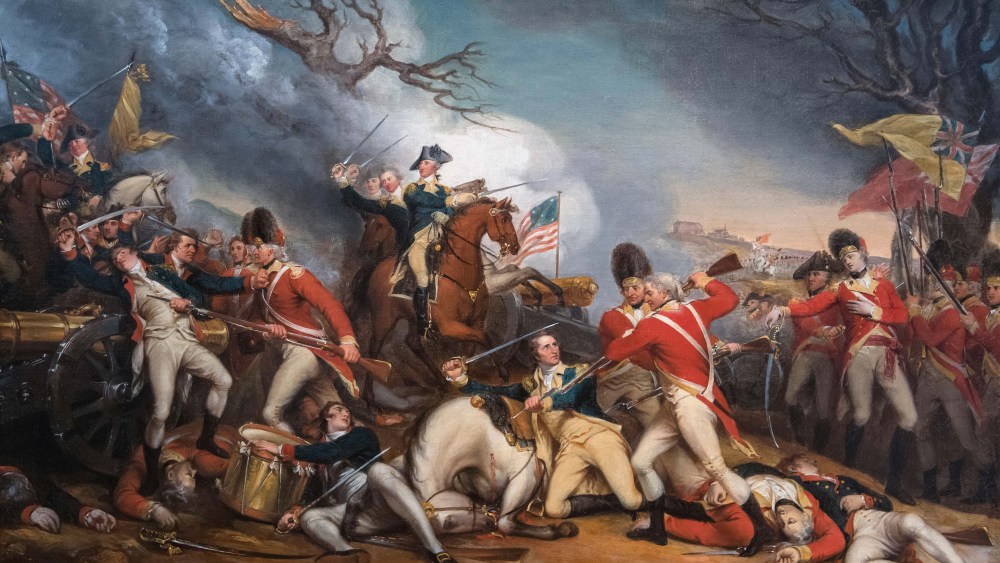
Six months away from their 250th year, the United States of America is still in its infancy. It is an empire that is constantly moving and shifting, trying to decide what it will be. Prolific documentarian Ken Burns and his co-directors, Sarah Botstein and David Schmidt, bring America’s bloody origin story to life in PBS’ sprawling, highly detailed “The American Revolution,” a project that took nearly a decade to bring to the small screen. Spanning three decades and two continents, the six-episode, 12-hour docuseries is a treasure trove of often forgotten history, illustrating who we were and illuminating who we are as a country.
Frequent Burns collaborator Peter Coyote begins “The American Revolution” well before that fateful July day in 1776, when the Second Continental Congress formally adopted the Declaration of Independence. The directors begin the story nearly twenty years earlier, when Benjamin Franklin first publicly called for the British colonies to form a union. Franklin’s proposal was initially rejected, but as the series highlights, the events of the following years—including unfair taxation by the British government, the French and Indian War, the Boston Massacre, and later the Boston Tea Party—led the colonists, who called themselves Patriots, to reconsider Franklin’s plan.
As with many of Burns’ works, such as “The Civil War,” “The American Buffalo” and even “Jazz,” “The American Revolution” is as complex as it is dense. In the absence of photographs and other modern images, the crew used various techniques to bring the period and the hard-fought battles to life. Using animated maps and portraits, voice-overs from leading speakers such as Keith David, Tom Hanks, Meryl Streep and Samuel L. Jackson, and commentary from historians and scientists such as Vincent Brown and Maggie Blackhawk, the filmmakers and writer Geoffrey Ward create a multi-dimensional tapestry of the era. Additionally, through hearing firsthand accounts from Loyalists and the English Crown, enslaved and free Blacks, indigenous peoples, women, and patriot warriors across the Thirteen Colonies, the series shows how diverse America has always been and how this war has affected everyone.
‘The American Revolution’ is deep, almost annoying. It’s also packed with compelling sequences, betrayals and shocking events. Episode 3, “The Times That Try Men’s Souls (July 1776-January 1777)” is particularly compelling. The episode focuses mainly on early battles, including the Battle of Trenton, a decisive American victory that boosted morale within the young Continental Army. The audience is immersed in the horrors of the war, fought face to face by landless men with muskets, unreliable rifles and terrifying bayonets. George Washington, who commanded the Americans, often made costly mistakes, and soldiers often went months without pay or proper food and clothing—even when exposed to the elements or deadly smallpox. (Washington would later require all soldiers to be vaccinated in an early version of a vaccination mandate.)
In true Burns fashion, “The American Revolution” is exhaustively thorough, not overlooking a single popular figure or person on the fringes. By portraying the war not only from an American point of view, but also from a global perspective, ‘The American Revolution’ paints a rounded picture of this country at its founding. It was an idea that eventually became a reality. The series also highlights the cracks in our ongoing union and suggests how we can overcome our misconceptions as a nation so that the country can endure and truly become the place of freedom it was meant to be. For now, however, the American Revolution continues.
“The American Buffalo” premieres on PBS on November 16, with the remaining episodes airing each consecutive night.