7 Best Ways to Get Payroll Training in 2026 (Free & Certified Options)

The best payroll training depends on your experience level. Beginners can start with free online resources and YouTube tutorials, while professionals should consider certification programs like PayrollOrg’s FPC or CPP for credibility and compliance expertise.
To figure out which payroll training options are best for you, it’s important to first evaluate what you need to learn. As a business owner running payroll for employees, you may be able to spend little to no money by using online resources. If you have a payroll clerk who needs to level up their skills, an advanced payroll program might be more appropriate. There are also plenty of online course platforms that offer low-cost payroll curricula created by payroll experts.
Below are the strategies to build payroll expertise, from free foundational learning to professional certification.
1. Search for free online payroll content
If you’re new to payroll, begin with free, reputable online guides before investing in paid courses or certifications. High-quality payroll articles can help you understand foundational topics like wage calculations, payroll tax withholding, compliance requirements, and software workflows.
Look for resources that cover:
- How to calculate gross-to-net pay
- Federal payroll taxes (FIT, Social Security, Medicare)
- State income tax requirements
- Payroll security and data protection
- Employee vs. independent contractor classification
- Common payroll compliance mistakes
For example, Fit Small Business offers in-depth guides on how to do payroll, payroll security, payroll laws and regulations, payroll tax rates, and payroll software integrations, to name a few. Together, these will help you establish a firm payroll foundation before diving into more complex topics.
If you want to learn how to do payroll with some of the most common small business software, check out the articles below for a step-by-step tutorial:
2. Sign up for a payroll certification program
If you want to build long-term credibility in payroll, earning a professional certification is one of the most effective steps you can take. Certification programs provide structured training in payroll compliance, federal and state tax regulations, wage and hour laws, reporting requirements, and audit readiness.
A payroll certification program can cost anywhere from $100 up to thousands of dollars per program, but it can solidify your understanding of concepts like federal labor laws and state regulations, ensuring you’re up-to-date on industry rules.
Here are the most reputable providers of payroll certification programs that you can take:
Udemy is an online learning platform offering thousands of business and accounting courses, including beginner to advanced payroll training. Most payroll courses are self-paced and include on-demand video lessons, downloadable resources (such as Excel templates and PDFs), lifetime access, and a certificate of completion. Udemy also offers a 30-day money-back guarantee.
If you’re a payroll beginner, the Effective Bookkeeping and Payroll course is a strong starting point. This is designed for entry-level bookkeepers who want to learn how to create an effective and reliable bookkeeping system with payroll management.
As of last update, this course has a 4.6 out of 5 rating on the platform and can be purchased for $129.99. Note that pricing can change (it can go as low as $18.99), depending on the discount promotions offered.
The following courses are also great options for those who are new to payroll:
-
- Covers minimum wage requirements, overtime pay calculations, payroll taxes, and the difference between employees and independent contractors
-
- Covers the basics for running payroll, from calculating earnings to determining which taxes to apply, and knowing the difference between mandatory and voluntary payroll deductions
For experienced bookkeepers who want to expand their services to include payroll, Udemy’s Payroll Accounting course is a practical next step. It has a 4.2 out of 5 rating and costs $79.99 at the time of this publication, but pricing also fluctuates depending on the discount promo on offer.
This course covers payroll legislation, generation of payroll registers and earning reports, calculation of payroll tax withholding—including federal income tax (FIT), Social Security, and Medicare—payroll journal entries, and payroll tax forms like Forms 941, 940, W-2, or W-4.
PayrollOrg (PAYO)—formerly the American Payroll Association (APA) and Global Payroll Management Institute (GPMI)—is a leading professional organization for payroll practitioners. It offers educational opportunities like webinars, interactive virtual sessions, online training, in-person seminars and events, and custom in-house training programs. Its courses and webinars cover a wide range of payroll topics, from basic payroll calculations to federal and state rules and regulations.
PayrollOrg offers membership for $312 per year, plus a $35 enrollment fee for new members. Members receive discounted pricing on training programs, certification exams, conferences, and official payroll publications.
In addition to training, PayrollOrg provides structured study materials and reference guides to prepare candidates for its two nationally recognized certifications:
FPC and CPP exams are offered twice per year in the United States and Canada. International testing is available year-round.
If your business uses QuickBooks Online, adding QuickBooks Payroll to your subscription can streamline payroll and accounting within a single system. Because payroll integrates directly with your books, this option reduces manual data entry and helps maintain accurate financial reporting. To know more about its features, check out our QuickBooks Payroll review.
Intuit offers several training paths for QuickBooks users, including:
These resources cover both QuickBooks Online and QuickBooks Payroll, from basic payroll setup to advanced reporting and compliance features.
Although provider-specific, ADP’s training and certification programs are designed to help payroll professionals effectively use ADP’s software. The training covers practical tasks such as entering pay data, processing payroll and manual checks, generating payroll reports, and reviewing results for accuracy. For organizations already using ADP, this type of system-based instruction provides a solid operational foundation.
Beyond basic system use, ADP’s Professional Certification Program validates your proficiency across its payroll, time and attendance, and human resources solutions. Earning certification demonstrates platform-specific expertise and confirms your competency within the ADP environment. Exam fees typically range from $100 to $595, depending on the certification track.
While many payroll software providers do not offer formal product certifications, ADP’s program can strengthen your credentials, particularly if you work in a midsize or large organization that relies on ADP systems. Businesses evaluating enterprise payroll platforms may also consider ADP Workforce Now, which integrates payroll, benefits, time tracking, and HR management within a single system.
3. Improve your Excel skills
Even if you use payroll software, Excel remains one of the most valuable tools for payroll analysis and verification. Payroll professionals often rely on spreadsheets to reconcile reports, validate tax calculations, audit payroll data, and model compensation scenarios.
A working knowledge of Microsoft Excel allows you to:
- Convert hours worked into gross and net pay
- Verify payroll tax calculations
- Reconcile payroll reports against the general ledger
- Identify discrepancies before payroll is finalized
Core formulas such as SUM, SUMIF, and IF help automate calculations, while lookup functions (such as VLOOKUP or XLOOKUP) can connect employee data across multiple tabs in a payroll workbook. For more advanced analysis, pivot tables, conditional formatting, and charts can help you review payroll trends, overtime costs, and department-level expenses.
Even basic spreadsheet proficiency can significantly reduce payroll errors and improve efficiency. Free tutorials, webinars, and downloadable templates are widely available online.
4. Watch YouTube videos
If you prefer learning through video, YouTube can be a practical way to understand payroll concepts step by step. Searching directly on YouTube allows you to filter results by upload date, view count, and relevance, helping you find current and widely used tutorials.
When evaluating payroll videos, focus first on the publisher’s credibility. Look for channels operated by accounting professionals, payroll specialists, reputable business publications, or established software providers. Check when the video was published to ensure the information reflects current tax rates and compliance rules.
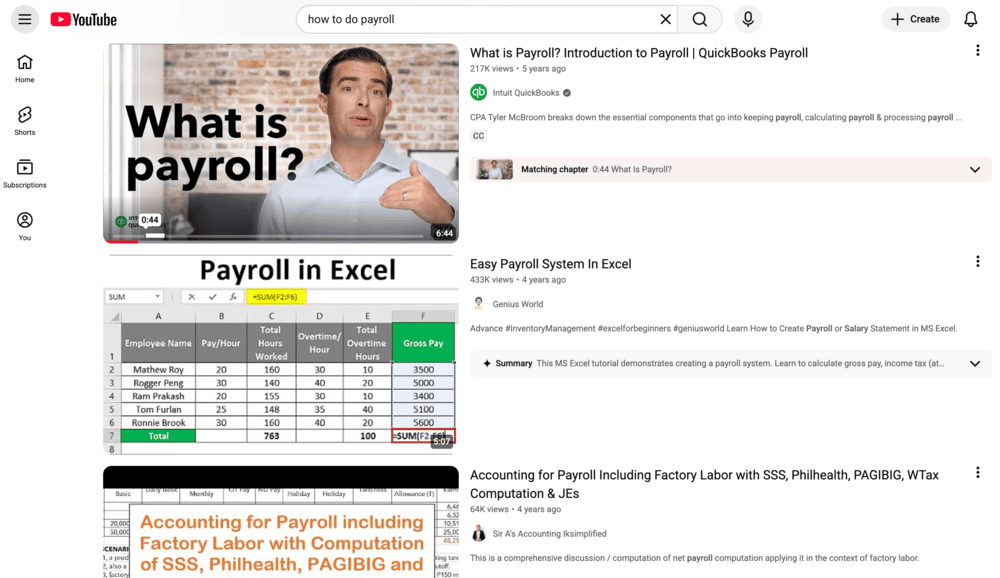
YouTube dashboard with “How to do Payroll” search key phrase (Source: YouTube)
While view count can signal popularity, it should not be your only quality indicator. Review the comments for feedback from other viewers and confirm that the creator links to authoritative sources or maintains an active website or professional presence. Clicking on the publisher’s channel page can provide additional context, including subscriber count, related videos, and overall subject expertise.
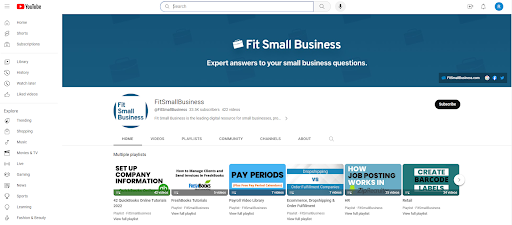
Fit Small Business maintains a YouTube channel with nearly 40,000 subscribers and publishes tutorials for small business owners, including payroll walkthroughs and software demonstrations. You can explore our payroll video library for structured, step-by-step guidance.
5. Familiarize yourself with payroll & labor laws
When most people think of payroll, they picture paychecks and tax calculations. In reality, payroll is deeply tied to labor law compliance. Even if you can accurately calculate gross-to-net pay, you are still responsible for following federal, state, and local wage and hour regulations.
For example, the Fair Labor Standards Act (FLSA) sets federal standards for minimum wage, overtime eligibility, overtime pay calculations, child labor restrictions, and recordkeeping requirements. In addition to federal law, each state may impose its own rules regarding minimum wage rates, meal and rest breaks, paid leave, and payroll reporting obligations.
Staying informed about both federal and state labor laws is essential to avoid penalties, back pay claims, and compliance audits. For a state-by-state breakdown of payroll requirements, review our state payroll guides, which outline wage laws, tax rules, and employer responsibilities in each jurisdiction.
For more details regarding labor laws, both federal and on a state-by-state basis, check out our state payroll guides. We break down everything you need to know, specific to each state.
6. Encourage payroll mentors & employee shadowing
Formal training builds knowledge, but hands-on mentorship builds confidence and accuracy. Encourage newer payroll team members to learn directly from experienced staff who understand your company’s processes, controls, and compliance standards.
Payroll managers and senior specialists can provide guidance on:
- Internal payroll workflows
- Audit and verification procedures
- Compliance best practices
- Error prevention and issue resolution
- Career advancement within payroll
Because payroll is both technical and compliance-driven, practical exposure to real payroll cycles helps reinforce what employees learn through courses or certification programs.
You can also offer job shadowing opportunities to employees in other departments who are interested in transitioning into payroll. Cross-training builds internal bench strength, reduces operational risk during absences, and ensures continuity if a payroll team member leaves unexpectedly.
For small businesses in particular, developing internal payroll talent can prevent costly disruptions and reduce reliance on a single individual.
7. Use official IRS & DOL resources
If you want to build true payroll expertise, learning directly from IRS and Department of Labor (DOL) resources is essential. While courses and certifications provide structured guidance, primary government sources define the rules payroll professionals must follow.
The IRS publishes detailed employer guidance that outlines federal payroll tax requirements, withholding rules, deposit schedules, and reporting obligations. Key resources include:
Reviewing these documents helps you understand not just how payroll works, but why certain calculations and reporting requirements exist.
Because payroll laws vary by state, you should also consult your state workforce agency or department of labor website. State portals typically provide guidance on:
- State income tax withholding
- New hire reporting requirements
- Unemployment insurance taxes
- State-specific wage and hour laws
Using official IRS, DOL, and state agency resources ensures your payroll knowledge is accurate, current, and aligned with regulatory expectations.
Bottom line
Depending on your goals, the best payroll training for your business might be as simple as watching free YouTube videos on payroll processing or as complex as enrolling personnel in an advanced payroll certification course. Weigh your options and choose a path that aligns best with your goals.
Payroll training FAQs
Are free payroll training resources enough for beginners?
Yes, free resources like YouTube are great for learning foundational math, such as gross-to-net calculations. However, you should pair these with Excel templates to practice real-world scenarios before pursuing a formal certification. While free tools build your skills, a certification is still the gold standard for proving you can handle legal compliance.
How much should I spend for payroll training?
For a beginner, a smart budget is between $400 and $1,200. This range covers essential study materials and the exam fee for a foundational credential like the Fundamental Payroll Certification (FPC). If you are on a tight budget, you can start for free using IRS publications and YouTube, then spend about $350–$500 specifically on the certification exam once you’re ready.
Source link