2026 will bring a turn toward affordability, even as home prices continue to rise
The coming year will likely be more affordable for many homebuyers, even as home prices continue to rise for sellers.
The reason that affordability is improving is that we expect mortgage interest rates to be lower on average in 2026. Monthly payments are expected to drop for the first time since 2020.
Moreover, incomes will grow, causing the share of monthly payments – which buyers must pay to purchase a normally priced home – to fall below 30%. This builds on the modest improvement in affordability we saw in 2025 and brings costs below this important benchmark for the first time since 2022.
Improving affordability will help bring more sellers back into the housing market, increasing inventory by about 9%. And buyers and sellers are more likely to meet in the middle, potentially increasing transactions by a modest 1.7%.
For tenants, I expect an additional rent reduction, but it is worth noting that both the rental and owner-occupied real estate markets continue to vary locally. You can explore the trends in your area in our Realtor.com® Housing forecast 2026.
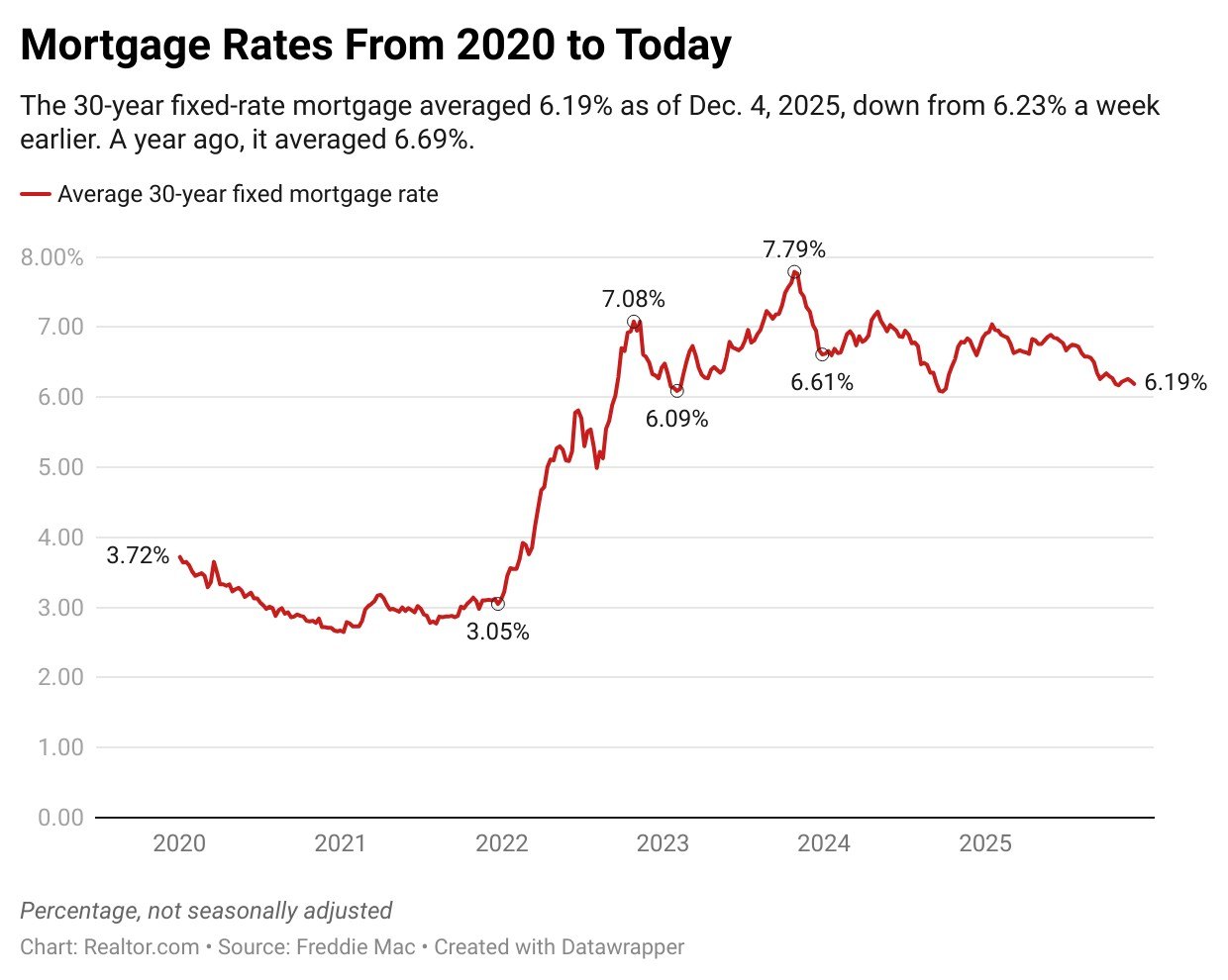
In line with our expectations that mortgage rates will remain low, mortgage rates fell 4 basis points this week, towards the lower end of the narrow range they have been operating since mid-September, which is among the lowest rates since October 2024.
Mortgage rates for a 30-year fixed home loan fell for a second week to 6.19% for the week ending December 4, according to Freddie Mac. Rates averaged 6.69% in the same period a year ago.
In mid-November, interest rates rose slightly as markets doubted the likelihood of a Fed rate cut in December. As the meeting approaches, investors expect that available data will be enough for a majority of the committee to support a rate cut, even as perspectives on the appropriate Fed policy rate continue to vary.
Simply put, while the Fed will likely cut rates at next week’s meeting, I don’t expect a major impact on mortgage rates. We could see more volatility as economic data, slowed by the government shutdown, continues to spread. Mortgage interest rates are currently fairly stable.
Weekly trends in housing data have also been relatively stable. Prices continue to hover near flat and have fallen slightly this week as new listings faded and active listing growth slowed. Homes were for sale two days longer than at this time last year, reducing the difference in activity compared to earlier this year.
Finally, let’s zoom in on the luxury trends in two pandemic-era hotspots: Nashville, TN, and Austin, TX. There are many similarities between these two markets, but as the national luxury market has softened in recent months, Nashville’s luxury segment has remained stable. While both markets had similar luxury prices in 2018, Nashville’s luxury segment is now well over a quarter of a million dollars more expensive.